
Traveling can get expensive surprisingly fast. You may find an affordable flight, plan a reasonable food budget, and even avoid expensive attractions, only to discover that your hotel costs more than everything else combined.
The frustrating part is that the same hotel room can appear at different prices across different booking websites. One platform might include breakfast, another may offer free cancellation, while a third could provide a lower member-only rate.
That is why choosing the right hotel booking site matters.
The best platforms do more than show cheap rooms. They make it easy to compare properties, understand cancellation policies, read verified guest reviews, earn rewards, and see what you will actually pay.
After comparing the major hotel booking platforms, these are the 5 best hotel booking sites for most travelers:
- Booking.com – Best overall hotel booking site
- Agoda – Best for hotel deals in Asia
- Expedia – Best for hotels and vacation packages
- Hotels.com – Best for straightforward hotel searches
- Trip.com – Best for international and Asia-focused travel
Let’s look at what makes each platform worth using.
Best Hotel Booking Sites: Quick Comparison
Before going into the detailed reviews, here is a quick comparison.
| Hotel Booking Site | Best For | Rewards/Member Program | Main Strength | Potential Drawback |
|---|---|---|---|---|
| Booking.com | Most travelers | Genius | Huge property selection | Cancellation rules vary |
| Agoda | Asia and budget travelers | AgodaVIP | Competitive discounts | Final price needs careful checking |
| Expedia | Vacation planning | One Key | Hotels, flights and packages together | Best rewards require staying within its ecosystem |
| Hotels.com | Hotel-focused searches | One Key | Simple hotel comparison | Fewer broader travel tools than Expedia |
| Trip.com | International travel | Trip Coins | Strong Asia coverage and rewards | Less dominant in some Western markets |
There is no single platform that will always have the cheapest hotel.
For important or expensive trips, compare the same property across at least two or three booking websites before paying.
1. Booking.com: Best Overall Hotel Booking Site
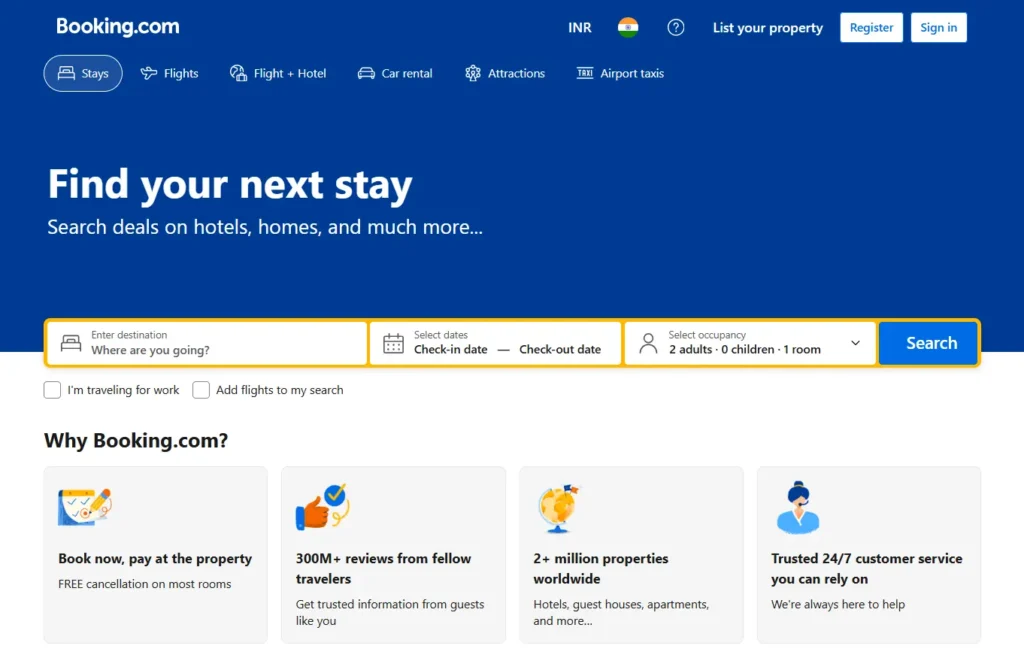
Booking.com is one of the first places many travelers should check when searching for accommodation.
Its biggest advantage is selection. Depending on the destination, you can find traditional hotels alongside apartments, resorts, hostels, guesthouses, villas, vacation homes, and other accommodation types.
That makes it particularly useful when you are not sure exactly what kind of place you want.
What Makes Booking.com Good?
The search system is one of its strongest features.
You can narrow results using filters such as:
- Price
- Guest rating
- Star rating
- Neighborhood
- Property type
- Facilities
- Meal options
- Bed preference
- Cancellation conditions
- Distance from landmarks
This becomes extremely useful in large destinations.
Instead of searching through hundreds of properties in London, for example, you could search specifically for highly rated accommodation near a particular neighborhood with breakfast and flexible cancellation.
Booking.com also displays a large amount of guest feedback. Rather than choosing a hotel purely because the photos look impressive, you can investigate what previous guests say about cleanliness, staff, comfort, location, and facilities.
Booking.com Genius Program
Frequent users should also pay attention to the Genius loyalty program.
Eligible properties can provide special rates or benefits to Genius members. The exact discount and perks depend on the property, destination, dates, and membership level.
This means the price visible when you are logged into your account may sometimes be better than the standard public rate.
Where Booking.com Could Be Better
The enormous number of options can become overwhelming.
You also need to pay close attention to individual room conditions.
Two rooms at the same hotel may have completely different rules. One could include free cancellation, while a cheaper option might be completely non-refundable.
Always check:
Room price + taxes + cancellation policy + included benefits
before choosing.
Booking.com Pros and Cons
Pros
- Huge accommodation selection
- Excellent filtering tools
- Large number of guest reviews
- Useful map search
- Genius member discounts at participating properties
- Good selection of apartments and alternative accommodation
- Flexible booking options at many hotels
Cons
- Cheapest rates can have restrictive cancellation policies
- Large number of listings can feel overwhelming
- Hotel policies vary significantly
Best for: Travelers who want the widest possible choice.
2. Agoda: Best for Hotel Deals in Asia
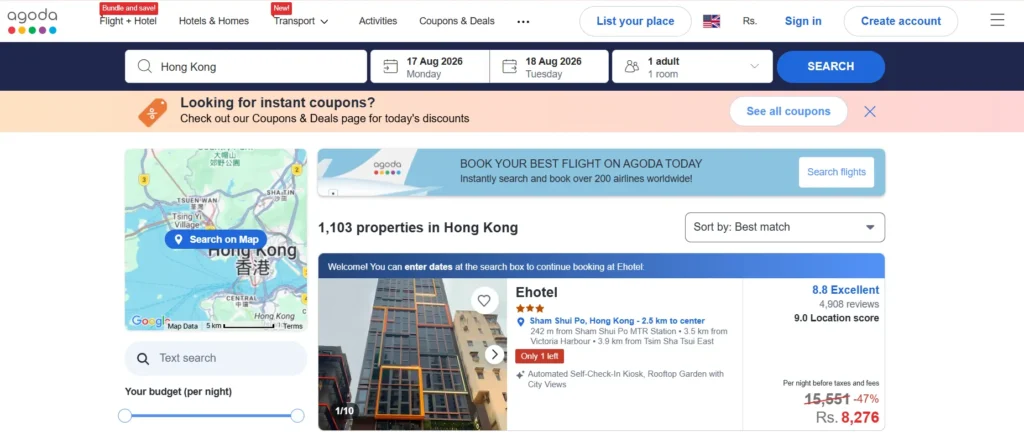
If you are traveling around Asia, Agoda deserves to be one of the first websites you check.
It has particularly strong coverage across destinations such as Thailand, Vietnam, Indonesia, Malaysia, Singapore, Japan, South Korea, and other parts of Asia.
Agoda isn’t limited to Asia, however. It offers accommodation worldwide.
Why Agoda Stands Out
Price is one of Agoda’s biggest attractions.
The platform regularly features promotional prices, coupons, app offers, member deals, and AgodaVIP rates.
Agoda’s official VIP program gives eligible members access to exclusive rates at participating properties. Benefits and eligibility can change, so travelers should check what is available on their account before booking.
The platform can be especially useful for:
- Budget hotels
- Resorts
- Apartments
- Guesthouses
- Hostels
- Smaller independent properties
That variety is useful in Southeast Asia, where some excellent accommodation options are independent rather than part of major international hotel chains.
AgodaVIP
AgodaVIP rewards frequent users with access to selected discounts and benefits.
Instead of assuming the advertised discount automatically makes Agoda cheapest, however, compare the final checkout price against competing websites.
Promotional pricing is useful only when the final amount is actually lower.
Pay Attention to Taxes and Fees
This is one area where travelers should be careful.
When comparing hotel websites, don’t simply compare the first large number displayed in the search results.
Check whether the amount includes:
- Local taxes
- Service charges
- Resort fees
- Breakfast
- Cancellation
- Payment processing charges
The cheapest-looking listing isn’t necessarily the cheapest final booking.
Agoda Pros and Cons
Pros
- Excellent coverage across Asia
- Frequent hotel promotions
- AgodaVIP discounts
- Large selection of budget accommodation
- Good mobile app
- Strong selection of independent hotels
Cons
- Promotional pricing can make comparisons complicated
- Cancellation policies vary
- You need to compare the final payable amount carefully
Best for: Travelers visiting Asia and anyone hunting aggressively for hotel discounts.
3. Expedia: Best for Hotels and Vacation Packages
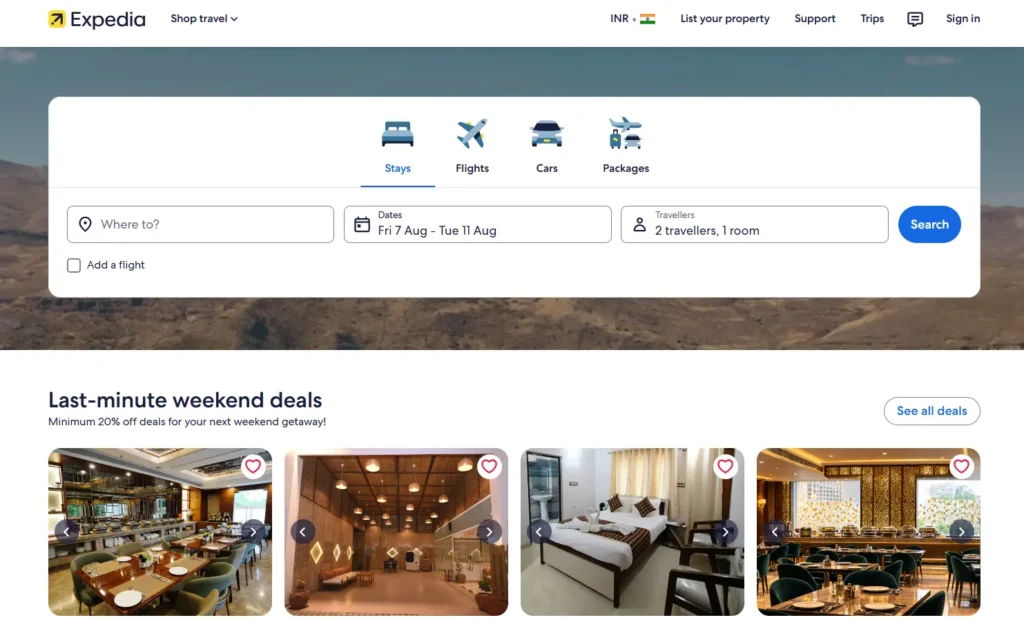
Expedia becomes particularly useful when your trip involves more than accommodation.
Instead of booking your hotel, flight, car rental, and activities through completely separate websites, you can search for several travel services through one platform.
That convenience makes Expedia especially attractive for family holidays and longer vacations.
Expedia’s Biggest Advantage: Package Booking
Suppose you are planning a seven-night vacation.
You need:
- Round-trip flights
- A hotel
- Airport transportation
- Possibly a rental car
- Activities
You could compare each component independently.
But you should also check whether bundling travel components through Expedia produces a competitive total price.
Packages can occasionally offer savings compared with purchasing everything separately, although this isn’t guaranteed.
Always calculate both options.
One Key Rewards
Expedia participates in One Key, a travel rewards program shared across participating Expedia Group brands.
For frequent users, this creates another reason to compare member pricing before completing a booking.
Rewards should not override price comparison, though.
Saving $10 in future rewards doesn’t make sense if another reputable booking option is $80 cheaper today.
Expedia Search Experience
Expedia provides the usual hotel filters, including:
- Property rating
- Guest reviews
- Price
- Neighborhood
- Amenities
- Meal options
- Property type
- Payment options
Its map tool is particularly useful when location matters.
If you’re visiting New York, Paris, Dubai, or another expensive city, staying slightly outside the most tourist-heavy neighborhood can sometimes reduce your hotel bill significantly.
Expedia Pros and Cons
Pros
- Excellent for complete trip planning
- Hotel and flight package options
- One Key rewards
- Strong filtering tools
- Large international hotel inventory
- Car rentals and activities available
Cons
- Not necessarily cheapest for hotel-only reservations
- Package cancellation can be more complicated than a simple hotel reservation
- Rewards are most valuable to travelers who regularly use participating brands
Best for: Travelers booking flights, hotels, cars, and activities for the same trip.
4. Hotels.com: Best for Simple Hotel Searching
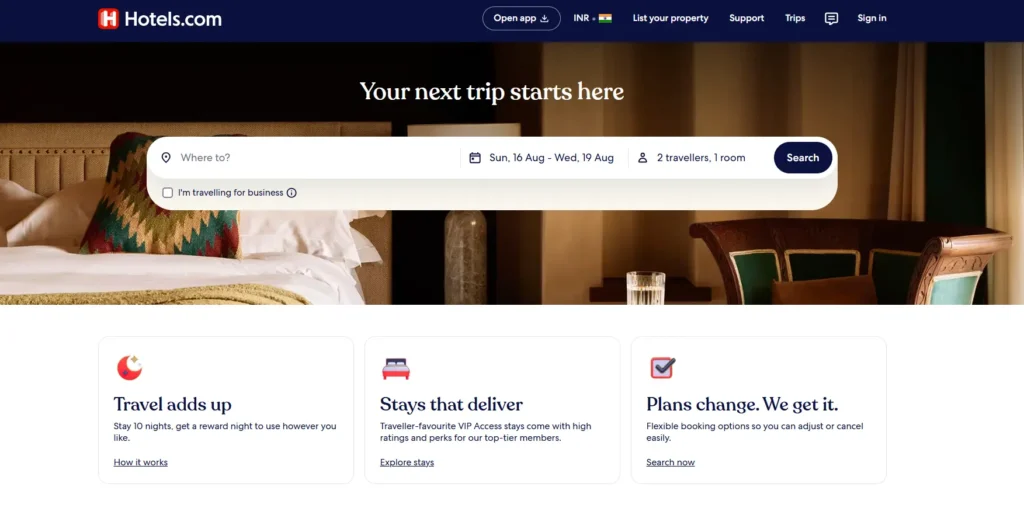
As the name suggests, Hotels.com has traditionally focused heavily on accommodation.
The platform is easy to understand and works well for travelers who simply want to compare hotels without dealing with an overly complicated booking process.
Why Use Hotels.com?
Its straightforward search experience is the main attraction.
Enter your:
Destination → Dates → Number of travelers → Rooms
You can then narrow the results based on your requirements.
Filters typically make it easy to separate luxury hotels from budget accommodation or find properties offering specific facilities.
This is particularly helpful for travelers with strict requirements.
For example, you could search for:
- Swimming pools
- Parking
- Breakfast
- Pet-friendly hotels
- Family-friendly properties
- High guest ratings
Hotels.com and One Key
Hotels.com also participates in Expedia Group’s One Key rewards ecosystem in supported markets.
If you already use Expedia Group platforms, this can make Hotels.com more attractive than starting from scratch with an unrelated booking platform.
However, loyalty programs should always be considered secondary to the booking itself.
Compare the final price, room conditions, and cancellation policy first.
Where Hotels.com Works Best
Hotels.com makes sense when you already know roughly what you want.
For example:
“I need a four-star hotel in central Barcelona with breakfast and free cancellation.”
That is a much easier search than simply browsing hundreds of hotels.
Using specific filters can quickly reduce the results to a manageable shortlist.
Hotels.com Pros and Cons
Pros
- Simple hotel search interface
- Strong filtering options
- Wide hotel inventory
- One Key participation in supported markets
- Useful guest reviews
- Good for straightforward hotel comparison
Cons
- Hotel prices are not always the lowest available
- Loyalty benefits can vary by market and property
- Less compelling if you rarely use Expedia Group platforms
Best for: Travelers who want a simple, hotel-focused search experience.
5. Trip.com: Best for International and Asia-Focused Travel
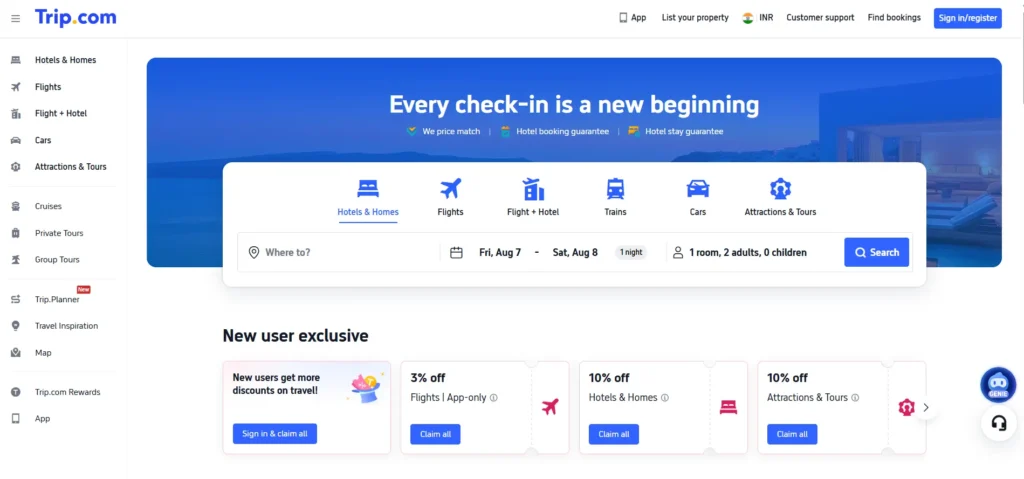
Trip.com has grown into a major global travel booking platform offering hotels, flights, trains, attractions, and other travel services.
It is especially worth checking for trips involving Asian destinations.
Why Trip.com Is Worth Comparing
Trip.com combines a large hotel search platform with a broader travel ecosystem.
This is helpful when you’re planning complicated international trips involving several bookings.
For example, you might use Trip.com to arrange:
- International flights
- Hotels
- Train tickets
- Airport transfers
- Attractions
Having multiple reservations inside the same account can make itinerary management easier.
Trip Coins
Trip.com’s loyalty system includes Trip Coins.
According to Trip.com’s current loyalty information, members can earn Coins through eligible activities and bookings. Coins can then be applied toward eligible future bookings.
The exact earning rate depends on factors including the booking category and membership tier, so travelers should check the current terms before relying on a particular reward value.
The program becomes more useful for frequent Trip.com customers because repeated bookings can generate benefits for future trips.
Hotel Search Experience
Trip.com’s hotel search includes the essential filters most travelers expect:
- Price
- Star category
- Guest rating
- Location
- Property type
- Facilities
- Breakfast
- Cancellation options
The platform also frequently promotes member or app-based offers.
Again, compare the final checkout total, rather than relying entirely on the advertised discount percentage.
Trip.com Pros and Cons
Pros
- Strong Asian travel coverage
- Hotels, flights and trains in one ecosystem
- Trip Coins rewards
- Competitive international hotel inventory
- Good mobile experience
- Useful for multi-part international trips
Cons
- Hotel selection varies by destination
- Loyalty program rules require some attention
- Other platforms may have stronger inventory in certain markets
Best for: International travelers, especially those traveling around Asia.
How to Choose the Best Hotel Booking Site
The best website depends on your trip.
Rather than automatically booking through the same platform every time, consider what matters most.
| Your Priority | Platform to Check First |
|---|---|
| Largest accommodation selection | Booking.com |
| Hotels in Asia | Agoda |
| Flight + hotel vacation | Expedia |
| Simple hotel comparison | Hotels.com |
| Asian/international multi-service travel | Trip.com |
The keyword here is “check.”
Even if Booking.com is normally your favorite, Agoda could be cheaper for one particular property. Expedia could offer a better package price, while Trip.com might have a member promotion.
Comparison is what saves money.
Pro-Tips for Finding Cheaper Hotel Rates
Experienced travelers rarely search once and immediately book the first attractive hotel.
A few extra minutes of comparison can sometimes produce meaningful savings.
1. Compare the Exact Same Room
Don’t compare only hotel names.
Make sure you’re comparing:
- Same room category
- Same number of guests
- Same bed type
- Same meal plan
- Same cancellation conditions
- Same dates
A $120 room with breakfast and free cancellation could actually offer better value than a $105 non-refundable room without breakfast.
2. Check the Hotel’s Direct Website
Once you’ve found a good OTA price, check the hotel’s own website.
Hotels sometimes provide direct-booking benefits such as:
- Member rates
- Breakfast
- Flexible cancellation
- Room upgrades
- Hotel credits
- Late checkout
The OTA can still be cheaper, but checking takes only a few minutes.
3. Log In Before Comparing Prices
Member pricing can change the result.
Check prices while signed into your Booking.com, Agoda, Expedia, Hotels.com, or Trip.com account where appropriate.
4. Compare the Final Price
Ignore flashy discount percentages.
A “40% OFF” badge doesn’t automatically mean the hotel is cheaper.
Your real comparison should be:
Total amount payable for the entire stay.
5. Use Free Cancellation Strategically
If your trip is several months away, consider booking a reasonably priced refundable room.
Continue checking prices occasionally.
If the same or a better hotel becomes significantly cheaper, you may be able to cancel the original reservation within its permitted cancellation window and book the better deal.
Never cancel the original room until the replacement reservation is confirmed.
6. Read Recent Reviews
A hotel with an excellent historical rating may have changed.
Look at reviews from recent months and watch for repeated complaints about:
- Construction
- Cleanliness
- Wi-Fi
- Noise
- Air conditioning
- Breakfast
- Staff
- Neighborhood safety
- Renovations
Repeated recent complaints matter more than one angry review from three years ago.
7. Check the Location on a Map
A cheap hotel can become expensive if you spend $30 to $50 every day traveling to the places you actually want to visit.
Location should be part of your hotel budget.
Common Hotel Booking Mistakes to Avoid
Cheap hotel prices can be tempting, but rushing through checkout creates problems.
Avoid these common mistakes:
- Booking non-refundable rooms without checking your travel plans
- Ignoring taxes and additional charges
- Selecting the wrong room type
- Forgetting to check breakfast inclusion
- Ignoring check-in times
- Assuming airport hotels are actually next to the terminal
- Not reading recent guest reviews
- Comparing nightly prices instead of total stay prices
- Booking before checking the hotel’s direct rate
Spend five extra minutes reviewing the reservation before paying.
It can save hours of trouble later.
FAQs About the Best Hotel Booking Sites
1. Which is the best hotel booking site overall?
Booking.com is one of the strongest all-around choices because of its large accommodation inventory, detailed filters, guest reviews, and broad international coverage.
However, it will not always have the cheapest price.
2. Which hotel booking site is cheapest?
There is no website that is consistently cheapest.
Hotel rates change according to destination, dates, promotions, inventory, membership status, and room conditions.
Compare at least two or three platforms.
3. Is Agoda better than Booking.com?
It depends on the destination.
Agoda is particularly useful in Asia, while Booking.com provides extremely broad worldwide accommodation coverage.
For Asian trips, checking both is a smart strategy.
4. Is it cheaper to book directly with a hotel?
Sometimes.
Hotels may provide direct-booking discounts or extra benefits. In other situations, online travel agencies have promotional rates that are cheaper.
Always compare the final price and benefits.
5. Are hotel booking sites safe?
Major established platforms such as Booking.com, Agoda, Expedia, Hotels.com, and Trip.com are widely used booking services.
Still, travelers should verify property details, cancellation terms, payment conditions, and communications carefully.
6. Should I choose a refundable hotel rate?
If your travel plans could change, paying slightly more for free cancellation can be worthwhile.
Non-refundable rates make more sense when your trip is highly certain and the savings are significant.
7. When is the best time to book a hotel?
There isn’t one perfect booking window for every destination.
Major events, holidays, conferences, festivals, and peak seasons can cause rooms to sell out early. For high-demand dates, booking earlier with flexible cancellation can reduce risk.
8. Should I use a hotel booking site or Google Hotels?
Hotel comparison tools can be useful for discovering prices across multiple sources, while booking platforms handle the actual reservation.
A good strategy is to use comparison tools for research, then compare the final offer from the booking platform and the hotel’s official website.
Final Verdict: Which Hotel Booking Site Should You Use?
The 5 best hotel booking sites each have a slightly different strength.
Booking.com is the strongest overall option for travelers who want a massive accommodation selection and powerful filters.
Agoda deserves special attention for Asian destinations and travelers searching for aggressive hotel promotions.
Expedia makes the most sense when accommodation is only one part of a larger vacation involving flights, cars, or activities.
Hotels.com provides a straightforward experience for travelers primarily interested in finding accommodation.
And Trip.com is a strong option for international trips, particularly when traveling through Asia or combining hotels with flights and trains.
But don’t become loyal to a booking website at the expense of a better deal.
The smartest approach is simple:
Find the hotel you want, compare it across two or three reputable booking sites, check the hotel’s direct price, and compare the final total with identical booking conditions.
Ten minutes of comparison could save you far more than chasing coupon codes or waiting for a mysterious “perfect” day to book.
So before confirming your next hotel, open a few tabs, compare the real checkout prices, read the latest reviews, and book the option that provides the best combination of price, flexibility, location, and reliability.