
Traveling is exciting. Paying for the flight usually isn’t.
Airfare can easily become the biggest expense of a trip, especially when you’re flying internationally or traveling during holidays. Even more frustrating, two people searching for the exact same route can sometimes find very different prices depending on where and how they search.
One flight might appear for $620 on an airline’s website, $585 through an online travel agency, and $550 through a flight comparison tool. Add baggage fees, seat selection, cancellation rules, and different fare classes, and finding the actual cheapest option becomes complicated.
That is why choosing the right flight booking site matters.
The best platforms don’t simply show flights. They help you compare airlines, identify cheaper travel dates, track price changes, explore alternative airports, and understand whether a fare is actually a good deal.
After comparing the major options available to travelers, five platforms stand out:
- Google Flights: Best overall flight search tool
- Skyscanner: Best for flexible destinations and budget travelers
- KAYAK: Best for advanced search and price comparison
- Expedia: Best for flights combined with hotels
- Kiwi.com: Best for unusual routes and multi-airline itineraries
Below, I’ll explain what each site does well, where it falls short, and which one makes the most sense for different types of travelers.
Quick Comparison of the 5 Best Flight Booking Sites
Before looking at each platform individually, here’s a quick comparison.
| Flight Site | Best For | Price Tracking | Flexible Dates | Direct Booking | Main Advantage |
|---|---|---|---|---|---|
| Google Flights | Overall flight research | Yes | Excellent | Usually redirects | Fast and powerful search |
| Skyscanner | Cheap and flexible travel | Yes | Excellent | Mostly redirects | Everywhere search |
| KAYAK | Comparing many options | Yes | Excellent | Mostly redirects | Advanced filters |
| Expedia | Flights + hotels | Available | Good | Yes | Package deals and rewards |
| Kiwi.com | Complex routes | Available | Excellent | Yes | Virtual interlining |
There isn’t one flight booking site that wins every search.
For expensive trips, I recommend checking at least two or three platforms before paying. A few extra minutes of comparison can sometimes save considerably more than searching for a coupon code later.
1. Google Flights: Best Overall Flight Search Tool
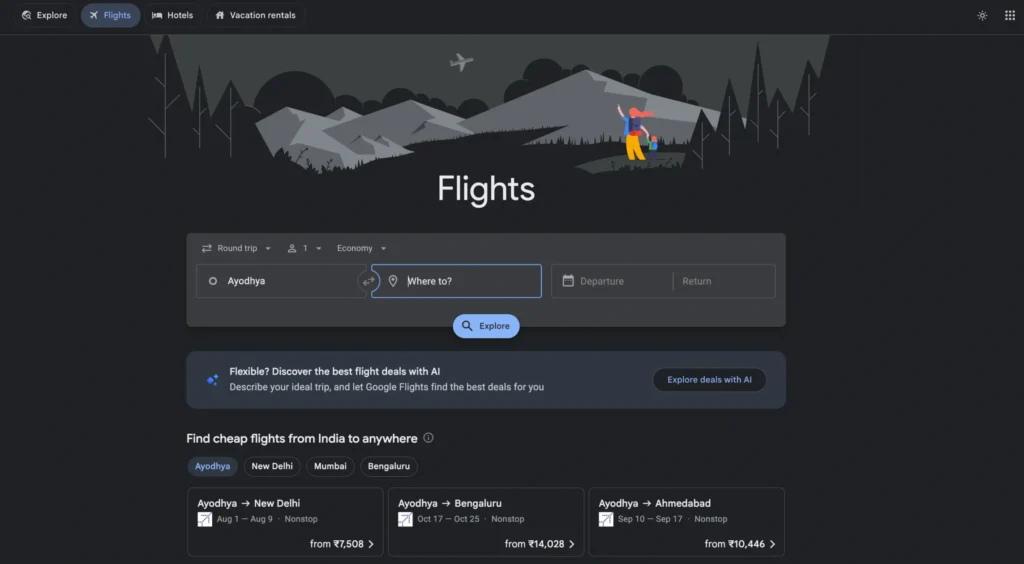
Google Flights is usually my first stop when researching airfare.
Instead of behaving like a traditional online travel agency, Google Flights works primarily as a powerful flight search and comparison engine. You enter your route and dates, compare available flights, and can then continue to the airline or another booking provider.
Why Google Flights Stands Out
Speed is one of its biggest advantages.
Enter your departure airport, destination, and dates, and results normally appear almost immediately. You can then filter them based on factors such as:
- Number of stops
- Airlines
- Baggage
- Departure and arrival times
- Connecting airports
- Flight duration
- Ticket class
- Price
The interface also makes it easy to understand whether changing your schedule could reduce the fare.
Date Grid and Price Graph
These are two of the most useful Google Flights features.
If your dates are flexible, the Date Grid lets you compare different departure and return combinations.
The Price Graph provides another visual way to see how fares change across a longer period.
Imagine you’re planning a seven-day trip but don’t care whether you leave Tuesday or Thursday. Instead of manually performing several searches, these tools can reveal the cheaper combinations.
That flexibility can produce much bigger savings than endlessly searching for discount codes.
Explore Feature
Don’t know exactly where you want to travel?
Google Flights’ Explore functionality can help.
Enter your departure city and browse potential destinations based on available fares. It is particularly useful when your priority is something like:
“I want to take an international vacation next month for under $500.”
Rather than choosing the destination first and accepting whatever airfare is available, you can reverse the process and choose your destination based on affordable flights.
Price Tracking
You can also track airfare for selected routes.
Instead of manually checking the same flight every morning, enable tracking and watch for meaningful price movements.
This is especially helpful when you’re researching a trip several weeks or months before departure.
Google Flights Pros
- Extremely fast
- Clean interface
- Excellent flexible-date tools
- Useful price history information
- Powerful filters
- Easy airline comparison
- Great destination exploration tools
- Price tracking available
Google Flights Cons
- It isn’t a traditional full-service travel agency
- Some smaller airlines or booking providers may not appear
- The cheapest displayed option isn’t automatically the best ticket
- You will often complete the purchase elsewhere
Who Should Use Google Flights?
Google Flights is ideal for travelers who want to research airfare quickly before booking directly with an airline.
Even if you eventually purchase your ticket elsewhere, it is an excellent starting point for understanding the market price.
Best for: Almost everyone, especially flexible travelers and international flight researchers.
2. Skyscanner: Best for Flexible and Budget Travelers
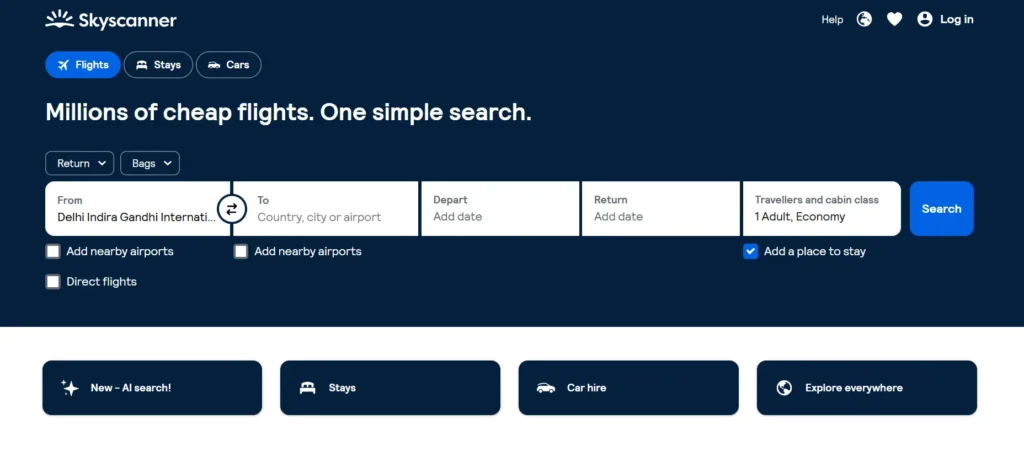
Skyscanner has become one of the most recognizable flight comparison platforms, and flexibility is where it really shines.
It searches airlines and travel providers to help users compare flight options across different routes and dates.
Search Everywhere
One of Skyscanner’s most useful features is its flexible destination search.
Instead of entering a specific destination, you can search more broadly and discover destinations based on airfare.
Suppose you’re departing from London and have a $250 flight budget but haven’t decided whether to visit Spain, Italy, Poland, or somewhere else.
Skyscanner can help you identify destinations offering attractive fares.
For spontaneous travelers, this is incredibly useful.
Search by Month
Exact dates can make flights expensive.
Skyscanner lets flexible travelers examine prices across broader periods rather than searching only one specific date combination.
For example, if you’re planning a trip sometime in September, you can look for cheaper days within that period.
Flying a day earlier or later can sometimes make a surprisingly large difference.
Wide Range of Booking Providers
Skyscanner compares options from airlines and third-party travel agencies.
That can expose fares you might not discover by checking individual airline websites.
However, there’s an important lesson here:
The cheapest seller isn’t necessarily the best seller.
Before selecting an unfamiliar online travel agency just to save a small amount, investigate its cancellation policies, support options, baggage rules, and reputation.
Sometimes paying slightly more to book directly with the airline is worth it.
Skyscanner Pros
- Excellent destination discovery
- Strong flexible-date searches
- Compares many airlines and agencies
- Useful for international routes
- Good for budget travelers
- Price alerts
- Simple interface
Skyscanner Cons
- Prices can change after you leave the comparison page
- Customer service depends on the company you actually book with
- Cheap third-party fares may have restrictive conditions
- Not every displayed deal is equally attractive after baggage and extras
Who Should Use Skyscanner?
Skyscanner is particularly good for travelers who care more about price than a specific destination or exact travel date.
If your approach is “show me where I can travel cheaply,” Skyscanner should be high on your list.
Best for: Backpackers, international travelers, flexible vacation planners, and bargain hunters.
3. KAYAK: Best for Advanced Flight Comparison

KAYAK is another veteran of the flight comparison space.
It searches flight options across airlines and travel websites and provides a wide range of filters to help travelers narrow down results.
Where KAYAK becomes especially useful is when your requirements are complicated.
Powerful Flight Filters
Suppose you need:
- Maximum one connection
- Departure after 8:00 a.m.
- Arrival before 9:00 p.m.
- No overnight layovers
- Specific airlines
- A checked bag
- Maximum 16-hour total journey
A basic flight search engine can make this frustrating.
KAYAK’s filtering system makes these types of searches much easier.
Instead of simply finding the cheapest ticket, you can find the cheapest ticket that actually fits your schedule.
Flexible Date Searching
Like Google Flights and Skyscanner, KAYAK provides tools for travelers whose dates aren’t completely fixed.
This matters because flexibility remains one of the strongest ways to reduce airfare.
Moving a departure by one or two days may reveal substantially different prices.
Price Forecasting
KAYAK also provides price-related guidance intended to help travelers judge whether they should book or continue watching fares.
No prediction tool can guarantee what an airline will do next. Airfare pricing is dynamic and affected by demand, inventory, competition, seasonality, and numerous other factors.
Still, having additional pricing context is useful when deciding whether to buy.
Hacker Fares
KAYAK is also known for its Hacker Fare concept.
Instead of buying a standard round-trip itinerary from one airline, KAYAK may identify separate one-way tickets that create a cheaper overall journey.
For example:
Outbound: Airline A
Return: Airline B
This strategy can reduce costs, but travelers need to understand that they may be dealing with separate reservations and different ticket conditions.
KAYAK Pros
- Detailed filtering
- Excellent for complicated searches
- Flexible date functionality
- Compares many travel providers
- Useful pricing insights
- Good mobile experience
- Helpful for mixed-airline itineraries
KAYAK Cons
- Large numbers of options can feel overwhelming
- Cheapest fares may come from third-party agencies
- Prices aren’t guaranteed until booking is completed
- Separate-ticket combinations require additional care
Who Should Use KAYAK?
KAYAK is excellent for experienced travelers who want greater control over their search criteria.
If you care about layovers, departure times, specific airlines, journey duration, and fare combinations, KAYAK deserves a search.
Best for: Frequent flyers and travelers with detailed itinerary requirements.
4. Expedia: Best for Flight and Hotel Packages

Expedia differs slightly from the first three options.
Google Flights, Skyscanner, and KAYAK are heavily focused on search and comparison. Expedia operates as a full online travel agency where travelers can book multiple parts of a trip.
You can use Expedia for:
- Flights
- Hotels
- Vacation packages
- Rental cars
- Activities
- Cruises in supported markets
Why Packages Matter
Booking the cheapest flight doesn’t always result in the cheapest vacation.
Suppose:
Flight alone: $600
Hotel alone: $900
Total: $1,500
A flight-and-hotel package might potentially cost less than purchasing both independently.
That doesn’t happen every time, so comparison is essential. But travelers planning a complete vacation should check package pricing before booking everything separately.
One Platform for Multiple Reservations
Convenience is another Expedia advantage.
Rather than managing separate bookings across multiple websites, you can organize several travel components through the same platform.
That can be helpful for families or travelers planning longer vacations.
Rewards
Expedia participates in the broader One Key rewards ecosystem in eligible markets.
The actual value depends on where you live, what you book, and the current program terms, so rewards should generally be treated as an additional benefit rather than the main reason to choose a more expensive itinerary.
Always compare the final price first.
Expedia Pros
- Book flights directly
- Hotel and flight packages
- Rental cars and activities
- Convenient trip management
- Rewards opportunities
- Large inventory
- Useful for complete vacation planning
Expedia Cons
- Flight-only prices aren’t always the lowest
- Changes can involve dealing with an intermediary
- Package conditions can be complicated
- Loyalty benefits vary by booking and market
Who Should Use Expedia?
Expedia makes the most sense when you’re booking more than just airfare.
Before purchasing a flight and hotel separately, compare the combined cost against an Expedia package.
Best for: Families, vacationers, and travelers booking flights plus accommodation.
5. Kiwi.com: Best for Complex and Unusual Routes
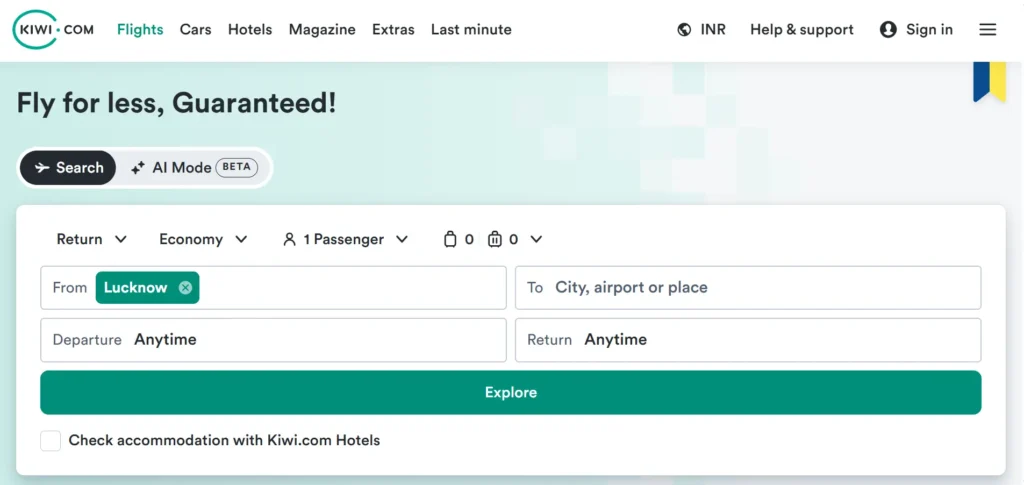
Kiwi.com takes a different approach to flight searching.
Its technology is known for combining flights from carriers that may not normally cooperate with each other on a single traditional itinerary.
This approach is often called virtual interlining.
Why Virtual Interlining Matters
Imagine you’re traveling from a smaller European city to an island in Southeast Asia.
Traditional airline searches might show expensive itineraries because participating airlines have limited partnerships.
Kiwi.com may create a route using several unrelated carriers.
For example:
Flight 1: Ryanair
Flight 2: Turkish Airlines
Flight 3: AirAsia
That combination could potentially create a cheaper or more convenient itinerary than traditional airline partnerships offer.
Nomad and Multi-City Travel
Kiwi.com can also be interesting for travelers visiting multiple destinations.
If you’re planning something like:
Paris → Rome → Athens → Bangkok → Singapore
finding the cheapest order and combination manually can become time-consuming.
Tools designed around multi-city routing can help identify less obvious combinations.
The Important Risk: Self-Transfers
This is the biggest thing travelers need to understand.
A cheap multi-airline itinerary may involve self-transfers.
That can mean:
- Arriving on one airline.
- Collecting checked luggage.
- Passing through immigration if necessary.
- Changing terminals or even airports.
- Checking in again.
- Clearing security again.
- Boarding an unrelated airline.
If the first flight is severely delayed, the next airline may have no obligation to accommodate you because the tickets are separate.
That makes these itineraries very different from a protected connection booked on one traditional airline ticket.
Always inspect the connection details carefully.
Kiwi.com Pros
- Creative route combinations
- Useful for low-cost carriers
- Strong multi-city searching
- Can uncover unusual cheap itineraries
- Flexible destination tools
- Good for adventurous travelers
Kiwi.com Cons
- Self-transfers can create additional risk
- Separate tickets may have different rules
- Baggage transfers can become complicated
- Complex itineraries require careful planning
- Airline support may differ when tickets are booked through an intermediary
Who Should Use Kiwi.com?
Kiwi.com is best for travelers who prioritize finding unusual or potentially cheaper routes and are comfortable managing more complicated connections.
For a simple round-trip flight, I would usually compare Google Flights and Skyscanner first.
Best for: Backpackers, multi-city travelers, and people comfortable with self-transfer itineraries.
Which Flight Booking Site Is Best for You?
Here’s the simplest way to decide:
| Your Priority | Best Option |
|---|---|
| Best overall airfare research | Google Flights |
| Cheapest flexible destination | Skyscanner |
| Detailed filters | KAYAK |
| Flight + hotel vacation | Expedia |
| Complex multi-airline route | Kiwi.com |
| Flexible travel dates | Google Flights / Skyscanner |
| Backpacking trip | Skyscanner / Kiwi.com |
| Direct airline booking research | Google Flights |
My preferred strategy isn’t to rely on one website.
For an expensive international ticket, I usually recommend using a combination.
Start with Google Flights to understand normal fares and identify cheap dates.
Then search Skyscanner or KAYAK to see whether another provider has found a better option.
If you’re also booking accommodation, compare the total against Expedia.
Finally, use Kiwi.com when conventional searches aren’t producing good routes.
Pro-Tips for Finding Cheaper Flights
The booking website matters, but how you search matters just as much.
Here are several strategies experienced travelers use.
1. Search Flexible Dates
Don’t automatically search Friday evening to Sunday evening.
Those convenient travel periods can also attract strong demand.
Check nearby dates.
Moving your trip by even 24 to 48 hours can sometimes produce a much better fare.
2. Compare Nearby Airports
Major cities often have multiple airports.
For example, someone traveling to London could potentially compare Heathrow, Gatwick, Stansted, Luton, and London City depending on the route.
But calculate transportation costs.
Saving $40 on airfare isn’t helpful if reaching the alternative airport costs an additional $60.
3. Compare the Airline’s Direct Price
After finding a flight through a comparison website, check the operating airline.
If the airline sells the same ticket for approximately the same amount, direct booking can be attractive because changes, cancellations, refunds, and schedule disruptions may be easier to manage.
4. Calculate the Real Ticket Price
A $79 flight isn’t necessarily cheaper than a $110 flight.
The $79 fare could include:
Base fare: $79
Carry-on: $35
Seat: $15
Payment or service fees: $8
Actual cost: $137
Compare the final price based on what you actually need.
5. Set Price Alerts
If your trip is several months away and the fare doesn’t look particularly attractive, consider tracking it.
Google Flights, Skyscanner, and other major platforms offer tools that can help you monitor pricing.
6. Be Careful With Extremely Short Connections
A cheap itinerary isn’t useful if the connection is unrealistic.
This is particularly important when:
- Changing terminals
- Entering another country
- Collecting checked baggage
- Using separate tickets
- Completing a self-transfer
Sometimes paying $30 more for a longer connection is money well spent.
7. Check One-Way Tickets
Don’t assume round-trip pricing will always be cheapest.
Compare:
Option A: Traditional round trip
against:
Option B: Airline A outbound + Airline B return
This strategy can also provide better flight times.
8. Don’t Wait Forever for the “Perfect” Price
Flight prices can go down.
They can also go up.
If you find a fare that fits your budget, has acceptable conditions, and compares favorably with surrounding dates, waiting indefinitely to save another $20 can backfire.
The goal isn’t necessarily finding the lowest airfare anyone has ever paid.
It’s finding a good price for the trip you actually want to take.
Frequently Asked Questions
What is the best flight booking site overall?
Google Flights is one of the best starting points for most travelers because it offers fast searching, strong filters, flexible-date comparisons, price tracking, and useful pricing information.
However, it is still worth comparing the itinerary on Skyscanner or KAYAK before purchasing.
Which website usually has the cheapest flights?
There is no website that always offers the cheapest airfare.
Prices depend on airlines, routes, dates, inventory, booking providers, and fare conditions.
For the best chance of finding a competitive fare, compare several platforms rather than relying on one.
Is Skyscanner better than Google Flights?
They serve slightly different purposes.
Google Flights is excellent for researching dates, schedules, airlines, and fare trends.
Skyscanner is particularly useful for discovering cheap destinations and comparing a broad range of booking providers.
Using both is often better than choosing one.
Is it better to book directly with the airline?
If the airline offers approximately the same price, booking directly can be a good choice.
When disruptions, cancellations, or schedule changes occur, dealing directly with the airline may be simpler than communicating through an intermediary.
However, third-party websites can sometimes offer lower prices or useful package discounts.
Are flight comparison websites safe?
Major flight search platforms are generally legitimate, but many operate as comparison services and may redirect users to other booking companies.
Always check which company will actually issue your ticket before paying.
What is the best website for international flights?
Google Flights and Skyscanner are both excellent starting points for international airfare.
KAYAK can also be useful when you need more detailed filtering, while Kiwi.com can help uncover unconventional multi-airline routes.
How far in advance should I book a flight?
There is no universal booking window that guarantees the lowest price.
Route demand, holidays, seasonality, airline capacity, and destination popularity all affect fares.
Instead of relying on a fixed rule, start researching early, compare flexible dates, and track prices when possible.
Can flight prices change while I’m searching?
Yes.
Airline fares are dynamic. Available inventory can change quickly, and a fare displayed by a comparison platform may no longer be available when you reach the final booking page.
Always judge the deal based on the final checkout price, not just the first number shown in search results.
Final Verdict: What Is the Best Flight Booking Site?
There is no single website that will find the cheapest and best flight every time.
Each of these five platforms has a different strength.
Google Flights is my top overall choice for researching fares, comparing dates, and understanding your options.
Skyscanner is excellent when your destination or travel dates are flexible.
KAYAK gives experienced travelers powerful filtering and comparison tools.
Expedia makes more sense when you’re booking flights together with hotels or other parts of a vacation.
And Kiwi.com can uncover creative routes that traditional searches may miss, although travelers should pay close attention to self-transfers and separate-ticket conditions.
The best approach is simple: don’t trust the first fare you see.
Search your route on two or three platforms, compare nearby dates and airports, check the airline’s direct price, and calculate baggage and other extras before paying.
Those extra ten minutes of research can potentially save you far more money than any flight-booking “hack.”
So before booking your next trip, open Google Flights, compare the same journey on Skyscanner or KAYAK, and check whether booking directly with the airline gives you a better overall deal.
A cheap flight is good. A cheap flight with sensible conditions, convenient times, and fewer surprises is much better.