
Traveling is exciting. Paying for it is usually the painful part.
A flight that looks affordable can suddenly become expensive after baggage fees. A hotel advertised at a great nightly rate may cost much more after taxes and resort charges. Add airport transfers, rental cars, activities, and other expenses, and a simple vacation can quickly go over budget.
The good news is that you no longer have to check dozens of airline and hotel websites manually.
The best travel booking websites can search or compare huge numbers of flights, hotels, rental cars, and other travel services in a matter of seconds. Some even offer package discounts, loyalty rewards, price alerts, flexible-date searches, and tools that help you decide when to book.
But not every travel website works the same way.
Some platforms, such as Expedia and Booking.com, let you make many reservations directly through their platform. Others, including Skyscanner and KAYAK, primarily work as travel search engines that compare offers from multiple providers and may redirect you elsewhere to complete the booking.
In this guide, I’ll compare 5 of the best travel booking websites, explain what each one does particularly well, and help you decide which platform fits your next trip.
Quick Comparison: Best Travel Booking Websites
Before getting into the detailed reviews, here is a quick overview.
| Travel Website | Best For | Flights | Hotels | Car Rentals | Packages | Price Comparison |
|---|---|---|---|---|---|---|
| Booking.com | Hotels and accommodation | Yes | Yes | Yes | Limited | Good |
| Expedia | Complete vacation booking | Yes | Yes | Yes | Yes | Good |
| Trip.com | International and Asian travel | Yes | Yes | Yes | Available in some markets | Good |
| Skyscanner | Finding cheap flights | Yes | Yes | Yes | No traditional packages | Excellent |
| KAYAK | Comparing multiple travel sites | Yes | Yes | Yes | Yes | Excellent |
Quick recommendation: If accommodation is your priority, start with Booking.com. For an entire vacation, Expedia is one of the strongest choices. For international travel, especially trips involving Asia, check Trip.com. If finding a low airfare is the main objective, compare Skyscanner and KAYAK before paying.
1. Booking.com: Best Overall for Hotels and Accommodation
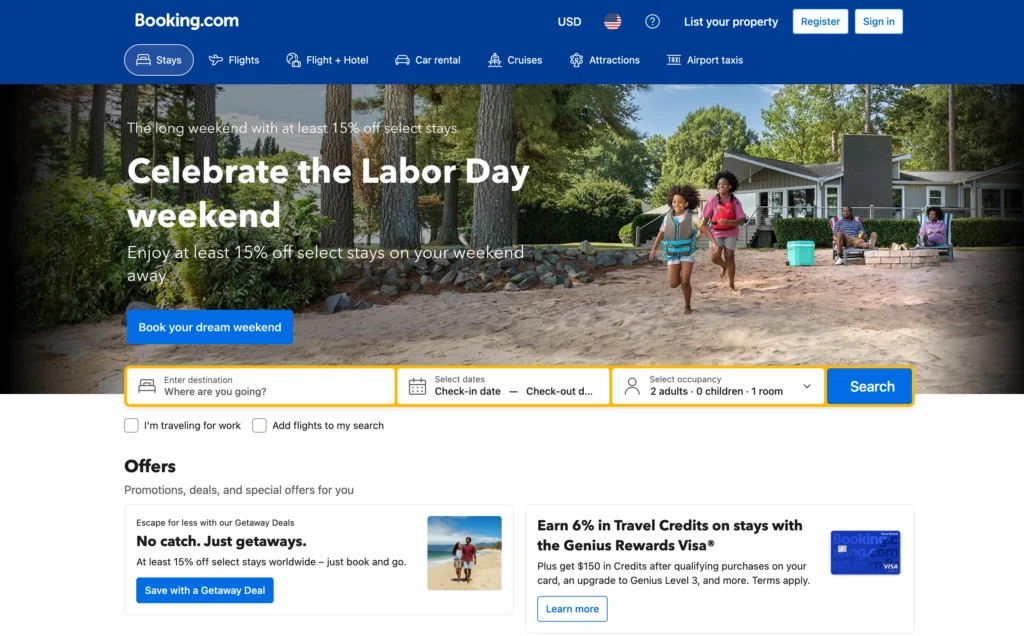
Booking.com is one of the first websites I recommend checking when accommodation is the biggest part of a trip.
Although many travelers still associate Booking.com primarily with hotels, the platform has expanded beyond accommodation and can also help travelers search for flights, rental cars, attractions, and airport taxis.
Its biggest strength, however, remains the huge variety of places to stay.
You can find traditional hotels alongside apartments, resorts, hostels, guesthouses, villas, vacation homes, and other properties.
Why Booking.com Stands Out
The search interface is straightforward.
Enter your destination, dates, number of travelers, and rooms. You can then narrow down what may initially be hundreds or thousands of results.
Useful filters can include:
- Price range
- Guest rating
- Property type
- Star rating
- Facilities
- Meal options
- Neighborhood
- Distance from landmarks
- Cancellation policies
- Payment options
This makes Booking.com particularly useful in destinations with an overwhelming number of hotels.
Booking.com also highlights its large collection of verified traveler reviews, which can help you understand what a property is actually like beyond its professional photographs and description.
Genius Loyalty Program
Frequent users should also look at Booking.com Genius.
Participating properties can provide eligible members with discounts or benefits. The exact deal depends on the property, dates, destination, and Genius level.
The important lesson is not to assume a Genius-labelled property is automatically the cheapest option. Compare the final rate against the hotel’s direct website and another booking platform.
Where Booking.com Works Best
Booking.com is particularly useful for:
- Travelers comparing several hotels
- International accommodation
- Apartments and vacation rentals
- Travelers who want flexible cancellation options
- Last-minute hotel searches
- Trips involving several destinations
Booking.com Pros and Cons
Pros
- Huge accommodation selection
- Strong filtering system
- Large volume of traveler reviews
- Genius loyalty benefits
- Flights and car rentals also available
- Many properties offer flexible booking conditions
Cons
- Cancellation and payment rules vary significantly by property
- The cheapest room may have restrictive conditions
- Not always the cheapest option compared with direct hotel offers
- Its biggest advantage remains accommodation rather than complete vacation packages
Best for: Travelers who want the widest choice of hotels and alternative accommodation.
2. Expedia: Best for Booking an Entire Vacation
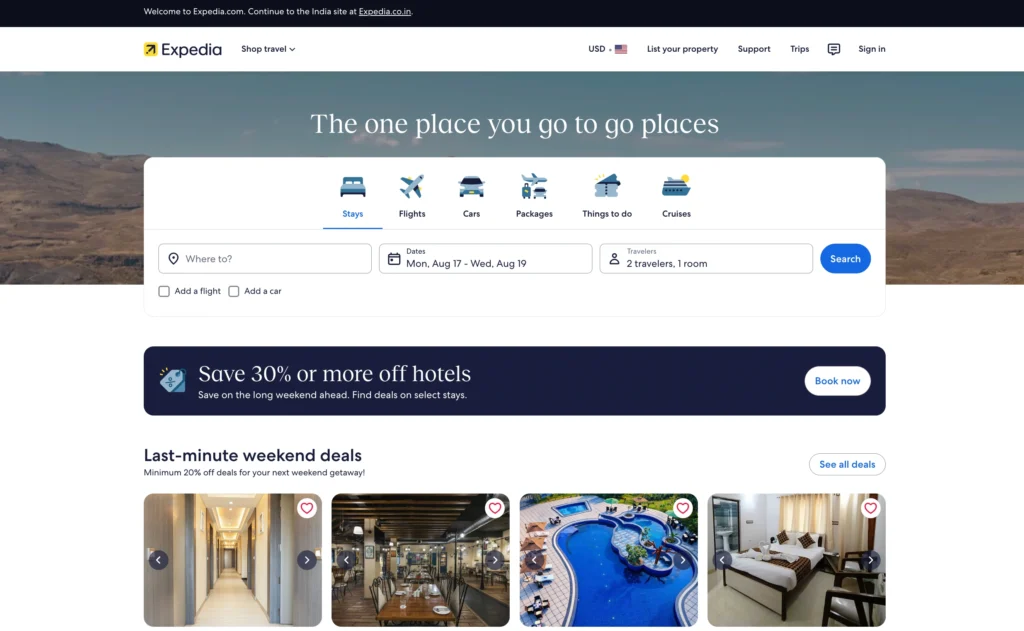
If you would rather organize several parts of your vacation from one account, Expedia deserves a place near the top of your search list.
Expedia covers a broad range of travel products, including hotels, vacation rentals, flights, rental cars, vacation packages, activities, and cruises.
That makes it particularly convenient for travelers who don’t want separate websites for every part of their trip.
Expedia Vacation Packages
Packages are one of Expedia’s biggest advantages.
Instead of purchasing your flight and hotel independently, you can search for combinations such as:
- Flight + hotel
- Flight + hotel + car
- Hotel + car
Bundling can sometimes lower the overall price compared with buying the same components separately, although savings vary by itinerary and provider. Expedia itself notes that package savings are not available on every booking.
Always perform a quick comparison.
For example, suppose an Expedia flight-and-hotel package costs $1,500.
Check the same flight directly with the airline and the same hotel separately. If they total $1,650, the package is clearly attractive. If they cost $1,450 separately, bundling doesn’t make financial sense.
One Key Rewards
Expedia also participates in the One Key rewards ecosystem.
Rewards can make Expedia more attractive to travelers who repeatedly use eligible services within the ecosystem rather than switching booking websites for every trip.
Still, loyalty rewards should be treated as a bonus, not a reason to overpay.
A $30 future reward isn’t valuable if another reputable website is currently $100 cheaper for the same booking.
Where Expedia Works Best
Expedia is especially useful for:
- Family vacations
- Flight-and-hotel trips
- Resort holidays
- Road trips requiring rental cars
- Travelers booking activities
- People who prefer keeping multiple reservations together
Expedia Pros and Cons
Pros
- Excellent selection of travel products
- Strong vacation-package options
- Hotels, flights, cars, activities, and cruises
- Loyalty benefits through One Key
- Convenient trip management
- Potential savings from bundling
Cons
- Package deals aren’t automatically cheaper
- Changes can be more complicated when several providers are involved
- Cancellation rules differ between bookings
- Direct airline or hotel rates can occasionally be better
Best for: Travelers who want to organize most of a vacation through one platform.
3. Trip.com: Best for International and Asia-Focused Travel
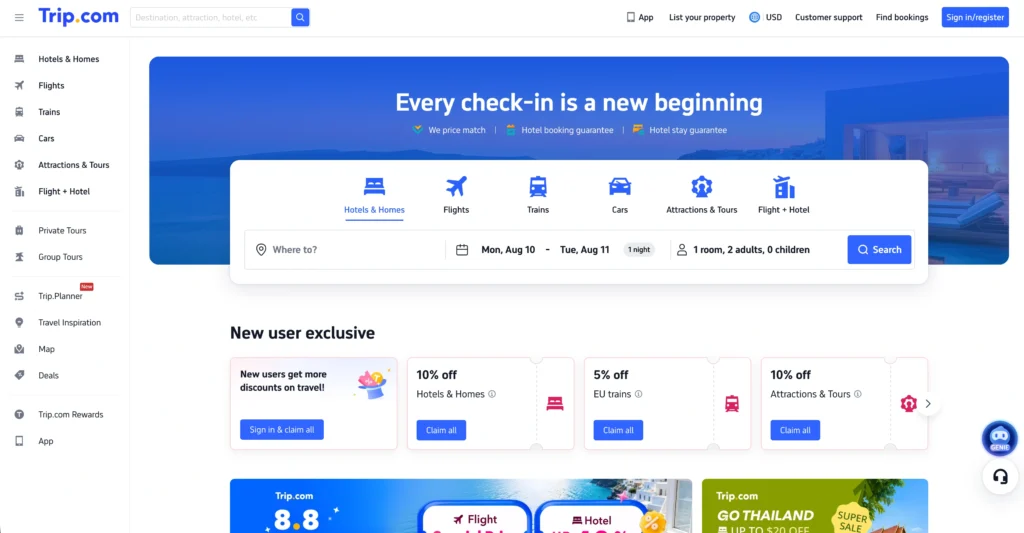
Trip.com has become a useful alternative to the large Western travel booking platforms, particularly for international itineraries and trips involving Asian destinations.
The platform offers access to products such as flights, hotels, trains, car rentals, airport transfers, and attractions, although availability can differ depending on destination and market.
Why Trip.com Is Worth Checking
One reason I like including Trip.com in a price comparison is that no travel website consistently has the lowest price.
Different OTAs may have different inventory, promotions, partnerships, and regional offers.
Trip.com can therefore uncover an itinerary or hotel rate that doesn’t appear as prominently elsewhere.
Its train-booking capabilities are another useful feature for travelers visiting destinations where rail is an important part of the journey.
Instead of thinking only about flights and hotels, you can plan more of the transportation between cities.
Trip.com Rewards and Promotions
Trip.com regularly promotes member pricing, app deals, loyalty benefits, and other offers.
As with every OTA promotion, focus on the final checkout price rather than the discount percentage displayed on the search page.
A large advertised discount doesn’t necessarily mean it is the lowest rate available online.
Where Trip.com Works Best
I would particularly consider Trip.com when booking:
- Travel within Asia
- International flights
- Multi-city Asian vacations
- Hotels in major international destinations
- Rail travel
- Airport transfers
- Attractions and activities
Trip.com Pros and Cons
Pros
- Strong international coverage
- Particularly useful for Asian destinations
- Flights and hotels in one platform
- Train-booking options
- Frequent promotions
- Useful mobile app
Cons
- Some services vary by country
- Cancellation conditions depend on the underlying provider
- Promotions can make price comparisons confusing
- Travelers should carefully check fare and baggage conditions before paying
Best for: International travelers, particularly people planning trips around Asia.
4. Skyscanner: Best for Finding Cheap Flights
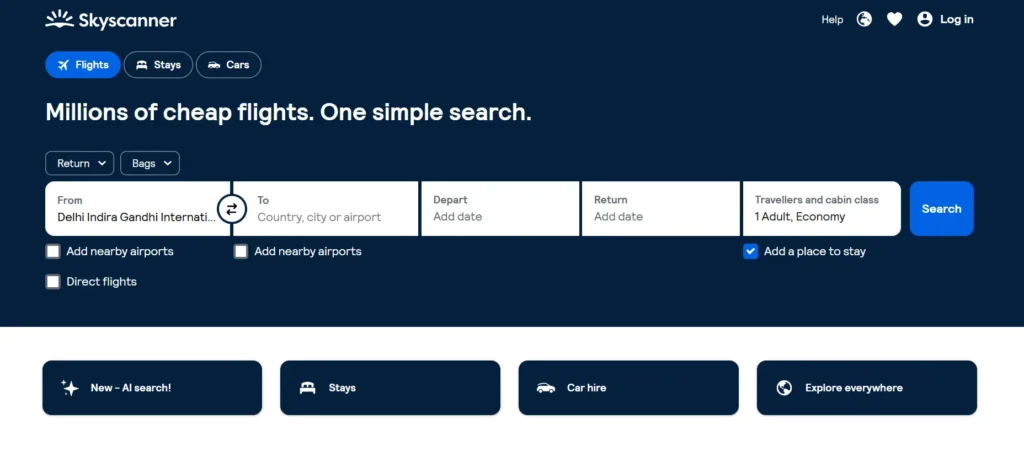
If airfare is your biggest expense, Skyscanner should be one of your first searches.
Skyscanner is different from a traditional online travel agency.
It is primarily a metasearch engine. Instead of selling every flight directly, it searches airlines and travel booking partners, compares available options, and generally sends you to the selected provider to complete the reservation.
That difference is important.
If you book after being redirected to an airline or travel agency, that company normally handles your payment, reservation, changes, and cancellation.
Explore Everywhere
One of Skyscanner’s most useful features is Explore Everywhere.
Imagine you have a week available for vacation but don’t care whether you visit Thailand, Spain, Vietnam, or somewhere else.
Instead of searching each destination individually, you can explore destinations based on available fares.
This is particularly useful for flexible travelers.
Search Flexible Dates
Airfares can change dramatically between nearby dates.
Flying on Tuesday instead of Friday, for example, might produce a completely different fare.
Skyscanner offers flexible-date tools, including month-based price views, that make it easier to identify cheaper travel periods.
Its own travel guidance recommends combining flexible-date searches with tools such as Everywhere and Price Alerts when hunting for lower fares.
Set Price Alerts
Found a flight but aren’t ready to buy?
Create a Price Alert.
Instead of manually repeating the same search every morning, you can monitor price changes and decide whether a new fare is attractive enough to book.
Skyscanner Pros and Cons
Pros
- Excellent flight comparison tools
- Searches many travel partners
- Flexible-date functionality
- Explore Everywhere is great for inspiration
- Price alerts
- Hotels and car rentals can also be compared
Cons
- Skyscanner generally isn’t the company handling your reservation
- Customer service quality depends on the provider you select
- Some third-party agencies may have stricter change policies
- The cheapest displayed offer isn’t necessarily the best overall booking
Best for: Flexible travelers focused on finding competitive airfare.
5. KAYAK: Best for Comparing Multiple Travel Websites
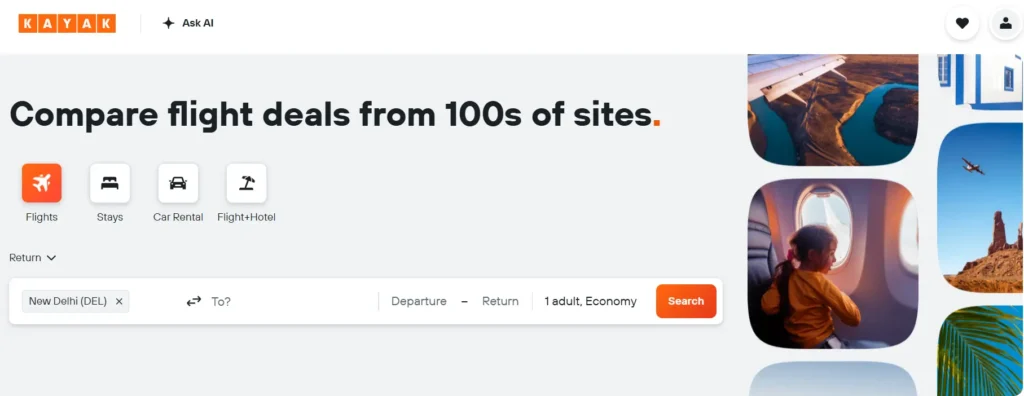
KAYAK is another powerful metasearch platform and one of Skyscanner’s closest alternatives.
KAYAK searches hundreds of travel websites to compare options for flights, hotels, rental cars, packages, and more.
Its biggest advantage is comparison.
Rather than treating the first fare you see as the market price, KAYAK helps you understand what different travel providers are offering.
Price Alerts
Like Skyscanner, KAYAK provides Price Alerts.
Save a search and KAYAK can notify you when prices change, reducing the need to repeatedly search for the same itinerary.
This feature is especially useful when you’re planning months ahead and aren’t under pressure to purchase immediately.
KAYAK Trips
Another useful feature is KAYAK Trips.
You can organize travel information into an itinerary and keep important booking details together. KAYAK says Trips can also provide features such as flight-status alerts and itinerary sharing.
That’s valuable for complicated journeys involving several flights, hotels, and cities.
Understand Who You’re Booking With
This is important.
KAYAK explains that it operates as a metasearch engine rather than processing every transaction itself. When you select an offer, the actual travel provider generally handles the booking and payment.
Always look at the provider before clicking Book.
Paying slightly more to book directly with a trusted airline can sometimes be worth it, especially when the cheapest alternative comes from an unfamiliar third-party agency with restrictive support policies.
KAYAK Pros and Cons
Pros
- Compares hundreds of travel sites
- Excellent flight-search functionality
- Hotel and rental-car comparison
- Vacation-package search
- Price alerts
- Useful itinerary-management tools
Cons
- Usually not the company servicing your final reservation
- Search results can include many different third-party providers
- Lowest price isn’t always the most flexible fare
- Support and cancellation procedures depend on the booking provider
Best for: Travelers who want to compare a broad range of websites before booking.
Which Travel Booking Website Should You Choose?
There isn’t one website that is cheapest for every traveler, destination, or date.
That is why I recommend using these platforms together rather than choosing only one forever.
Here is a simple approach:
| Your Priority | Start With |
|---|---|
| Hotels | Booking.com |
| Complete vacation | Expedia |
| Asia and international travel | Trip.com |
| Cheap flight discovery | Skyscanner |
| Broad price comparison | KAYAK |
| Vacation packages | Expedia or KAYAK |
| Flexible destination search | Skyscanner |
| Alternative accommodation | Booking.com |
For expensive trips, spending an additional 10 minutes comparing two or three websites can potentially be more valuable than chasing coupons for hours.
Pro-Tips for Getting Better Travel Booking Deals
Experienced travelers rarely depend on a single search.
Here are several techniques that can make a much bigger difference.
1. Compare an OTA With the Direct Provider
If Booking.com shows a hotel for $180 per night, check the hotel’s website.
If Skyscanner finds a $600 flight, check the airline’s direct price.
Sometimes the prices match. When they do, direct booking may provide simpler communication if your plans change.
Other times the OTA genuinely offers a better deal.
Compare before deciding.
2. Compare the Final Price
Never judge a booking by the first price displayed.
Check for:
- Taxes
- Resort fees
- Baggage fees
- Seat-selection charges
- Cleaning fees
- Payment fees
- Cancellation restrictions
A $400 flight with a checked bag included could be better than a $360 fare that charges $70 for baggage.
3. Use Flexible Dates
Flexibility is one of the most powerful money-saving tools in travel.
Check:
- One day earlier
- One day later
- Midweek departures
- Nearby airports
- Different trip lengths
For flights, tools such as Skyscanner and KAYAK make this process much easier.
4. Set Price Alerts
If your trip is several months away, don’t rely entirely on manual searches.
Set alerts on Skyscanner or KAYAK and watch how the fare develops.
Just don’t wait forever for the “perfect” price. If you find a fare that fits your budget and schedule, booking it can be more sensible than gambling on a small future reduction.
5. Check Cancellation Rules Before Paying
A non-refundable room can be significantly cheaper.
But that discount becomes meaningless if your plans change and you lose the entire payment.
For uncertain trips, paying slightly more for flexible cancellation can be worthwhile.
6. Be Careful With Extremely Cheap Third-Party Offers
Metasearch engines may show offers from many agencies.
Don’t automatically choose an unfamiliar provider because it saves $10.
Check who is actually issuing the ticket, what baggage is included, how changes are handled, and who you must contact if something goes wrong.
7. Compare Packages Against Separate Bookings
Expedia and other platforms may offer flight-and-hotel packages.
Always calculate both options:
Package price vs. Flight + Hotel booked separately
Whichever provides the better combination of price, flexibility, and convenience wins.
FAQs About the Best Travel Booking Websites
1. What is the best travel booking website overall?
There isn’t a universal winner. Booking.com is particularly strong for accommodation, while Expedia works well for travelers wanting flights, hotels, cars, and packages in one ecosystem. Skyscanner and KAYAK are better suited to broad price comparison.
2. What is the best website for finding cheap flights?
Skyscanner and KAYAK are two excellent starting points because they compare offers from numerous airlines and booking websites rather than limiting your search to a single provider.
3. Which website is best for booking hotels?
Booking.com is one of the strongest hotel-booking choices due to its extensive property selection, filtering tools, traveler reviews, and range of accommodation types.
4. Is it cheaper to book directly or through a travel website?
Either can be cheaper.
OTAs sometimes have promotional or package rates, while airlines and hotels may provide direct-booking discounts, loyalty points, upgrades, or better cancellation terms.
The safest strategy is to compare both.
5. Are travel booking websites safe?
Major travel websites such as Booking.com, Expedia, Trip.com, Skyscanner, and KAYAK are established travel platforms. However, metasearch sites may redirect you to third-party agencies. Always check the actual company handling your reservation before entering payment information.
6. Is Skyscanner a travel agency?
Not in the traditional sense. Skyscanner describes itself as a metasearch platform. It compares travel options and generally redirects travelers to an airline or online travel agency to complete the booking and payment.
7. Is KAYAK a booking website?
KAYAK primarily operates as a travel metasearch engine. It searches travel websites and shows available options. The partner selected from the results generally handles the transaction and reservation.
8. Should I use more than one travel website?
Yes.
For a major trip, I recommend checking at least two comparison platforms plus the direct airline or hotel website. Prices, inventory, package deals, and cancellation conditions can vary between platforms.
Final Verdict: What Is the Best Travel Booking Website?
The best travel booking website depends on what you’re actually trying to book.
Choose Booking.com when accommodation selection is your priority. Use Expedia when you want to organize flights, hotels, cars, activities, or vacation packages within one ecosystem. Add Trip.com to your comparison when planning international travel, particularly in Asia.
For airfare hunting, Skyscanner is one of the most useful tools for flexible dates, destination discovery, and price comparison. KAYAK is similarly valuable when you want to compare a broad range of travel websites and organize complicated itineraries.
Most importantly, don’t become loyal to a booking website before comparing prices.
The smartest approach is simple: search broadly, compare the final price, check the cancellation conditions, verify who will handle your reservation, and then book the option offering the best overall value.
Your next trip doesn’t need to start with hours of opening browser tabs. Pick two or three of the websites above, compare your dates, and see what your travel budget can actually get you.