
Traveling can get expensive quickly. You may find a reasonably priced flight, build a perfect itinerary, and set aside money for food and activities, only to discover that hotels are eating up a huge part of your budget.
A room that costs $120 per night becomes $600 for a five-night trip before you even consider taxes, resort fees, parking, or other charges.
The good news is that you do not have to accept the first hotel price you see.
Hotel prices can vary between booking websites, sometimes even for exactly the same room. One site may have a special member rate, another may include breakfast, while another could offer free cancellation at roughly the same price.
The trick is knowing where to search and what to compare.
After looking at the major hotel booking platforms and the features that actually help travelers save money, I narrowed the options down to five websites worth checking:
- Booking.com
- Agoda
- Hotels.com
- Expedia
- Priceline
Each has different strengths. Agoda can be particularly useful for Asian destinations, Booking.com gives you a huge selection, Hotels.com is easy to use, Expedia works well when you want to bundle different parts of your trip, and Priceline has interesting discount tools for flexible travelers.
This guide explains how each website works, its strengths and weaknesses, and how to use it to find cheaper hotel rooms.
Quick Comparison of the Best Websites for Cheap Hotels
Before getting into the detailed reviews, here is a quick comparison.
| Website | Best For | Rewards/Member Discounts | Free Cancellation Options | App |
|---|---|---|---|---|
| Booking.com | Overall hotel selection | Genius | Yes, on eligible rooms | Yes |
| Agoda | Hotels in Asia | AgodaVIP and special rates | Yes, depending on property | Yes |
| Hotels.com | Simple hotel searching | One Key | Yes, on eligible bookings | Yes |
| Expedia | Hotels + travel packages | One Key | Yes, depending on rate | Yes |
| Priceline | Discount hunters | VIP | Available on many standard rates | Yes |
There is no single website that will always have the cheapest hotel.
For that reason, I recommend checking at least two or three platforms before confirming an expensive or multi-night reservation.
A $10 difference might not matter for one night. For a seven-night vacation, however, it could save you $70 or more.
1. Booking.com: Best Overall Website for Cheap Hotels

Booking.com is one of the first places I check when researching accommodation.
Its biggest advantage is simply the amount of inventory available. Depending on your destination, you can find traditional hotels alongside apartments, hostels, resorts, guesthouses, villas, and other types of accommodation.
That makes it useful for almost every type of traveler.
Why Booking.com Is Good for Finding Cheap Hotels
Booking.com makes comparison relatively easy.
Enter your:
- Destination
- Check-in date
- Check-out date
- Number of travelers
- Number of rooms
You can then filter the results based on your actual requirements.
Useful filters commonly include:
- Price range
- Property rating
- Guest review score
- Distance from landmarks
- Free cancellation
- Breakfast included
- Property type
- Facilities
This is important because the cheapest room is not necessarily the best deal.
Suppose Hotel A costs $85 but charges $20 for breakfast, while Hotel B costs $95 with breakfast included. Hotel B could easily provide better overall value.
Booking.com Genius Discounts
Frequent Booking.com users should pay attention to the Genius loyalty program.
Eligible properties may offer Genius members discounted rates and additional perks. Benefits vary depending on your Genius level and the individual property.
That can include things such as:
- Member-only discounts
- Complimentary breakfast at selected properties
- Possible room upgrades at participating hotels
The important phrase is participating properties. Do not assume every hotel provides the same Genius benefits.
Flexible Cancellation Is a Major Advantage
Another reason I regularly check Booking.com is the availability of flexible rates.
Many properties offer rates that can be cancelled without a fee until a specified deadline.
Flexible reservations can be useful when planning months in advance. You can secure a reasonable price today and continue checking the market.
Just remember that cancellation rules vary considerably.
Always read the conditions before paying.
Booking.com Pros and Cons
Pros:
- Huge accommodation selection
- Excellent filtering options
- Genius member rates
- Plenty of user reviews
- Free cancellation available on many rates
- Good for hotels, apartments, and hostels
Cons:
- The lowest displayed option may have stricter conditions
- Taxes and additional property charges require attention
- Genius benefits vary between hotels
- A large number of listings can make choosing difficult
Best For
Booking.com is my best overall choice for travelers who want a large selection and plenty of ways to filter hotel deals.
2. Agoda: Best for Cheap Hotels in Asia
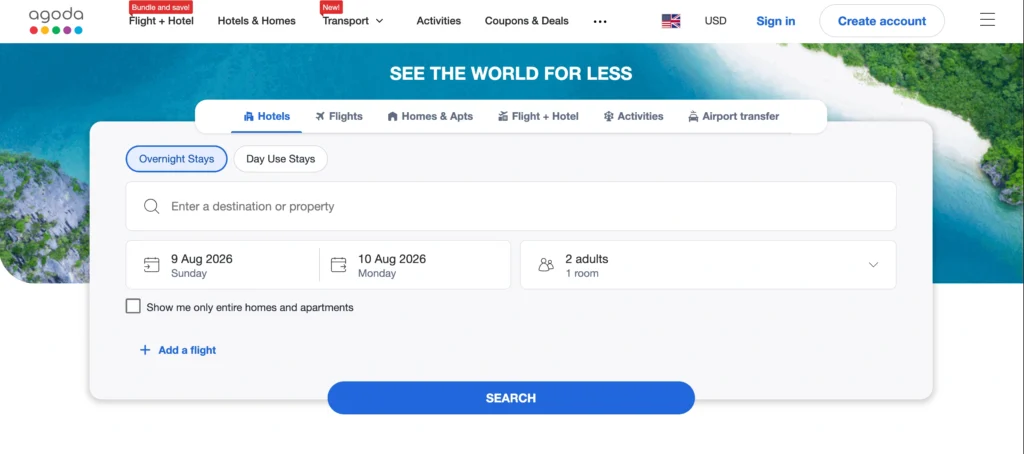
If you are traveling around Asia, Agoda deserves a separate search.
It has a particularly strong presence across destinations such as Thailand, Vietnam, Malaysia, Indonesia, Japan, South Korea, and other parts of the Asia-Pacific region.
You can also use Agoda for hotels in Europe, North America, and elsewhere, but Asia is where I find it especially worth comparing.
How Agoda Helps You Find Lower Rates
Agoda regularly displays several different offers for the same property.
Depending on the hotel and your account, you may encounter:
- Member prices
- Mobile or app offers
- Limited-time promotions
- AgodaVIP rates
- Different meal options
- Non-refundable discounts
This makes it possible to customize the booking around your priorities.
For example, a non-refundable room may be cheaper than a flexible booking. That can be worthwhile if your travel plans are completely fixed.
If there is any chance your dates could change, however, saving a few dollars may not justify giving up cancellation flexibility.
AgodaVIP
Agoda also has its AgodaVIP loyalty program.
Participating properties may provide special prices or benefits to eligible members.
The exact discount varies, so compare the final rate instead of assuming the VIP label automatically means it is the cheapest offer available.
Pay Attention to the Final Price
This is particularly important when comparing Agoda with another booking website.
Do not compare only the large price displayed on the search page.
Continue far enough into the booking process to understand the total, including applicable taxes, fees, and selected extras.
A $72 room is not cheaper than an $80 room if another $15 appears later in the booking process.
Agoda Pros and Cons
Pros:
- Particularly useful for Asian destinations
- Large accommodation inventory
- Member and AgodaVIP rates
- App promotions may provide additional savings
- Good filtering system
- Frequent promotional offers
Cons:
- Cancellation conditions vary
- Some of the lowest rates can be non-refundable
- Final-price comparisons require careful checking
- Discounts differ significantly by hotel and destination
Best For
Agoda is especially useful for travelers visiting Asia, although it is still worth checking for destinations elsewhere.
3. Hotels.com: Best for Straightforward Hotel Searching
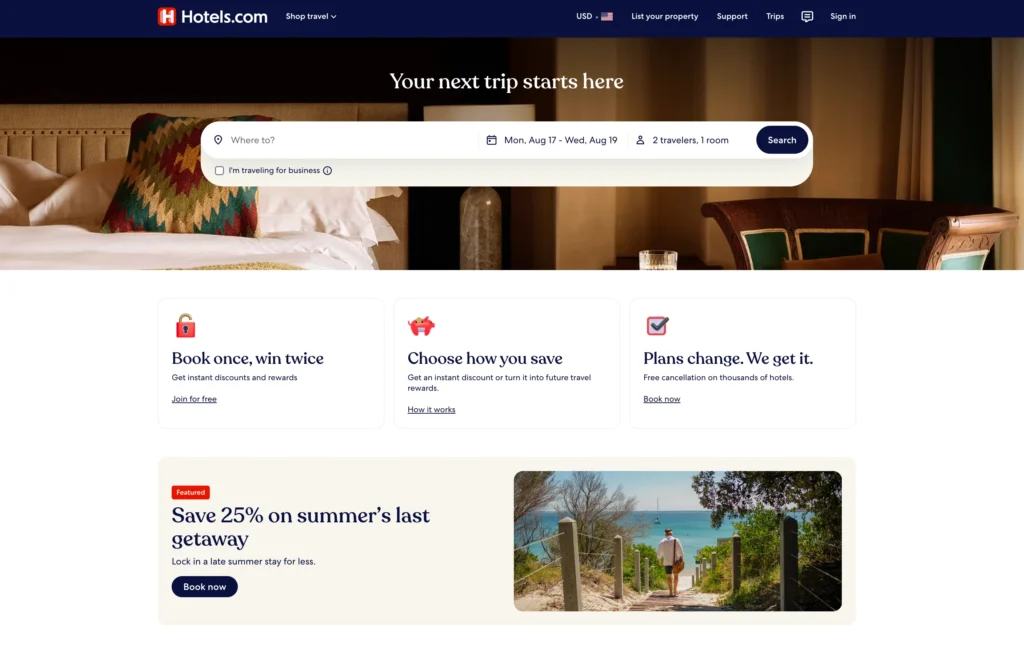
Hotels.com has long focused heavily on accommodation, which makes it easy to understand.
Search for your destination, enter your dates, choose the number of travelers, and compare the available properties.
The interface works particularly well for travelers who do not want to spend hours learning complicated booking tools.
One Key Rewards
Hotels.com participates in One Key, the rewards program also connected with other Expedia Group travel brands.
Eligible bookings can earn OneKeyCash, which can later be used toward qualifying travel bookings.
This makes Hotels.com more interesting if you travel regularly rather than booking a hotel once every few years.
However, rewards should never replace price comparison.
A hotel offering rewards at $150 per night is not necessarily better than an identical room available elsewhere for $125.
Calculate the actual value you receive.
Useful Search Filters
Hotels.com allows you to narrow your search based on factors such as:
- Price
- Guest rating
- Star rating
- Amenities
- Property type
- Neighborhood
- Payment options
- Cancellation conditions
The map is also useful.
A cheap hotel 10 miles outside the area you want to explore could cost more overall once you add taxis, rental cars, parking, or public transportation.
Hotels.com Pros and Cons
Pros:
- Easy hotel comparison
- One Key rewards
- Strong range of accommodation
- Helpful maps and filters
- Member pricing on eligible properties
- User-friendly interface
Cons:
- Not always the lowest cash price
- Reward eligibility varies
- Some rates have restrictive cancellation policies
- Hotel inventory varies by destination
Best For
Hotels.com works well for travelers who want a simple booking experience combined with travel rewards.
4. Expedia: Best for Hotel and Flight Packages

Expedia becomes particularly interesting when you need more than a hotel.
Instead of booking your flight, hotel, and rental car separately, Expedia lets you search for several parts of the trip through one platform.
That makes it worth checking for vacations where you need multiple reservations.
Why Packages Can Save Money
Hotels and travel providers sometimes offer different pricing when services are bundled.
For example, you might search separately and find:
- Flight: $450
- Hotel: $650
- Total: $1,100
But a combined flight-and-hotel package could potentially cost less.
This is not guaranteed.
The only way to know is to compare both options.
Calculate the price of booking everything separately, then compare it with the package total.
Expedia Member Prices
Signing in can also reveal eligible member prices.
Like Hotels.com, Expedia participates in the One Key rewards program, allowing eligible travelers to earn rewards across qualifying bookings.
This can be useful for people who regularly book:
- Hotels
- Flights
- Vacation rentals
- Rental cars
- Activities
The exact earning and redemption rules depend on the booking type and current program conditions.
When Expedia Makes the Most Sense
I would particularly check Expedia when organizing a complete vacation.
For a one-night hotel stay, another platform might be quicker.
For a week-long international trip requiring flights, accommodation, and transportation, Expedia’s broader travel ecosystem becomes more valuable.
Expedia Pros and Cons
Pros:
- Excellent for multi-part trips
- Hotel and flight package options
- One Key rewards
- Member pricing
- Large hotel inventory
- Can manage several travel bookings together
Cons:
- Packages are not automatically cheaper
- Comparing package components takes extra time
- Cancellation policies vary between reservations
- Rewards can make direct price comparisons more complicated
Best For
Expedia is best for travelers booking hotels together with flights, rental cars, or other travel services.
5. Priceline: Best for Flexible Travelers Looking for Discounts
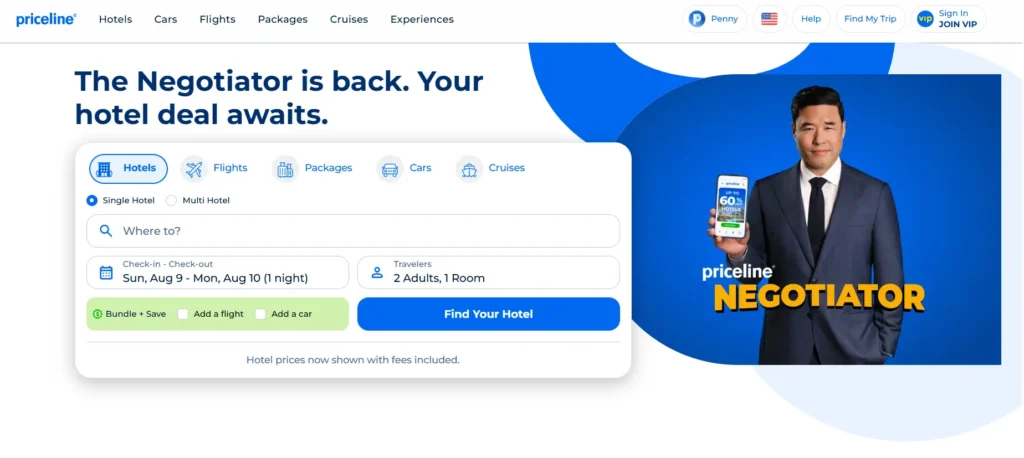
Priceline has been associated with discounted travel for years and remains worth checking when hunting for cheaper hotel rates.
It offers regular hotel listings along with special discount formats that can appeal to flexible travelers.
Priceline Express Deals
One of Priceline’s most recognizable features is Express Deals.
With these offers, some details about the hotel may remain hidden until after you book. You generally receive information such as the general area, star level, guest rating, and selected amenities before purchase.
In return for accepting uncertainty about the exact property, you may receive a lower price.
This strategy is not suitable for everyone.
If you absolutely need a particular hotel, neighborhood, or property feature, a standard booking is safer.
But if your priority is simply getting a comfortable room within a particular area, these deals can be worth investigating.
Priceline VIP
Priceline also provides its VIP membership program.
Members can access eligible discounts and benefits, with additional advantages available depending on membership status and qualifying activity.
As with every loyalty program in this guide, compare the actual checkout price.
The word “VIP” is not proof that no other website has a better deal.
Priceline Pros and Cons
Pros:
- Express Deals can offer attractive prices
- VIP member rates
- Good for flexible travelers
- Hotels, flights, and rental cars available
- Useful filters and map tools
Cons:
- Express Deals involve uncertainty
- Some discounted bookings may be restrictive
- Not ideal if you need one exact property
- Cancellation policies need careful attention
Best For
Priceline is best for flexible travelers willing to trade some control for the possibility of a lower hotel price.
Which Cheap Hotel Website Should You Choose?
The right website depends on how you travel.
| Your Priority | Website to Check First |
|---|---|
| Largest overall selection | Booking.com |
| Hotels in Asia | Agoda |
| Simple hotel comparison | Hotels.com |
| Flight + hotel packages | Expedia |
| Flexible discount hunting | Priceline |
I would not rely exclusively on one platform.
For an expensive booking, open two or three websites and search using exactly the same:
- Hotel
- Dates
- Room type
- Number of guests
- Cancellation conditions
- Meal plan
Then compare the final payable amount.
That final step is what separates a genuine deal from a price that only looks cheap on the search page.
Pro-Tips for Finding Cheaper Hotel Deals
Knowing the right websites is only half the job. How you search can make an equally big difference.
1. Compare the Same Room
Do not compare a non-refundable room on Agoda with a refundable room including breakfast on Booking.com.
Make the comparison as close to identical as possible.
2. Sign In Before Comparing Prices
Member rates are often hidden until you log in.
Create free accounts on the platforms you use regularly and search again after signing in.
3. Check the Hotel’s Direct Website
After finding your preferred property, check its official website.
Hotels occasionally provide direct-booking benefits such as breakfast, parking, flexible cancellation, upgrades, or loyalty points.
Even when the room rate is similar, those extras can improve the value.
4. Search Flexible Dates
Hotel prices can change dramatically from one night to another.
A major conference, concert, sports event, or public holiday can push rates higher.
If possible, move your dates by one or two days and search again.
5. Use the Map
Location affects your total vacation cost.
A $70 hotel far outside the city center may require $30 of transportation every day.
Paying $90 for a centrally located hotel could actually save money.
6. Look Beyond the Nightly Rate
Calculate the real stay cost.
Check for:
- Taxes
- Resort fees
- Parking
- Breakfast
- Wi-Fi charges
- Cleaning fees
- Transportation costs
A hotel should be judged on total trip cost, not simply the advertised nightly rate.
7. Compare Refundable and Non-Refundable Prices
Non-refundable rates are often cheaper, but the savings need to justify the risk.
If a refundable room costs $104 and the non-refundable option is $101, I would usually value the flexibility more than the $3 saving.
8. Read Recent Reviews
A cheap hotel is not a bargain if the experience is terrible.
Pay particular attention to recent comments about:
- Cleanliness
- Noise
- Location
- Staff
- Wi-Fi
- Air conditioning
- Safety
- Unexpected fees
Recent reviews can reveal problems that star ratings alone do not show.
Common Mistakes to Avoid When Booking Cheap Hotels
One of the biggest mistakes travelers make is choosing the first cheap-looking room.
Before booking, verify the room type. A hotel’s cheapest listing might be a small room, shared-bathroom accommodation, or a room without the view or facilities shown in promotional photos.
Also check whether your reservation is refundable.
Another common mistake is ignoring the hotel’s location. Always open the map and calculate how long it will take to reach the places you plan to visit.
Finally, take screenshots or save your confirmation showing the room type, inclusions, payment status, and cancellation policy.
This can be helpful if there is confusion when you arrive.
FAQs About the Best Websites for Cheap Hotels
1. What is the best website for cheap hotels?
Booking.com is a strong overall starting point because of its large accommodation inventory, filtering tools, user reviews, and Genius discounts. However, Agoda, Hotels.com, Expedia, and Priceline may have lower prices for individual properties.
2. Is Agoda cheaper than Booking.com?
Sometimes.
Agoda can be particularly competitive in Asia, while Booking.com may have a different rate or cancellation option for the same property. Compare both before making a significant booking.
3. Is it cheaper to book a hotel directly?
It can be.
Some hotels offer direct-booking rates or benefits that are unavailable through online travel agencies. Always check the hotel’s website before paying.
4. What is the cheapest day to book a hotel?
There is no universal cheapest booking day.
Hotel prices depend heavily on destination, occupancy, seasonality, events, and demand. Being flexible with your stay dates is generally more useful than trying to find one magical day of the week to book.
5. Are hotel booking websites safe?
Major platforms such as Booking.com, Agoda, Hotels.com, Expedia, and Priceline are established travel-booking services.
However, travelers should still verify property details, read cancellation rules, use secure payment methods, and be cautious of suspicious messages asking for payment outside the official booking process.
6. How far in advance should I book a hotel?
It depends on your destination.
For major holidays, festivals, conferences, or peak-season trips, booking earlier can give you more choice.
For ordinary trips, prices may change repeatedly, which is why a refundable reservation can be useful if you want to continue monitoring rates.
7. Are non-refundable hotel rooms worth it?
They can be when the discount is substantial and your plans are certain.
If the difference is small, a refundable booking may provide better value because it protects you if your plans change.
8. How can I get the lowest possible hotel price?
Use several strategies together:
- Compare multiple booking websites
- Log in for member rates
- Check the hotel’s official website
- Try slightly different travel dates
- Compare package prices
- Check app offers
- Calculate taxes and fees
- Use rewards when they provide genuine value
The goal should not simply be finding the lowest advertised number. It should be finding the best total price for the room and conditions you actually need.
Conclusion: Which Website Is Best for Cheap Hotels?
Finding cheap accommodation is easier when you stop relying on a single booking website.
Booking.com is my top starting point for overall selection and flexibility. Agoda deserves special attention for trips around Asia. Hotels.com provides an easy hotel-search experience and One Key benefits. Expedia is particularly useful when combining accommodation with other parts of your vacation, while Priceline can appeal to flexible travelers looking for deeper discounts.
Most importantly, compare the final price rather than the headline rate.
Check taxes, cancellation terms, breakfast, parking, resort charges, and location before deciding.
Spending an extra 10 minutes comparing two or three websites could save a meaningful amount, particularly on longer stays.
So before you book your next hotel, open a few tabs, compare the same room under the same conditions, check the hotel’s direct price, and only then confirm your reservation.
A cheap hotel deal is not just the lowest nightly rate. It is the lowest total cost that still gives you the location, flexibility, comfort, and booking conditions you need.