
Traveling is expensive. Between flights, hotels, food, local transportation, and activities, even a short vacation can quickly become a major expense. For many trips, accommodation is one of the biggest costs.
The frustrating part is that the same hotel room can appear at different prices on different websites.
You might find a room for $150 per night on one booking site, $137 on another, and $129 directly through the hotel. Research has also documented persistent price differences for identical hotel rooms across online platforms.
This is exactly where hotel price comparison websites become useful.
Instead of manually opening Booking.com, Agoda, Expedia, Hotels.com, and several hotel websites, a comparison engine searches multiple sources and puts available rates in one place.
But there is an important catch: no hotel comparison website finds the lowest price every single time.
The smartest approach is to know which comparison sites are worth checking, understand what their displayed prices include, and compare the final booking conditions before paying.
In this guide, we’ll look at the best hotel price comparison websites, including Google Hotels, Trivago, KAYAK, HotelsCombined, Skyscanner, Tripadvisor, and Momondo.
Quick Comparison: Best Hotel Price Comparison Websites
| Website | Best For | Price Comparison | Filters | Direct Hotel Rates |
|---|---|---|---|---|
| Google Hotels | Overall hotel comparison | Excellent | Excellent | Yes |
| Trivago | Comparing many booking providers | Excellent | Very Good | Sometimes |
| KAYAK | Advanced search and price tracking | Excellent | Excellent | Yes |
| HotelsCombined | Straightforward rate comparison | Excellent | Very Good | Varies |
| Skyscanner Hotels | Comparing flights and hotels together | Very Good | Very Good | Varies |
| Tripadvisor | Combining prices with traveler reviews | Very Good | Excellent | Often |
| Momondo | Flexible travel planning | Very Good | Very Good | Varies |
There isn’t one universal winner. A site that finds the cheapest hotel in New York may not produce the best deal for Bangkok, Dubai, London, or Bali.
For that reason, I recommend checking at least two comparison engines plus the hotel’s official website before booking an expensive stay.
1. Google Hotels: Best Overall Hotel Price Comparison Tool

Google Hotels is one of the first places I recommend checking when comparing hotel prices.
Its biggest advantage is simplicity.
Search for your destination and travel dates, and Google displays available hotels on both a list and an interactive map. Selecting a property lets you compare rates from different booking providers and, when available, the hotel itself.
This last point is particularly useful.
A 2025 comparison by consumer organization Which? found that Google Hotels regularly produced some of the cheapest prices in its testing, partly because it consistently offered direct-hotel booking options during those checks.
Why Google Hotels Stands Out
Google Hotels is particularly useful when you don’t know exactly where you want to stay.
The map makes it easy to understand the relationship between price and location. Instead of choosing a $130 hotel and later discovering that it is 40 minutes from the attractions you want to visit, you can compare properties geographically.
Filters can also narrow results according to factors such as:
- Price
- Guest rating
- Hotel class
- Amenities
- Property type
- Brands
- Free cancellation
You can therefore move quickly from hundreds of properties to a manageable shortlist.
Pros
- Excellent map-based hotel search
- Compares multiple booking sources
- Frequently displays official hotel rates
- Strong filtering tools
- Easy interface
- Useful for researching unfamiliar destinations
Cons
- Google generally isn’t the company handling your reservation
- Some discounted member-only rates may not initially appear
- You still need to check taxes and booking conditions on the final provider
Best for: Travelers who want a fast starting point for comparing hotel prices and locations.
2. Trivago: Best Dedicated Hotel Price Comparison Website
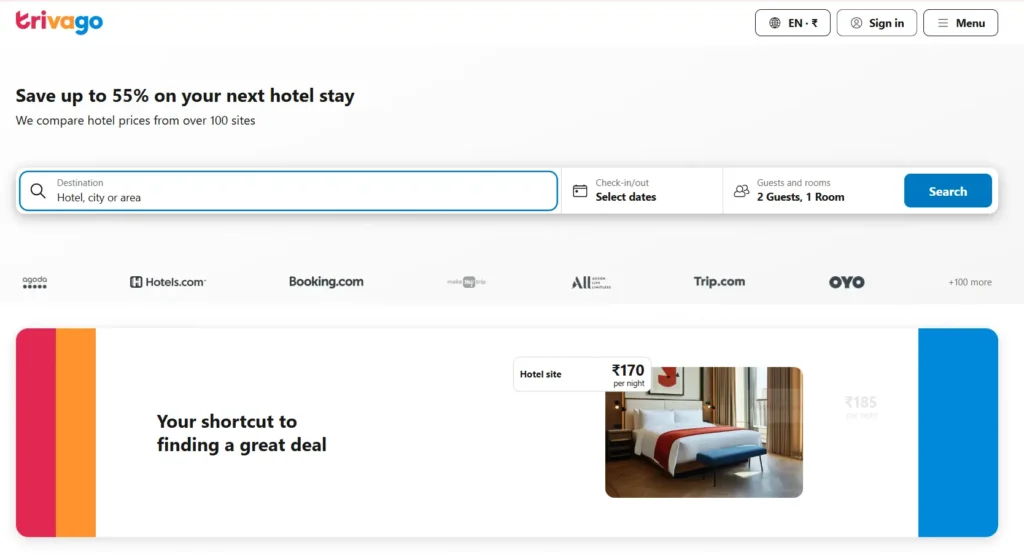
Trivago is probably one of the best-known dedicated hotel comparison engines.
Unlike a traditional online travel agency, Trivago’s primary job is comparison. You search for a destination, dates, and number of travelers, and it searches rates available through numerous hotel booking sources.
Trivago currently says it compares hotel prices from hundreds of websites.
That makes it particularly useful when the same property is being sold by several providers.
How to Use Trivago Effectively
Enter your destination and exact travel dates.
Instead of immediately clicking the cheapest hotel, first apply filters for the things that actually matter to your trip.
For example:
- Maximum nightly budget
- Guest rating
- Hotel category
- Distance from your preferred location
- Breakfast
- Pool
- Parking
- Wi-Fi
Once you find an interesting property, compare the available offers.
Don’t assume the lowest number automatically represents the best deal.
A $120 rate with no breakfast and no refunds could be worse than a $128 rate offering breakfast and free cancellation.
Trivago’s app also advertises price-drop notifications, which can be useful if your trip is several weeks or months away.
Pros
- Designed specifically for hotel comparison
- Searches a large number of booking websites
- Simple interface
- Good filtering system
- Useful price-drop features
Cons
- Usually redirects you elsewhere to complete the reservation
- Cheapest provider isn’t necessarily the best provider
- Rates can change after clicking through
Best for: Travelers who want to quickly compare prices for a specific hotel across multiple booking websites.
3. KAYAK: Best for Advanced Hotel Search and Price Alerts

KAYAK Hotels is another powerful hotel metasearch engine.
KAYAK says its hotel search checks prices across hundreds of travel websites. Once you select an offer, you generally complete the reservation on the provider’s website rather than with KAYAK itself.
That basic model is similar to Trivago, but KAYAK provides particularly useful search and tracking tools.
Price Alerts Are a Major Advantage
One feature I like is Price Alerts.
Instead of searching for the same hotel every morning to see whether the rate has fallen, you can create an alert for your search.
KAYAK explains that users can set hotel Price Alerts through their account or directly from hotel search results.
This can be especially useful when you’re planning:
- An international vacation months in advance
- A honeymoon
- A major city break
- A business trip
- A stay during a large festival or sporting event
KAYAK also provides filters for exclusive deals, including certain member and private rates.
Pros
- Searches hundreds of travel websites
- Strong filtering options
- Price Alerts
- Map-based search
- Useful for flights, hotels, and rental cars
- Verified guest reviews
Cons
- Usually redirects you to another company
- Number of options can feel overwhelming
- The cheapest offer may have restrictive cancellation rules
Best for: Travelers who enjoy researching deals and want to monitor hotel prices before booking.
4. HotelsCombined: Best for Straightforward Hotel Comparison

HotelsCombined has built its reputation around a simple concept: search multiple accommodation providers rather than making travelers check them individually.
If you’ve already chosen your destination and dates, HotelsCombined can be a quick way to see how hotel rates compare.
The experience is particularly useful when you’re trying to answer one basic question:
“Is this hotel actually cheaper somewhere else?”
When HotelsCombined Is Most Useful
Suppose you find a hotel you like for $175 per night.
Before booking, search the exact hotel on HotelsCombined. You may discover that another provider offers the same room for less.
But make sure you’re comparing identical products.
Check:
Room type: Standard, Deluxe, King, Twin, Suite, etc.
Cancellation policy: Refundable and non-refundable prices shouldn’t be compared as if they’re identical.
Meals: One offer may include breakfast while another doesn’t.
Taxes: Some providers display taxes earlier in the booking process than others.
Pros
- Simple hotel-focused search
- Good for comparing multiple providers
- Useful filters
- Easy way to double-check an existing hotel deal
Cons
- Final reservation may happen on a third-party website
- Not every offer has identical conditions
- Provider quality varies
Best for: Travelers who already have a hotel in mind and want to check whether another booking source has a better rate.
5. Skyscanner Hotels: Best for Comparing Your Whole Trip
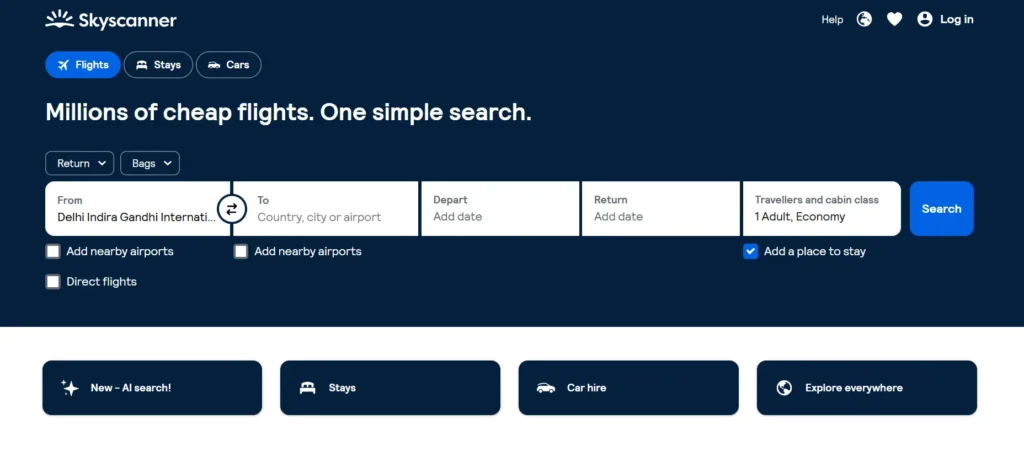
Most travelers know Skyscanner for flight comparison, but it can also be used for hotels.
This makes Skyscanner particularly convenient when you’re researching an entire trip rather than accommodation alone.
You can research your flight first and then check hotels without switching to a completely different travel ecosystem.
Who Should Use Skyscanner Hotels?
Imagine you’re planning a week in Tokyo.
You can compare flights, determine your arrival and departure dates, and then search accommodation for those exact dates.
That creates a smoother planning process.
Skyscanner can also be useful for travelers who are still comparing destinations.
Perhaps flights to one city are $250 cheaper, but hotels cost $100 more per night. Looking at both expenses gives you a much better idea of the real cost of the trip.
Pros
- Familiar, easy-to-use interface
- Flights and hotels in one place
- Useful filters
- Good international coverage
- Convenient for trip planning
Cons
- Hotel comparison isn’t its only focus
- Deals come from third-party providers
- Final prices still need to be verified
Best for: Travelers comparing both flights and accommodation.
6. Tripadvisor: Best for Comparing Prices and Reviews Together

Tripadvisor takes a slightly different approach.
Hotel price matters, but price alone doesn’t tell you whether you’ll actually enjoy staying there.
Tripadvisor is particularly useful because you can research traveler reviews, photos, rankings, location information, and booking offers in the same place.
Why Reviews Matter During Price Comparison
Suppose Hotel A costs $105 and Hotel B costs $118.
Hotel A initially looks better.
But then you discover recent guests repeatedly complain about:
- Street noise
- Poor cleanliness
- Weak air conditioning
- Construction
- Bad Wi-Fi
- Long walks to public transport
Suddenly, saving $13 doesn’t look particularly attractive.
This is why hotel comparison should focus on value, not simply the lowest rate.
Tripadvisor is useful for creating that broader picture.
Pros
- Huge collection of traveler reviews
- User-uploaded photos
- Hotel price comparisons
- Restaurant and attraction information
- Useful destination research
Cons
- Large number of reviews can become overwhelming
- Prices may change after clicking to another website
- Lowest price isn’t always displayed with identical booking conditions
Best for: Travelers who care equally about hotel quality and price.
7. Momondo: Best Alternative Comparison Engine
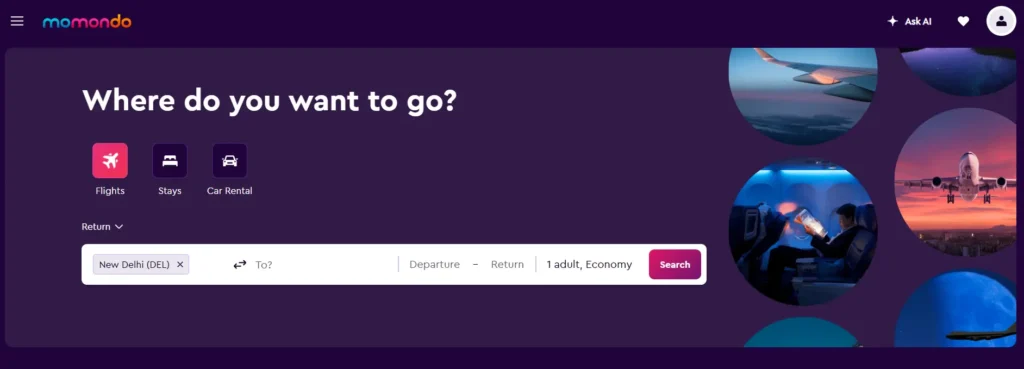
Momondo Hotels is another option worth adding to your comparison routine.
Like KAYAK and Skyscanner, Momondo is better known for travel metasearch than hotel booking itself.
The main reason to use another comparison engine isn’t because it will always be cheaper.
It’s because hotel prices vary across platforms.
Academic research examining London hotels found persistent price dispersion between booking platforms, even for comparable hotel rooms.
That means running the same search through another engine can occasionally uncover an offer you didn’t see elsewhere.
Pros
- Clean travel-search interface
- Hotel and flight comparison
- Useful for international trips
- Another source for verifying whether you’ve found a competitive rate
Cons
- Hotel search isn’t as specialized as Trivago
- You may still need to visit several providers
- Cheapest displayed rate isn’t automatically the best deal
Best for: Travelers who want a second opinion before finalizing a hotel reservation.
How to Compare Hotel Prices Correctly
Finding the lowest number on your screen is easy.
Finding the best final deal requires a little more work.
Here’s the method I recommend.
Step 1: Start With Google Hotels
Search your destination and dates.
Use the map and filters to create a shortlist of three to five hotels.
Step 2: Search Your Shortlisted Hotel on Trivago or KAYAK
Now compare the same property across multiple booking providers.
Don’t compare different room categories.
Step 3: Compare the Total Stay Price
A hotel advertising “$99 per night” doesn’t necessarily cost $297 for three nights.
Taxes, resort fees, service charges, cleaning fees, and other mandatory charges can change the final amount.
Always reach the checkout page before deciding which offer is cheaper.
Step 4: Compare Cancellation Conditions
A non-refundable $500 reservation isn’t necessarily better than a refundable reservation costing $525.
If your plans aren’t fixed, paying slightly more for flexibility can be worthwhile.
Step 5: Check the Hotel’s Official Website
This is one of the most overlooked hotel-booking strategies.
After finding the best OTA price, search the hotel’s official website.
Hotels sometimes provide:
- Member discounts
- Free breakfast
- Complimentary Wi-Fi
- Flexible cancellation
- Room upgrades
- Hotel credits
- Loyalty points
Even if the direct price is slightly higher, the additional benefits can make it a better deal.
Pro-Tips for Finding Cheaper Hotel Deals
Professional deal hunting isn’t about finding one “secret” website. It’s about comparing prices intelligently.
1. Compare total cost, not nightly rate.
A cheap headline rate can become expensive after taxes and mandatory fees.
2. Check the hotel’s website before paying.
A comparison engine should often be your research tool, not automatically your final booking destination.
3. Compare like-for-like rooms.
Check room size, bed type, breakfast, refundability, taxes, and payment terms.
4. Use refundable reservations strategically.
If your hotel offers free cancellation, you can secure a reasonable rate and continue checking prices. If the same room becomes cheaper and your original terms permit cancellation, you may be able to rebook.
5. Search in the hotel’s local currency.
Currency conversion can sometimes make prices look different. Also check whether your payment card charges foreign transaction fees.
6. Look at the map before chasing a bargain.
Saving $20 per night isn’t useful if you spend another $30 every day traveling to the places you want to visit.
7. Don’t trust an unfamiliar provider solely because it’s cheapest.
A small saving isn’t always worth creating a more complicated reservation if something goes wrong.
Which Hotel Comparison Website Is Best?
If I had to build a simple hotel-search routine, I’d use three stages:
Start with Google Hotels to understand prices, neighborhoods, and direct-booking options.
Then use Trivago or KAYAK to compare the same shortlisted hotels across additional booking providers.
Finally, visit the hotel’s official website and compare the direct rate with your best third-party offer.
That takes a few extra minutes, but for a five-night stay, even a modest nightly difference can produce meaningful savings.
Frequently Asked Questions
1. What is the best website to compare hotel prices?
Google Hotels is one of the strongest starting points because it combines hotel prices, maps, filters, reviews, and direct-hotel offers. Trivago and KAYAK are excellent secondary searches for comparing rates across multiple providers.
2. Is Trivago actually cheaper than Booking.com?
Not necessarily.
Trivago is primarily a comparison engine. It can show rates from different booking providers, potentially including Booking.com and competitors. The cheapest provider can change depending on hotel, destination, dates, room type, and promotions.
3. Is Google Hotels a booking website?
Google Hotels mainly functions as a hotel discovery and comparison service. After selecting an offer, you’ll commonly continue to a hotel or travel provider to make the actual reservation.
4. Why does the same hotel have different prices on different websites?
Rates can vary because of negotiated agreements, promotions, member pricing, currency conversion, inventory, cancellation conditions, room packages, and platform-specific discounts.
That’s why comparing identical rooms and conditions is essential.
5. Is booking directly with a hotel cheaper?
Sometimes.
Direct booking can offer a lower price, but even when it doesn’t, hotels may provide additional benefits such as breakfast, loyalty points, upgrades, credits, or better cancellation conditions.
Always check.
6. When should I book a hotel to get the cheapest price?
There is no universal booking window.
Rates depend on destination, season, events, occupancy, and demand. Instead of relying on rules such as “always book on Tuesday,” start monitoring your destination early and use price alerts when available.
7. Are hotel price comparison websites free?
Major hotel metasearch engines are generally free for travelers to search. They typically make money through advertising, referrals, or commercial relationships with travel providers rather than charging travelers a search fee.
8. Should I choose the cheapest hotel booking provider?
Not automatically.
Compare the provider’s reputation, refund policy, payment terms, customer support, taxes, and cancellation conditions.
Saving $8 on a $900 hotel reservation probably isn’t worth choosing a provider you don’t trust.
Final Thoughts: Compare Before You Book
Hotel prices aren’t fixed across the internet.
The same property, room, and travel dates can produce different rates depending on where you search and which booking conditions are attached.
That’s why using the best hotel price comparison websites can make a real difference.
For most travelers, Google Hotels is an excellent starting point, while Trivago and KAYAK provide additional price-comparison power. HotelsCombined, Skyscanner, Tripadvisor, and Momondo are also useful when you want to verify that you’ve found a competitive deal.
Most importantly, don’t stop when you see a cheap headline price.
Compare the final price, room type, taxes, cancellation policy, included extras, and direct hotel rate.
Five or ten minutes of comparison can save considerably more than spending hours hunting for questionable coupon codes.
Before booking your next hotel, open two comparison websites, check the hotel’s official rate, compare the final totals, and then book the offer that provides the best combination of price, flexibility, and reliability.