
For years, Booking.com was primarily associated with one simple task: finding a hotel. In 2026, that description is far too narrow.
The platform has evolved into a broader travel marketplace where users can search for accommodation, flights, rental cars, airport taxis, attractions, and other parts of a trip. This fits into the wider “Connected Trip” concept: reducing the need for travelers to jump between multiple websites while planning, booking, managing, and changing a journey.
That scale remains one of Booking.com’s biggest competitive advantages. A traveler can search for a five-star hotel in Dubai, an apartment in Barcelona, a hostel in Bangkok, or a small family-run guesthouse in Vietnam through essentially the same interface.
At the same time, Booking.com has become more complicated. Genius discounts, mobile-only discounts, dynamic hotel pricing, AI-driven travel tools, business travel features, sustainability certifications, and dozens of filters mean that two travelers searching for the same city can have very different booking experiences.
For property owners, the platform is equally complex. Getting listed is only the beginning. Visibility, conversion, availability, pricing, reviews, promotions, Genius participation, and commission strategy can all influence performance.
This guide explains how Booking.com works in 2026 from both sides of the marketplace, and more importantly, how to use it intelligently.
Quick Verdict: Booking.com remains one of the strongest all-purpose online travel agency platforms for travelers who value accommodation choice, flexible booking options, verified guest reviews, and loyalty discounts. However, the smartest users should still compare the final price against direct hotel rates and competing OTAs before paying.
The Booking.com Genius Loyalty Program: 2026Update
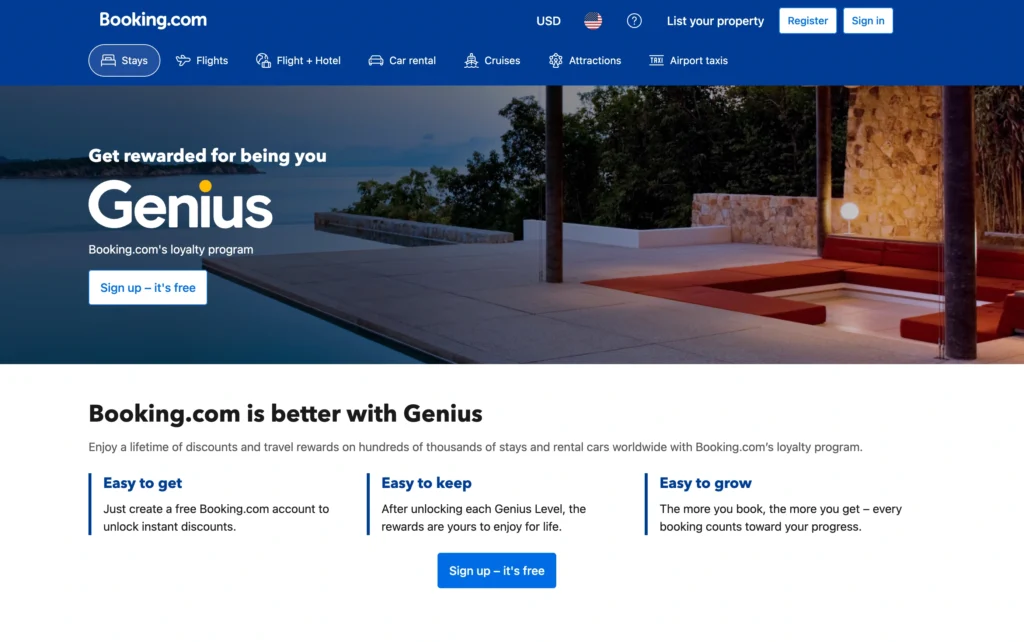
The Genius program is one of the most important features for frequent Booking.com users.
Unlike traditional hotel loyalty programs where travelers may need to collect points or maintain status every year, Genius is free and based largely on completed bookings.
There are three main levels.
Genius Level 1
Creating a free Booking.com account unlocks Genius Level 1.
The headline benefit is:
- 10% discount on select stays
- 10% discount on select rental cars
The important word is select.
A Genius account does not automatically make every hotel 10% cheaper. Properties must participate in the program, so you should look for the blue Genius label in search results.
For an occasional traveler taking one or two trips per year, Level 1 is still useful because there is essentially no membership cost.
Genius Level 2
Regular travelers can move to Level 2 after completing five eligible bookings within two years.
Benefits can include:
- 10% to 15% discounts on participating stays
- 10% to 15% discounts on select rental cars
- Free breakfast at participating properties
- Complimentary room upgrades at select properties
The breakfast benefit can be more valuable than the headline discount.
Imagine booking four nights in Rome for two people. If breakfast normally costs €18 per person each morning, complimentary breakfast could theoretically represent €144 in additional value over the stay.
Similarly, a complimentary upgrade from a standard room to a superior room may be worth more than an additional 5% discount.
Genius Level 3 Perks
Genius Level 3 is the highest regular Genius tier.
Travelers generally reach it after completing 15 eligible bookings within two years.
Benefits include:
- 10% to 20% discounts on select stays
- 10% to 15% discounts on select rental cars
- Free breakfast at select properties
- Complimentary room upgrades at participating properties
- Priority support for stays
The particularly attractive part is status retention.
Booking.com states that members are not demoted after unlocking a Genius level. In other words, once you reach the higher tier, its status benefits are yours for life.
That makes Genius different from airline and hotel elite programs that typically require annual spending, nights, flights, or points to retain status.
Is Genius Level 3 Actually Worth It?
Yes, but with an important qualification.
Do not assume a Genius rate is automatically the cheapest rate available on the internet.
The discount percentage is calculated against the property’s applicable Booking.com price. Another OTA, a hotel membership program, promotional package, or direct booking rate could still produce a lower final price.
The best strategy is simple.
Find the property while signed into your Genius account, note the final price including taxes and fees, and then compare it with the hotel’s direct website and one or two major competitors.
Do not compare the advertised discount percentage. Compare the amount that will actually leave your bank account.
Host’s Perspective: Is Genius Worth the Margin Hit?
Genius works very differently from the property owner’s side.
Participating properties offer discounts to eligible Booking.com customers, effectively accepting a lower room rate in exchange for potentially stronger visibility and conversion.
Consider a simplified example.
A hotel normally sells a room for $150. Offering a 10% Genius discount reduces the rate to $135 before considering other promotional or commission costs.
That sounds painful.
However, an empty room produces $0.
If Genius participation helps a property improve occupancy during weak periods, attract repeat Booking.com users, or compete more effectively against similar hotels, the lower rate may still produce better overall revenue.
The key is not to treat Genius as a permanent solution for every room and date.
Independent owners should monitor:
- Average daily rate
- Occupancy
- Net revenue after commission and discounts
- Genius versus non-Genius conversion
- Length of stay
- Cancellation rate
- Seasonal demand
During extremely high-demand dates, aggressive discounting may be unnecessary. During shoulder seasons, the additional visibility may be far more valuable.
AI-Powered Travel Planning on Booking.com in 2026
Search is changing.
Traditional OTA search begins with structured information:
Destination → Dates → Travelers → Filters → Results
AI-driven travel search begins with intent.
Instead of telling Booking.com exactly where you want to stay, you can increasingly describe what kind of trip you want.
Booking.com originally launched its AI Trip Planner in 2023, combining its existing machine-learning recommendation systems with large language model technology. Since then, Booking.com has expanded generative AI deeper into the travel-planning experience.
How the AI Trip Planner Works
Imagine you are a digital nomad planning a month in Europe.
Traditional search requires you to research cities first.
An AI-driven query can start much earlier:
“I need an affordable European city for three weeks with reliable public transport, coworking options, good nightlife, and apartments under €120 per night.”
That is an intent-based query.
The system can interpret the requirements and surface destinations and accommodation options that fit them.
You could then refine the request:
“Make it warmer and closer to the beach.”
Instead of restarting the search, conversational AI can use the context of the earlier request.
Intent-Based Search vs. Keyword Search
Keyword search works best when you already know what you want.
For example:
Hotels in Barcelona
Intent-based search is more useful when your needs are complicated:
A quiet Barcelona hotel for remote work with strong Wi-Fi, a desk, gym, breakfast, and easy metro access to the Gothic Quarter.
Booking.com has also developed AI-powered Smart Filters that allow travelers to describe accommodation requirements using natural language.
That is particularly useful because hotels have dozens of attributes.
Instead of manually checking boxes for gym, parking, pool, Wi-Fi, location, view, breakfast, and room type, natural-language search can interpret multiple preferences together.
Generative AI Across the Booking Journey
AI is no longer limited to destination inspiration.
Booking.com has introduced AI-powered features around review summaries, property questions, trip support, voice support, and guest-property communication.
For travelers, one of the most useful applications is review analysis.
A hotel may have 4,000 reviews. Reading them individually is unrealistic.
AI-generated summaries can help identify recurring themes such as:
- Excellent breakfast
- Small rooms
- Street noise
- Helpful staff
- Weak Wi-Fi
- Convenient metro access
That does not mean travelers should blindly trust an AI summary.
For an expensive booking, manually read several recent reviews, particularly the negative ones.
AI Is Best Used for Discovery, Not Final Verification
AI-driven travel tools are excellent for narrowing hundreds of choices to a manageable shortlist.
But before booking, manually verify:
- Exact room type
- Cancellation conditions
- Taxes
- Resort or destination fees
- Breakfast inclusion
- Bed configuration
- Parking charges
- Check-in requirements
- Distance from key attractions
Use AI as your research assistant, not as a replacement for checking the booking conditions.
Booking.com for Business: A Serious Tool for SMEs
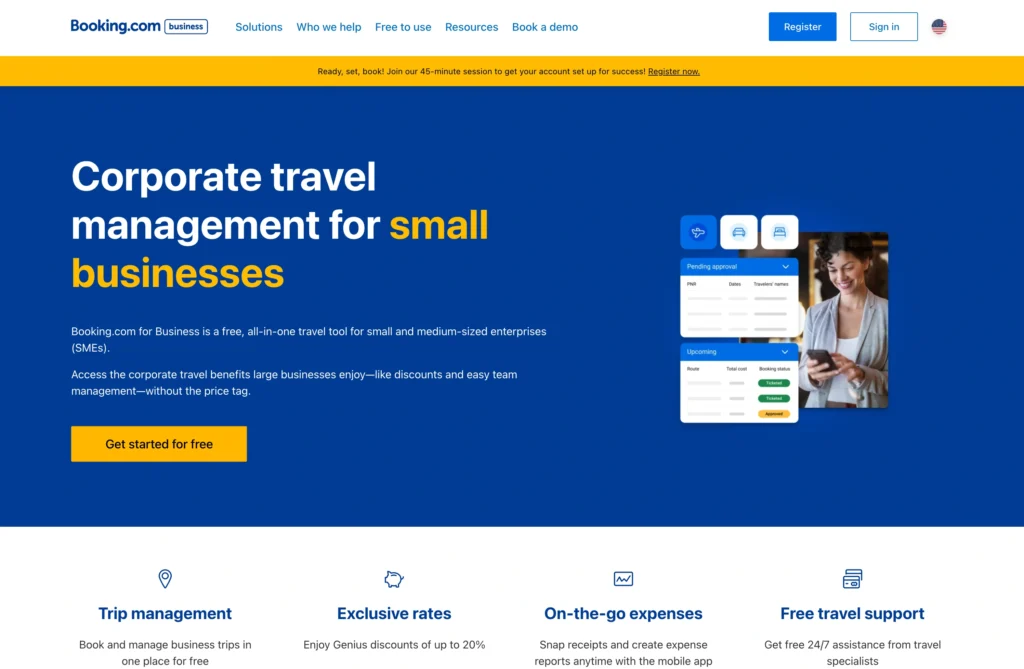
Booking.com is not limited to leisure travelers.
Booking.com for Business is designed for organizations that need a more centralized way to manage employee travel.
Businesses can manage accommodation, flights, and rental car bookings while providing travel managers with greater visibility over company trips.
Why SMEs Should Pay Attention
Large corporations often use expensive travel-management systems.
Small businesses may not need that level of infrastructure.
Booking.com for Business provides features such as:
- Centralized business travel management
- Traveler profiles
- Company payment cards
- Hotel budget settings
- Role and access management
- Trip visibility
- Spend oversight
- Accommodation, flight, and rental-car booking
- Genius benefits
Companies can also add VAT or GST information during the accommodation booking process so it can be shared with the property for invoicing.
There is an important distinction here: Booking.com for Business does not itself issue the accommodation invoice. The property issues it. Travelers or managers can request the invoice through the platform.
Expense Management and Traveler Visibility
The platform’s Traxo functionality can provide a broader view of employee itineraries, including travel booked through other sources.
It can also work with expense-management services such as Expensify, helping companies reduce manual expense reporting.
This is particularly useful for a 30-person consulting company where employees regularly travel between London, Amsterdam, Berlin, and Paris.
Instead of collecting travel details through email chains and spreadsheets, travel managers can centralize more of the process.
The Rise of Bleisure Travel
Business and leisure travel increasingly overlap.
An employee might attend a conference in Singapore from Monday to Thursday, then stay until Sunday for personal sightseeing.
Booking platforms have adapted to this behavior.
For a bleisure trip, travelers should prioritize properties with:
- Reliable Wi-Fi
- Work desks
- Flexible cancellation
- Breakfast
- Laundry facilities
- Good public transportation
- Fitness facilities
- Central leisure attractions
For example, a business traveler visiting Bangkok may choose a hotel near the BTS network rather than staying directly beside the meeting venue. That can make business meetings manageable during the week while improving access to restaurants, shopping, and attractions afterward.
Expert Booking Strategies: How to Pay Less in 2026
Finding a cheap hotel is not about discovering one magical booking day.
It is about stacking multiple advantages while maintaining flexibility.
1. Check Mobile-Only Discounts
One of the easiest budget travel tips for 2026 is comparing the Booking.com app against the desktop website.
Participating properties can offer special mobile rates designed to convert smartphone users.
A mobile-only rate may provide around 10% or more savings depending on the specific promotion and property.
Suppose a hotel in Tokyo is:
Desktop rate: $210 per night
Mobile rate: $189 per night
Across five nights, that is a $105 difference.
If the property also qualifies for Genius benefits or another compatible promotion, the effective savings can become more significant.
The practical rule is simple:
Never make an expensive Booking.com reservation without checking the app.
[Image: Desktop hotel rate compared with Booking.com mobile-only discount]
2. Compare the Final Price, Not the Headline Price
A $120 hotel is not necessarily cheaper than a $135 hotel.
Taxes and additional charges matter.
For example:
| Cost | Hotel A | Hotel B |
|---|---|---|
| Advertised rate | $120 | $135 |
| Taxes | $20 | Included |
| Resort fee | $25 | $0 |
| Breakfast | $20 | Included |
| Effective cost | $185 | $135 |
Hotel B initially appears $15 more expensive.
In practice, it is $50 cheaper.
This is especially important in destinations where taxes, resort charges, parking, or destination fees can substantially increase the final cost.
3. Understand Booking.com’s Price Match
Booking.com’s terms include a We Price Match policy for qualifying accommodation bookings.
The concept is straightforward.
If you book accommodation through Booking.com and subsequently find the same accommodation online for less under equivalent conditions, Booking.com may refund the difference if the claim meets its requirements.
The details matter.
The competing offer generally needs to match key conditions such as:
- Same property
- Same accommodation or room type
- Same dates
- Same cancellation conditions
- Same number of guests
- Comparable inclusions
- Publicly available online price
If one rate is non-refundable while your Booking.com reservation offers free cancellation, that is not an equivalent comparison.
How to Make a Strong Price Match Claim
Take screenshots immediately.
Capture:
- Property name
- Room type
- Stay dates
- Number of guests
- Cancellation policy
- Included meals
- Final price
- Link or source of the competing offer
Do not wait several days.
Hotel inventory and dynamic pricing change constantly. Booking.com’s terms indicate that the competing offer needs to remain available when checked.
4. Stop Looking for a Magical “Cheapest Tuesday”
Travel articles often claim that hotels are cheapest at a particular hour or weekday.
In 2026, that advice is too simplistic.
Modern hotel prices are dynamic.
Rates can change according to:
- Occupancy
- Search demand
- Local events
- Competitor pricing
- Remaining inventory
- Season
- Cancellation patterns
- Length of stay
- Booking window
- Promotions
There is no universal hour when Booking.com suddenly becomes cheapest worldwide.
A hotel in Las Vegas, a beach resort in Bali, and a business hotel in Frankfurt operate under completely different demand patterns.
5. Use Flexible Cancellation as a Pricing Tool
One of the smartest strategies is to reserve a good refundable rate early and continue monitoring prices.
Suppose you book Barcelona six months ahead for €190 per night with free cancellation.
Two months later, the same category falls to €155.
If your booking conditions permit it, you can make the cheaper reservation and cancel the original.
The potential saving across four nights is €140.
This approach gives you protection against rising prices without completely giving up the possibility of benefiting from falling rates.
Always secure the replacement reservation before canceling the original.
6. Search One Day Either Side
Hotel pricing can change dramatically between dates.
A four-night stay from Thursday to Monday could cost significantly more than Friday to Tuesday because of a major conference, football match, festival, or holiday.
If your itinerary is flexible, compare:
- One day earlier
- One day later
- Different lengths of stay
- Weekday versus weekend combinations
This matters especially in cities with large event calendars such as Las Vegas, Dubai, Singapore, Barcelona, London, and New York.
7. Use the Map, Not Just the Ranking List
The cheapest property is useless if you spend the savings on transportation.
Map search is particularly useful in sprawling cities.
In Bangkok, being close to a BTS or MRT station can be more useful than simply being geographically close to an attraction.
In London, staying slightly outside Zone 1 near a fast Underground line may produce better overall value than choosing the cheapest central hotel.
8. Compare Genius, Mobile, Direct and Competitor Prices
For a high-value reservation, create a four-way comparison:
| Rate Source | What to Check |
|---|---|
| Booking.com desktop | Standard baseline |
| Booking.com app | Mobile-only discounts |
| Genius account | Loyalty pricing and perks |
| Hotel direct | Member rates and direct-booking perks |
Then compare the same room under equivalent cancellation and meal conditions.
This is much more reliable than assuming one platform always has the best last-minute hotel deals.
Sustainable and Eco-Friendly Travel on Booking.com
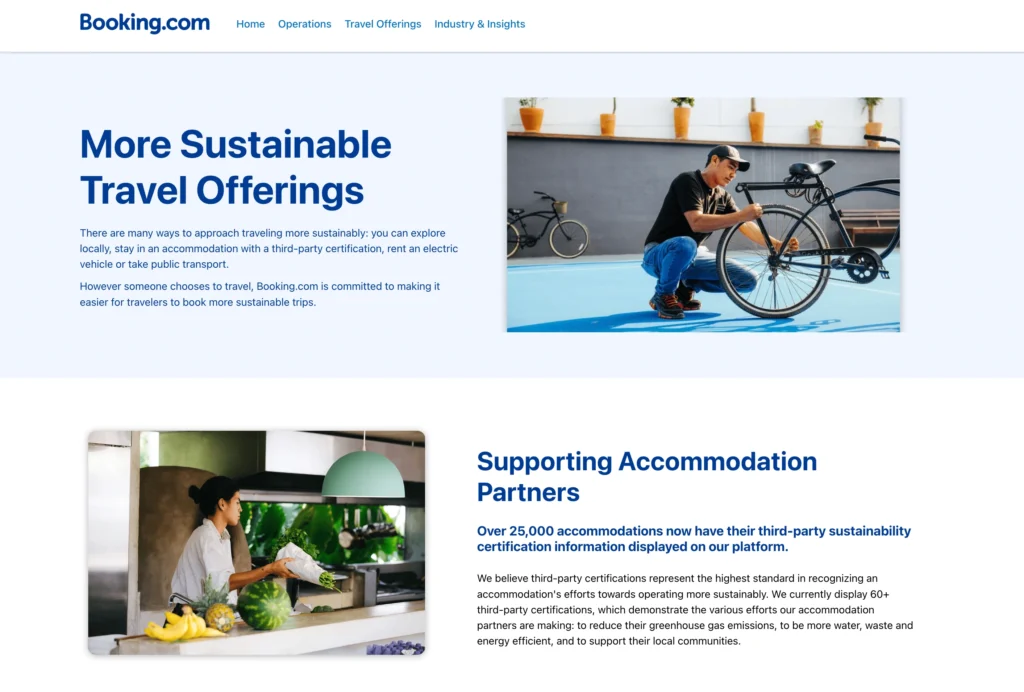
There is an important 2026 update travelers need to understand.
Booking.com previously used its own Travel Sustainable badge and levels to highlight properties implementing certain sustainability practices.
That system has changed.
Booking.com announced in 2024 that the Travel Sustainable name, logo, and levels would no longer be displayed as before. Instead, the platform shifted toward giving greater visibility to accommodations with credible third-party sustainability certifications.
This is a meaningful change.
Rather than Booking.com creating its own consumer-facing sustainability level, travelers can increasingly look for properties recognized through external certification systems.
[Image: Booking.com property page displaying third-party sustainability certification]
For travelers who care about sustainability, look beyond the badge itself.
Consider:
- Public transportation access
- Renewable energy practices
- Waste reduction
- Water conservation
- Local sourcing
- Single-use plastic reduction
- Bicycle facilities
- Third-party environmental certification
Also consider location.
A highly efficient hotel requiring a rental car for every journey may not necessarily produce a lower-impact trip than a centrally located certified property connected to trains, buses, or cycling infrastructure.
Booking.com Property Owner’s Guide
For independent hotels and property owners, listing on Booking.com creates access to a massive audience.
But visibility is competitive.
Simply uploading rooms does not guarantee bookings.
Ranking and Conversion Factors
Booking.com’s marketplace is designed to show travelers relevant properties that have a reasonable likelihood of converting.
Owners should therefore concentrate on fundamentals such as:
- Competitive rates
- Strong availability
- Accurate property information
- High-quality photographs
- Positive guest reviews
- Attractive booking conditions
- Fast communication
- Competitive room inventory
- Good conversion performance
A property with excellent photographs but poor availability cannot capture much demand.
Likewise, a cheap property with weak reviews and confusing policies may receive clicks without converting them into bookings.
Review Scores Matter
Reviews affect both trust and conversion.
Booking.com emphasizes reviews from guests who have actually booked through the platform, which makes the review score a particularly important piece of social proof.
An 8.8-rated independent hotel may outperform a similar 7.2-rated property even when the second hotel is slightly cheaper.
Owners should therefore treat reputation management as revenue management.
Respond professionally to problems and identify patterns.
If 15 guests mention poor Wi-Fi, the solution is not 15 clever responses.
The solution is better Wi-Fi.
Response Time Matters to Travelers
Fast responses reduce uncertainty.
Guests frequently ask about:
- Airport transfers
- Early check-in
- Late arrival
- Parking
- Extra beds
- Dietary requirements
- Luggage storage
Booking.com has also introduced AI-powered communication tools for partners, including Auto-Reply and Smart Messenger in supported markets.
Automation can help, but owners should still personally handle unusual or sensitive requests.
Visibility Booster
Booking.com also provides promotional tools that can help properties compete for greater exposure.
However, increased visibility should never be evaluated purely by the number of impressions generated.
Owners need to calculate the economics.
If a promotion increases bookings by 20% but destroys profitability through stacked discounts and higher acquisition costs, it may not be worthwhile.
Track net revenue per available room, not vanity metrics.
Booking.com vs. Airbnb vs. Expedia in 2026
| Category | Booking.com | Airbnb | Expedia |
|---|---|---|---|
| Traditional hotels | Excellent | Limited to Moderate | Excellent |
| Apartments & homes | Excellent | Excellent | Good |
| Loyalty | Genius | Limited traditional loyalty structure | One Key |
| Business travel | Strong | Moderate | Strong |
| Hotel filters | Excellent | Strong | Strong |
| Alternative stays | Excellent | Excellent | Good |
| AI-driven travel | Strong | Growing | Strong |
| Flexible hotel booking | Excellent | Varies | Excellent |
Booking.com wins most clearly when travelers want a huge selection of traditional hotels, apartments, hostels, guesthouses, and other accommodation types inside one search experience.
Airbnb remains particularly strong for distinctive homes and longer residential-style stays, while Expedia is compelling for travelers who like bundling hotels with flights and using the broader One Key ecosystem.
There is no universal winner.
For a two-night hotel stay in Paris, Booking.com may be the easiest starting point. For a month-long apartment in Lisbon, Airbnb deserves comparison. For a flight-and-resort package to Cancun, Expedia may be more attractive.
Frequently Asked Questions About Booking.com
1. Is Booking.com safer than Airbnb?
Both are major travel marketplaces, but their accommodation models differ. Booking.com has particularly deep traditional hotel inventory, while Airbnb is strongly associated with privately hosted homes and apartments. Regardless of platform, travelers should review recent guest feedback, property policies, payment terms, and cancellation conditions before booking.
2. Is Genius Level 3 permanent?
Yes. Booking.com states that it does not demote members after they unlock a Genius level. Standard Level 3 qualification requires 15 completed eligible bookings within two years. Genius Level 3 perks can include 10% to 20% discounts on select stays, free breakfast, room upgrades, and priority support.
3. Is Booking.com always cheaper than booking directly?
No. Genius and mobile-only discounts can make Booking.com extremely competitive, but hotels may occasionally offer attractive direct-booking packages, loyalty rates, credits, or other benefits. Always compare the final price and inclusions.
4. How do I get a refund from Booking.com?
Start by checking the cancellation conditions attached to your reservation. Refund eligibility depends heavily on the specific booking terms. Flexible bookings may allow free cancellation before a deadline, while non-refundable reservations may provide limited or no refund rights unless an exception applies.
5. Does Booking.com have mobile-only discounts?
Yes. Participating properties can offer special mobile rates. Travelers should compare prices in the Booking.com app with desktop rates, particularly for expensive or multi-night reservations.
6. How do I find last-minute hotel deals on Booking.com?
Search using accurate dates, compare nearby neighborhoods on the map, sign into your Genius account, check mobile rates, and evaluate both refundable and non-refundable options. Last-minute discounts are more likely when properties have unsold inventory, but prices can also rise sharply when demand is high.
7. Does Booking.com charge hidden fees?
Booking.com displays pricing information during the booking process, but taxes, destination charges, property fees, or other costs can vary by destination and property. Always review the complete price breakdown and payment conditions before confirming a reservation.
8. Is Booking.com for Business free?
Businesses can create a Booking.com for Business account and use the platform to manage employee travel. It includes traveler management, booking oversight, business travel features, Genius integration, and tools for monitoring spending and itineraries.
Final Verdict: Is Booking.com Worth Using in 2026?
Booking.com remains one of the strongest starting points for accommodation search in 2026.
Its real advantage is not simply cheap hotel rooms. It is the combination of enormous accommodation variety, verified guest reviews, Genius rewards, flexible booking options, mobile-only discounts, business travel tools, and increasingly sophisticated AI-driven travel features.
Frequent travelers should work toward Genius Level 3 naturally, while property owners should focus on conversion and net profitability rather than chasing visibility at any cost.
The best strategy is straightforward: use Booking.com to discover and compare, take advantage of Genius and mobile pricing, read the conditions carefully, and always verify the final price before paying.