
For travelers trying to organize an entire trip without jumping between airline websites, hotel portals, rental-car companies, and activity providers, Expedia remains one of the biggest all-in-one travel booking platforms available.
Introduction
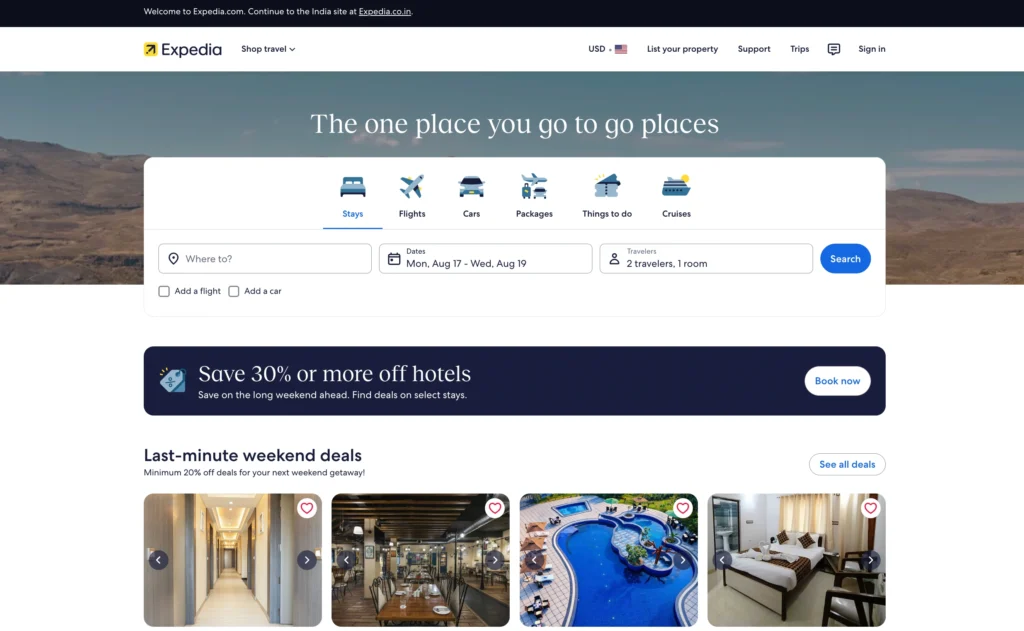
Expedia began in the 1990s as a Microsoft travel-booking project and eventually became part of what is now Expedia Group, one of the world’s major online travel companies. Today, the broader Expedia Group portfolio includes brands such as Hotels.com and Vrbo, while Expedia itself operates as a full-service online travel agency.
The platform covers most of the major pieces of trip planning, including:
- Flights
- Hotels and resorts
- Vacation rentals
- Rental cars
- Cruises in supported markets
- Airport transportation
- Tours and activities
- Flight + hotel vacation packages
Expedia’s biggest strength is not necessarily having the lowest price for every individual booking. Its real advantage is convenience and bundling. Travelers can put several components of a holiday into one account and manage them from a single Trips dashboard.
Expedia says eligible package bookings can produce substantial savings compared with purchasing the same components separately, although the actual saving depends heavily on the route, property, dates, and suppliers selected.
That makes Expedia particularly useful for holiday planners, families, frequent travelers, and anyone booking a multi-part trip.
However, there is an important trade-off.
Expedia is an intermediary. If an airline cancels your flight or a hotel disputes a refund, resolving the issue can sometimes involve both Expedia and the actual travel provider. Expedia’s own terms make clear that supplier-specific rules concerning cancellation, refundability, payments, and restrictions apply to bookings.
So, is the convenience worth that extra layer?
This Expedia review takes a closer look.
Core Features and Booking Experience

User Interface and Mobile App Usability
Expedia has one of the more polished interfaces among large online travel agencies.
The website organizes its major products into straightforward categories, while the mobile app puts bookings, notifications, itinerary information, rewards, and trip management in one place.
Searching for a hotel is particularly easy. Enter your destination, dates, and number of travelers, and Expedia produces a large list that can then be narrowed down.
Useful hotel filters generally include:
- Guest rating
- Star category
- Price range
- Property type
- Amenities
- Neighborhood
- Meal options
- Payment options
- Cancellation conditions
The map-based search is useful in large destinations. Instead of choosing a hotel simply because it says “London” or “New York,” for example, you can see approximately where it sits relative to the places you actually want to visit.
The mobile experience has another advantage: app-specific hotel offers can occasionally beat standard desktop pricing. Expedia advertises discounts of up to 20% on select hotels through app deals, though this should not be interpreted as a guaranteed 20% saving on every booking.
Booking Flow and Search Filters
Expedia’s standard booking process is straightforward:
- Choose a travel category, such as Stays, Flights, Cars, or Packages.
- Enter your destination and travel dates.
- Apply relevant filters rather than sorting only by price.
- Open individual results and examine cancellation and payment terms.
- Compare the total price, including displayed taxes and fees.
- Sign in to your Expedia account to access eligible member pricing and rewards.
- Review the final booking conditions carefully.
- Pay and save your confirmation details.
The important step is number seven.
The cheapest result is not automatically the best deal. A hotel that costs $20 less but is completely non-refundable may be a poor choice compared with a slightly more expensive flexible rate.
Flights require similar attention. Basic economy fares may exclude checked baggage, seat selection, changes, or refunds.
Expedia itself warns that package prices can exclude certain additional airline charges, including baggage-related costs, and that some fares are non-refundable.
Unique Selling Propositions (USPs) and Special Features
One of Expedia’s strongest features is Bundle & Save.
Instead of purchasing your flight, hotel, and rental car separately, Expedia can combine eligible components. Members can also start with one reservation and add certain travel products later while retaining access to eligible Bundle & Save offers.
For example, you could:
Book flight → add hotel later → add rental car → manage everything under one trip.
Expedia says Bundle & Save applies only to selected bookings, so travelers should compare the bundled total against separate bookings rather than assuming a package is always cheaper.
Another useful feature is Price Drop Protection on eligible flights. When available, Expedia can monitor the flight price after booking and provide the difference in OneKeyCash if the qualifying price falls before departure, subject to program conditions.
Comprehensive Feature & Service Breakdown
| Feature | Platform Availability | Best Use Case | Standout Capability |
|---|---|---|---|
| Hotels | Website + App | Almost all travelers | Huge inventory and detailed filters |
| Flights | Website + App | Domestic and international trips | Multiple airlines in one search |
| Vacation Packages | Website + App | Families and holiday planners | Potential bundled savings |
| Rental Cars | Website + App | Road trips | Compare multiple rental suppliers |
| Vacation Rentals | Website + App | Groups and families | Alternative to traditional hotels |
| Activities | Website + App | Complete itinerary planning | Book attractions alongside accommodation |
| One Key | Account based | Frequent users | Rewards across eligible Expedia Group bookings |
| Bundle & Save | Selected bookings | Multi-part trips | Add eligible components and potentially save |
| Price Drop Protection | Eligible flights | Price-sensitive travelers | Tracks eligible flight-price changes |
| Trips Dashboard | Website + App | Multi-booking travelers | Centralized itinerary management |
The strongest part of this ecosystem is the way these services connect.
Expedia says its Bundle & Save program includes access to more than 300,000 hotels, alongside cars, activities, airport transfers, and other travel products.
For someone arranging a two-week international vacation, that centralization can save a surprising amount of planning time.
Pricing, Hidden Fees, and Loyalty Programs
Transparency in Pricing and Payment Options
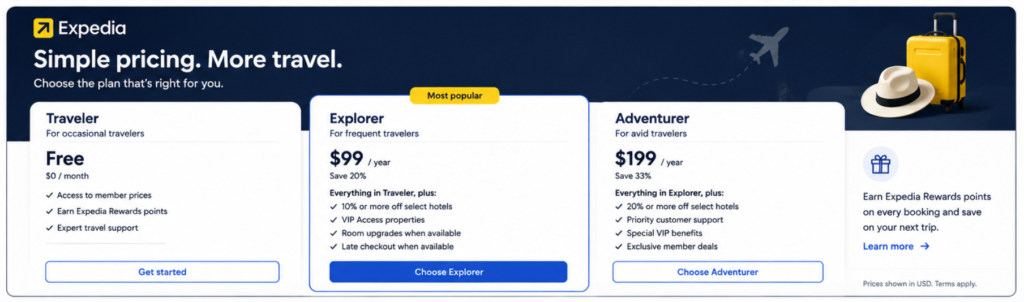
Expedia is free to search. There is no general membership fee required simply to compare hotels or flights.
Where pricing gets more complicated is at the supplier level.
| Cost Type | What to Expect | What to Check |
|---|---|---|
| Hotel rate | Nightly or total accommodation price | Taxes and cancellation terms |
| Resort/destination fees | May apply at selected properties | Whether payable online or at property |
| Airfare | Depends on airline and fare class | Baggage and seat fees |
| Car rental | Base price plus applicable taxes/fees | Insurance, fuel and deposits |
| Package | Combined travel price | Compare with booking separately |
| Cancellation fee | Depends on booking conditions | Read rules before payment |
| Currency costs | Can vary by payment method | Card FX/foreign transaction charges |
The biggest mistake is confusing the initial headline price with the final trip cost.
A cheap flight can become less attractive once baggage and seat selection are added. Similarly, a hotel may have property-level charges.
Expedia’s package terms explicitly note that additional fees may apply and baggage may not be included.
Reward System and Loyalty Benefits Breakdown
Expedia uses One Key, a loyalty ecosystem connected with Expedia, Hotels.com, and Vrbo in supported markets.
The standard tiers are:
| One Key Tier | Qualification | Typical Benefit Level |
|---|---|---|
| Blue | Join for free | Member pricing |
| Silver | 5 qualifying Trip Elements/year | Higher member savings and selected perks |
| Gold | 15 Trip Elements/year | Stronger hotel discounts and VIP benefits |
| Platinum | 30 Trip Elements/year | Highest tier benefits |
A qualifying Trip Element generally needs to meet the program’s minimum eligible value requirements. Expedia’s current terms set Silver at 5, Gold at 15, and Platinum at 30 Trip Elements within a calendar year.
Trip Elements can accumulate faster than you might expect.
Eligible hotel nights, flights, car-rental days, activities, and other qualifying components can count individually. Expedia has previously illustrated how a traveler combining hotel nights with a multi-day rental car can reach Silver status within one trip.
Higher tiers can also unlock enhanced benefits at eligible VIP Access properties, potentially including additional OneKeyCash earning and perks such as room upgrades where available.
OneKeyCash is useful if you already book frequently inside the Expedia ecosystem. It is much less compelling if you prefer to switch constantly between unrelated booking sites.
Cancellation, Refund, and Customer Support Policies
There is no single Expedia cancellation policy covering every reservation.
That distinction is extremely important.
Cancellation and refund rules can depend on:
- Airline
- Hotel
- Fare type
- Room rate
- Rental-car provider
- Travel dates
- Package conditions
- How close you are to departure
- Whether you purchased a refundable or non-refundable product
Expedia’s terms specifically state that the travel provider’s Rules and Restrictions apply alongside Expedia’s own terms.
This can become frustrating when something goes wrong.
Recent Reddit posts include travelers describing difficulties involving hotel cancellations, refunds, reservation discrepancies, and extended customer-support interactions. These are individual reports rather than evidence that every Expedia booking has such problems, but they demonstrate the potential disadvantage of having an intermediary between traveler and supplier.
Deep-Dive Analysis: Pros and Cons
Key Advantages (Pros)
- Excellent all-in-one booking ecosystem: Expedia can handle flights, hotels, cars, packages, and activities. That makes complex trips much easier to organize.
- Strong package-booking potential: Bundle & Save is one of Expedia’s biggest advantages. Eligible combinations can cost less than buying the same components independently, although savings vary.
- Powerful search filters: Hotel shoppers can quickly narrow hundreds of properties according to budget, location, rating, amenities, and cancellation preferences.
- Useful loyalty ecosystem: One Key adds meaningful value for travelers repeatedly booking through Expedia and associated participating brands.
- Good mobile experience: The app combines trip management with bookings and can provide app-specific accommodation offers.
- Useful for comparison shopping: Even if you ultimately book directly, Expedia provides a convenient way to compare multiple airlines and hotels from one interface.
- Good choice for vacation planners: Families arranging flights, accommodation, cars, and attractions can benefit significantly from keeping their itinerary together.
Major Drawbacks and Limitations (Cons)
- Third-party booking complications: When something goes wrong, you may need Expedia to coordinate with the airline or hotel instead of resolving the issue directly.
- Refunds can become complicated: Supplier rules determine many cancellation and refund outcomes, creating an additional layer of communication.
- Lowest displayed price is not always final cost: Baggage charges, resort fees, optional extras, car-rental costs, and other supplier fees can increase the effective price.
- Customer support receives mixed feedback: Online complaints frequently focus on complex refunds and difficulty resolving unusual booking problems. Expedia’s India-focused Trustpilot page, for example, currently shows a low score, although the sample is extremely small and therefore should not be treated as representative of Expedia’s worldwide customer base.
- Direct-booking benefits can sometimes be better: Hotel loyalty members may receive points, elite-night credits, upgrades, or other benefits only when booking directly. Airline changes may also be easier when the ticket was purchased directly from the carrier.
- Package savings are inconsistent: Expedia can offer excellent bundle prices, but its own terms make clear that savings vary and are not available on every package.
Expedia Pros and Cons at a Glance
| Pros | Cons |
|---|---|
| Excellent travel inventory | Third-party support layer |
| Convenient all-in-one booking | Refund disputes can take time |
| Strong vacation packages | Some extra charges are supplier-specific |
| One Key rewards | Direct-booking perks may be lost |
| Easy-to-use app | Package savings aren’t guaranteed |
| Detailed filters | Complex changes can be frustrating |
| Member and app deals | Supplier policies still control many bookings |
Detailed Comparison Matrix
The closest Expedia alternatives include Booking.com and Priceline. Priceline, for example, currently operates a VIP program offering member hotel and rental-car discounts, with higher tiers adding priority service and larger eligible savings.
| Parameter | Expedia | Booking.com | Priceline |
|---|---|---|---|
| Hotels | Excellent | Excellent | Excellent |
| Flights | Excellent | Good | Excellent |
| Vacation Packages | Excellent | Limited/market dependent | Excellent |
| Rental Cars | Excellent | Excellent | Excellent |
| Activities | Strong | Strong | Strong |
| Loyalty Program | One Key | Genius | VIP |
| Package Savings | Major strength | Not primary focus | Strong |
| Global Coverage | Excellent | Excellent | Strong |
| Cancellation Ease | Depends on supplier | Depends on property | Depends on supplier |
| Best For | Complete trips | Accommodation-heavy trips | Deal hunting |
| Overall Convenience | Excellent | Excellent | Very good |
Expedia is particularly competitive when a traveler wants several travel products in one transaction or itinerary.
Booking.com is extremely strong for accommodation discovery, while Priceline’s VIP system and deal-focused approach can appeal to travelers prioritizing discounts. Priceline currently advertises hotel savings of up to 50% for certain higher VIP tiers across eligible properties.
Is Expedia Safe and Legit?
Yes. Expedia is a legitimate mainstream online travel agency, not a scam website.
That does not mean every transaction will be problem-free.
The distinction is important because many negative reviews concern customer-service disputes, cancellations, or supplier communication rather than the legitimacy of Expedia itself.
Payment transactions may be handled by an Expedia-associated entity, travel provider, or third-party payment processor depending on the booking structure. Expedia’s terms also describe payment-method verification procedures such as pre-authorization.
Travelers should still take basic precautions:
- Use the official Expedia website or app.
- Avoid calling random “Expedia support” numbers found in advertisements or unofficial search results.
- Read cancellation conditions before paying.
- Screenshot important fare and refund terms.
- Confirm important hotel reservations directly with the property before major trips.
- Check airline baggage rules separately.
- Use a payment method with appropriate consumer protections.
- Keep booking confirmations until the trip is fully completed.
The warning about fake customer-support numbers is particularly important. Scam reports exist involving third parties pretending to represent Expedia and attempting to access travelers’ accounts.
For expensive international trips, confirming flights and hotels directly with the supplier a few days after booking is a sensible extra precaution.
Quick Verdict
- Ideal for: Travelers booking hotels, flights, cars, and activities together.
- Avoid if: You strongly prefer dealing directly with airlines or hotels when plans change.
- Best feature: Bundle & Save combined with Expedia’s broad travel inventory.
- Overall Expedia Rating: 8.3/10
Final Verdict
After examining Expedia’s booking tools, packages, loyalty ecosystem, pricing structure, and common customer complaints, the platform remains one of the strongest all-in-one travel-booking services in 2026.
Its biggest advantage is convenience.
A traveler can search for a flight, reserve a hotel, add a rental car, book airport transportation, purchase attraction tickets, and manage much of the trip from one account. For complicated holidays, that can be significantly easier than maintaining reservations across five separate companies.
Bundle & Save strengthens the proposition. Expedia allows eligible travelers to book travel components together or add qualifying items later, creating opportunities for discounts that may not exist when purchasing each component independently.
One Key gives frequent users another reason to stay within the ecosystem. Higher tiers can become especially interesting for travelers who regularly book hotels, flights, cars, and activities.
But Expedia’s greatest weakness is essentially the reverse of its greatest strength.
It sits between you and the travel provider.
When everything runs normally, this is barely noticeable. When a flight is cancelled, a hotel reservation is missing, or a refund becomes disputed, having another company in the communication chain can make resolution more complicated. Recent traveler reports continue to highlight this as a recurring frustration.
For straightforward, expensive flights where flexibility is crucial, booking directly with the airline can still be the safer option. Likewise, travelers chasing hotel-chain elite benefits should compare Expedia with the hotel’s own website.
For hotels, vacation packages, family holidays, and multi-component trips, however, Expedia becomes much more attractive.
The best strategy is therefore not to assume Expedia is always cheaper or always worse than booking directly. Use Expedia as both a comparison engine and a booking option. Compare the final price, cancellation terms, rewards, and direct-booking benefits before paying.
If Expedia offers a meaningful package discount or better flexible rate, it can be an excellent choice. If the price is identical to booking directly and flexibility matters, direct booking may provide a simpler support path.