
Introduction
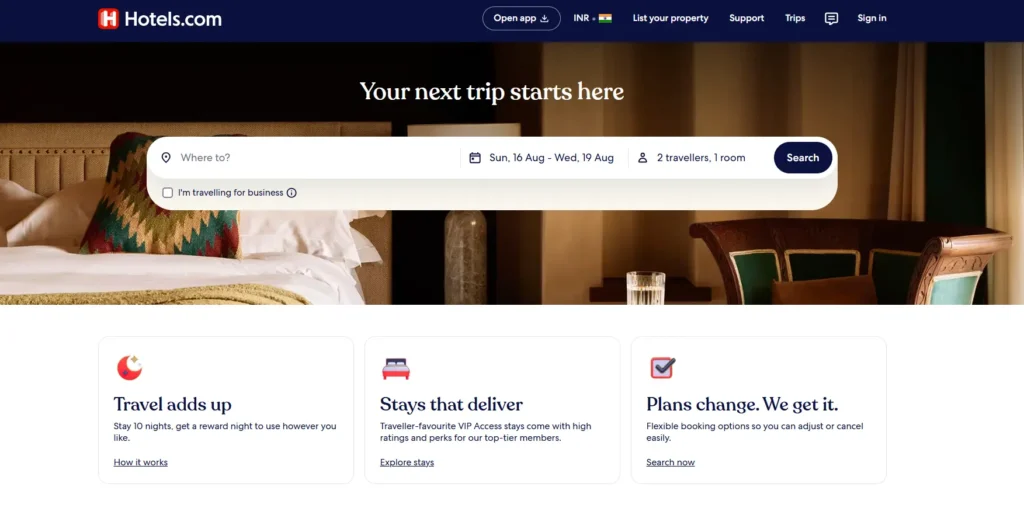
Hotels.com is one of the best-known online accommodation booking platforms, particularly for travelers who want to compare hotels, resorts, apartments, and other places to stay without checking dozens of individual hotel websites.
The platform is part of Expedia Group, the global travel company whose major consumer brands include Expedia, Hotels.com, and Vrbo. Expedia Group reported access to millions of lodging properties across its broader travel ecosystem, giving Hotels.com considerable inventory and technology support.
Hotels.com originally built its reputation around one straightforward idea: make finding and booking accommodation easier. While Expedia is positioned as a broader trip-booking platform, Hotels.com remains much more accommodation-focused.
Depending on your country and the version of the platform you use, you may find access to:
- Hotels and resorts
- Apartments and aparthotels
- Vacation-style accommodation
- Guesthouses and hostels
- Car rentals in some markets
- Travel products connected to the wider Expedia Group ecosystem
For travelers who mainly need accommodation, this specialization is actually an advantage. The interface does not feel as overloaded as some full-service travel agencies.
Hotels.com is particularly useful for frequent travelers, couples, families, business travelers, and budget-conscious tourists who want to compare a large number of properties quickly.
Its biggest strengths are its enormous accommodation selection, useful filters, member pricing, flexible booking options, and rewards programs. Its biggest weakness is common to almost every major online travel agency: when a booking becomes complicated, dealing with a third party can sometimes be less straightforward than dealing directly with the hotel.
This Hotels.com review takes a closer look at the platform’s booking experience, pricing, rewards, cancellation policies, customer support, advantages, disadvantages, and overall value.
Core Features and Booking Experience
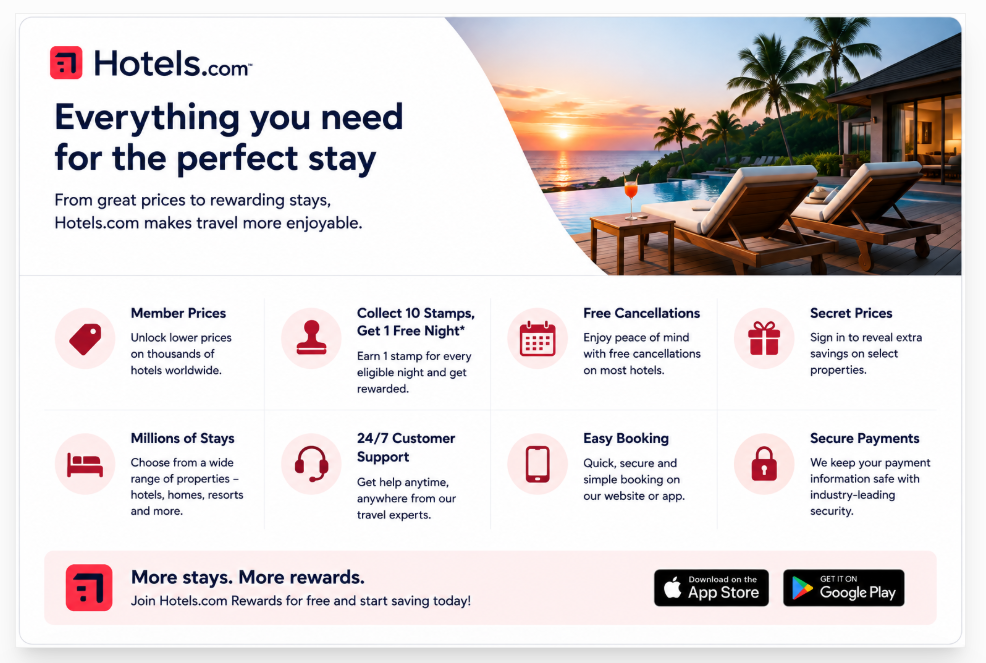
User Interface and Mobile App Usability
Hotels.com has one of the cleaner interfaces among large online travel agencies.
The main search process starts with the essentials:
- Destination
- Check-in date
- Check-out date
- Number of travelers
- Number of rooms
Once you enter these details, Hotels.com displays available accommodation with pricing, ratings, photographs, location information, and other important details.
The desktop experience is particularly good for research. Travelers comparing ten or twenty hotels can quickly move between listings and use filters to eliminate unsuitable properties.
The mobile app, meanwhile, is more convenient when you are already traveling.
It can be useful for:
- Checking upcoming reservations
- Making last-minute hotel bookings
- Viewing booking information
- Managing eligible reservations
- Accessing member offers
- Keeping travel information available from your phone
The design is relatively straightforward even for someone who does not regularly use travel-booking apps.
One area requiring attention is the displayed price. Travelers should always continue through the booking process far enough to understand the total cost, rather than making a decision based only on the first nightly rate they see.
Booking Flow and Search Filters
Hotels.com performs especially well when you know what kind of accommodation you want but have not selected a particular hotel.
You can search an entire city and gradually narrow hundreds of results into a manageable shortlist.
Common filters include:
- Price range
- Guest rating
- Property class
- Property type
- Neighborhood
- Amenities
- Meal options
- Payment options
- Fully refundable properties
- Popular traveler experiences
The availability of a fully refundable property filter is particularly helpful when your travel plans are uncertain. Hotels.com notes that individual properties establish their own cancellation conditions, meaning different rooms at the same hotel can have different cancellation rules.
The booking flow generally follows five steps:
- Search your destination and travel dates.
- Apply filters based on budget and requirements.
- Select a property and room type.
- Review cancellation, payment, taxes, and property conditions.
- Enter traveler and payment information and confirm.
Your booking confirmation contains essential information such as the booked travel service and price. Hotels.com says travelers who do not receive confirmation within 24 hours should contact its Help Center.
Unique Selling Propositions (USPs) and Special Features
Hotels.com has several features that distinguish it from simply booking directly with a hotel.
1. Accommodation specialization
Hotels.com remains strongly focused on places to stay. That makes it particularly effective when your main objective is hotel comparison rather than planning an entire trip.
2. Member pricing
Selected properties offer special prices to eligible members or app users. Availability depends on the property and travel dates.
3. Rewards
Loyalty benefits can make Hotels.com more valuable for repeat customers. However, the exact rewards system varies by market.
For example, the U.S. platform uses Expedia Group’s One Key ecosystem, while some international Hotels.com markets continue to display the traditional Hotels.com Rewards structure. Travelers should therefore check the loyalty program offered by their local Hotels.com site rather than assuming benefits are identical worldwide.
4. Price Guarantee
Hotels.com operates a Price Guarantee for qualifying bookings. If an eligible traveler finds the same accommodation option at the same property for the same dates at a lower price, there may be an opportunity to have the price matched or receive the difference, subject to the applicable conditions.
5. Flexible cancellation search
The ability to specifically search for refundable accommodation is valuable when booking several months in advance.
Comprehensive Feature & Service Breakdown
| Feature | Platform Availability | Best Use Case | Standout Capability |
|---|---|---|---|
| Hotel Search | Website & App | General accommodation | Large selection of property types |
| Advanced Filters | Website & App | Narrowing large searches | Filters for rating, price, amenities and flexibility |
| Member Prices | Selected properties | Budget-conscious travelers | Potential additional member savings |
| Rewards Program | Market dependent | Frequent travelers | Rewards toward future eligible stays |
| Mobile App | iOS & Android | Travelers on the move | Booking management and mobile convenience |
| Refundable Booking Filter | Website & App | Uncertain travel plans | Quickly identifies flexible rates |
| Guest Reviews | Property pages | Comparing similar hotels | Helps evaluate actual traveler experiences |
| Pay Now | Eligible properties | Travelers wanting costs settled | Payment generally collected when booking |
| Pay Later | Eligible properties | Travelers wanting payment flexibility | Property typically charges later |
| Price Guarantee | Qualifying bookings | Price-sensitive travelers | Potential price matching |
| Maps & Location Search | Website & App | City trips | Helps identify accommodation near preferred areas |
The overall feature set is strongest for travelers comparing accommodation rather than those trying to construct complicated multi-product itineraries.
Pricing, Hidden Fees, and Loyalty Programs
Transparency in Pricing and Payment Options
Hotels.com can offer competitive accommodation prices, but travelers should understand how online travel agency pricing works.
The price shown during the early search process may not always represent every cost associated with your stay.
Potential charges can include:
| Cost | When It May Apply | Paid To | What to Check |
|---|---|---|---|
| Room Rate | Every booking | Hotels.com or property | Total stay price |
| Taxes | Most bookings | Platform/property/government | Final checkout total |
| Service/F facilitation Fees | Certain bookings | Booking platform | Price breakdown |
| Resort Fees | Certain resorts/hotels | Usually property | Property fee information |
| Deposit | Selected hotels | Property | Check-in conditions |
| Parking | Selected properties | Property | Amenities/fee section |
| Breakfast | Rate dependent | Property | Whether included |
| Currency Conversion | International transactions | Bank/card issuer | Card’s FX conditions |
| Cancellation Fee | Restricted bookings | Depends on policy | Cancellation deadline |
Hotels.com’s terms explain that Pay Now accommodation rates can incorporate the amount charged by the travel provider along with a facilitation fee. Separate service fees may also apply depending on the booking.
With Pay Now, payment is generally charged when the reservation is made.
With Pay Later, the accommodation provider typically charges the traveler at the property or according to the schedule disclosed during booking.
One overlooked expense is foreign transaction or currency conversion fees. Hotels.com states that banks and card issuers may impose international transaction or currency conversion charges.
These charges come from your financial institution rather than necessarily being a Hotels.com fee.
Reward System and Loyalty Benefits Breakdown
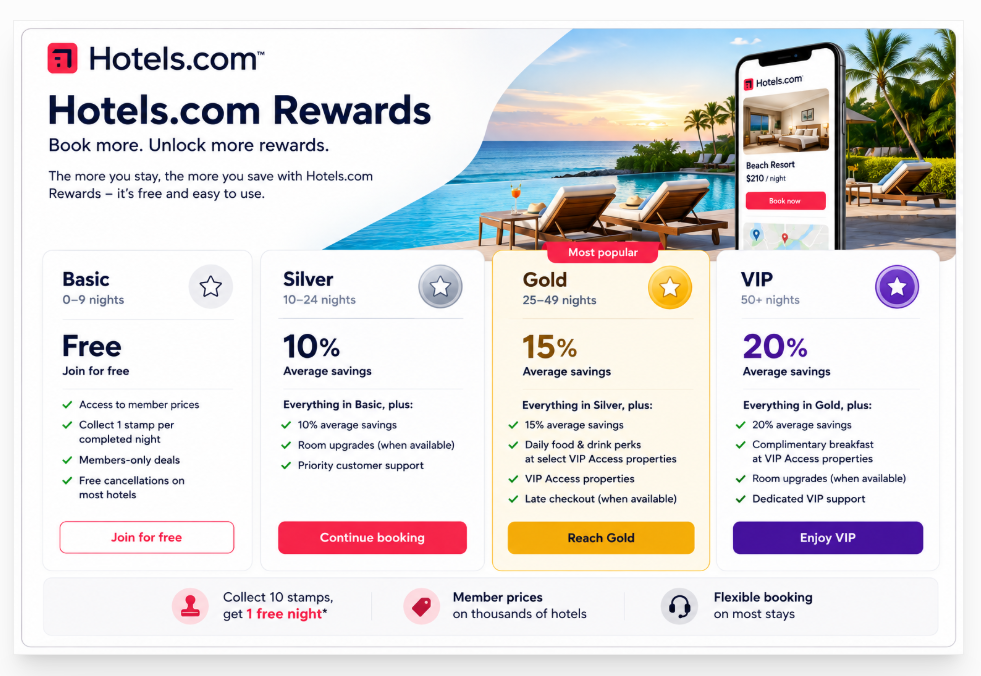
Rewards are one of the more complicated parts of evaluating Hotels.com because the system can differ by country.
In markets using One Key, travelers can earn OneKeyCash from eligible activity. Hotels.com states that $1 in OneKeyCash equals $1 toward eligible redemption. One Key membership is free.
Hotels.com’s newer Save Your Way feature also gives eligible One Key members an interesting choice on certain discounted hotel bookings:
- Apply the discount immediately, or
- Bank the discount as OneKeyCash for a future eligible booking.
Rewards banked this way become pending and, according to Hotels.com, generally become confirmed three days after completing the trip.
Some international markets continue to show the classic Hotels.com Rewards program.
Under that model, travelers collect one stamp for each eligible night. After collecting 10 stamps, they can receive a reward night based on the average value of those ten stamps, excluding taxes and fees.
Therefore, before evaluating Hotels.com specifically for loyalty rewards, check which rewards structure operates in your country.
Cancellation, Refund, and Customer Support Policies
Hotels.com does not have one universal cancellation policy for every hotel.
The individual property and selected rate determine the rules.
You may encounter:
- Fully refundable rates
- Partially refundable reservations
- Non-refundable reservations
- Cancellation deadlines
- No-show penalties
The cancellation conditions should appear before payment and again in your booking confirmation.
Hotels.com states that refunds for qualifying refundable accommodation are typically processed within 24 hours after cancellation, although the bank or card issuer may take additional time to make the money available.
The platform also provides a Help Center covering bookings, refunds and charges, account issues, security, loyalty, and other support topics.
One important warning: Hotels.com’s terms state that users do not automatically have the right to cancel or change a reservation unless the relevant travel provider’s rules permit it. An administration fee may also apply to certain changes or cancellations if disclosed before proceeding.
Deep-Dive Analysis: Pros and Cons
Key Advantages (Pros)
- Huge accommodation selection: Hotels.com benefits from Expedia Group’s enormous travel ecosystem. This makes it particularly useful when comparing accommodation across major cities and tourist destinations.
- Excellent filtering tools: Travelers can narrow results by budget, rating, location, amenities, property type, and cancellation flexibility.
- Good for flexible bookings: The fully refundable property filter makes it easier to avoid restrictive rates when your itinerary could change.
- Rewards for repeat customers: One Key or the applicable local Hotels.com Rewards program can increase long-term value for frequent users.
- Member pricing: Selected accommodation can offer lower member-only prices, making it worthwhile to sign in before comparing rates.
- Easy price comparison: Instead of checking twenty individual hotel websites, you can compare numerous properties from one search screen.
- Useful mobile experience: The app works particularly well for last-minute bookings and managing reservations while traveling.
- Price Guarantee: Eligible reservations can receive price-matching protection when qualifying lower rates are found elsewhere.
Major Drawbacks and Limitations (Cons)
- Third-party booking complications: Hotels.com sits between you and the accommodation provider. If something goes wrong, resolving the issue can involve communication between multiple parties.
- Cancellation conditions vary: Seeing “free cancellation” somewhere on the platform does not mean every reservation is refundable. Rules depend on the exact room and rate.
- Final cost needs careful checking: Taxes, service charges, resort fees, deposits, parking, breakfast, and other property-level costs can change the real cost of a stay.
- Loyalty system varies by market: The differences between One Key and legacy Hotels.com Rewards can be confusing for international travelers.
- Refund timing isn’t completely controlled by Hotels.com: Even after a refund is processed, banks and payment providers can take additional time to credit the money.
- Direct hotel bookings can occasionally offer better perks: Hotel loyalty members may receive points, upgrades, elite-night credits, or other benefits that are unavailable through an online travel agency.
- Complex booking problems may take longer: Simple cancellations are often easy online, but unusual situations involving overbooking, property disputes, or payment issues can require customer support.
Detailed Comparison Matrix
| Category | Hotels.com | Booking.com | Expedia | Agoda |
|---|---|---|---|---|
| Primary Strength | Accommodation booking | Huge accommodation marketplace | Complete trip planning | Competitive accommodation pricing |
| Hotel Selection | Excellent | Excellent | Excellent | Excellent |
| Budget Accommodation | Very Good | Excellent | Good | Excellent |
| Luxury Hotels | Excellent | Excellent | Excellent | Very Good |
| Rewards | Strong, market dependent | Genius loyalty benefits | One Key | Agoda loyalty/member offers |
| Search Filters | Excellent | Excellent | Very Good | Very Good |
| Mobile Experience | Excellent | Excellent | Excellent | Excellent |
| Global Coverage | Excellent | Excellent | Excellent | Excellent, particularly strong in Asia |
| Cancellation Ease | Rate dependent | Rate dependent | Rate dependent | Rate dependent |
| Packages | Limited compared with Expedia | Limited | Excellent | Available in selected markets |
| Best For | Hotel-focused travelers | Maximum accommodation choice | Entire trip booking | Deal hunters, especially in Asia |
Hotels.com is therefore not automatically cheaper or better than its competitors.
Its biggest advantage is simplicity. If accommodation is your primary concern, Hotels.com provides most of the tools required without making the experience overly complicated.
Booking.com may be more appealing when you want an extremely broad selection of accommodation types. Agoda can be particularly attractive when traveling around Asia, while Expedia is generally stronger when you want to combine hotels with flights, cars, and packages.
Smart travelers should compare the final payable price, not simply the headline nightly rate.
Is Hotels.com Safe and Legit?
Yes. Hotels.com is a legitimate major online travel booking platform and is part of Expedia Group. Expedia Group identifies Hotels.com as one of its flagship consumer travel brands.
However, “legitimate” should not be confused with “risk-free.”
Hotels.com acts as an intermediary between travelers and accommodation providers. Problems can still occur with individual hotels, cancellation conditions, overbooking, incorrect room descriptions, or payment disputes.
Hotels.com’s terms also describe payment verification measures and procedures for bookings or accounts showing signs of fraud or suspicious activity.
Travelers can reduce their risk considerably by following a few simple practices:
- Read the exact cancellation policy before paying.
- Check whether payment is Pay Now or Pay Later.
- Review taxes and property fees carefully.
- Take screenshots of important booking conditions.
- Keep your confirmation email.
- Contact the property directly before an important trip to confirm the reservation.
- Use a payment method offering appropriate purchase or dispute protection.
- Avoid assuming every room at the same hotel has identical cancellation rules.
- Compare the final Hotels.com price with the hotel’s direct rate.
- Check recent property reviews rather than relying only on the overall rating.
For expensive international trips, that final step of confirming directly with the property can provide extra peace of mind.
Quick Verdict
- Ideal for: Travelers who want a simple platform for comparing and booking hotels, resorts, apartments, and other accommodation.
- Avoid if: You strongly prefer booking directly with hotels for loyalty points, elite benefits, or direct customer service.
- Best feature: Powerful hotel search filters combined with member pricing and rewards.
Final Verdict
Hotels.com remains a strong accommodation booking platform in 2026, particularly for travelers who prioritize selection, convenience, filtering tools, flexible rates, and rewards.
Its biggest advantage is not necessarily that it will always provide the lowest price. No major online travel agency can realistically guarantee that for every hotel and every date.
Instead, Hotels.com’s value comes from making the comparison process significantly easier.
You can search hundreds of properties, compare guest ratings, investigate neighborhoods, filter for specific amenities, identify refundable options, and book without visiting individual hotel websites one by one.
The rewards component can add another reason to stay with the platform, particularly if you regularly make eligible bookings. Just remember that the exact loyalty experience depends on your market, with One Key available in some regions while traditional Hotels.com Rewards remains visible elsewhere.
The platform’s biggest weakness is the inherent disadvantage of third-party booking.
When everything works normally, booking through Hotels.com can be remarkably convenient. When something unusual happens, such as a hotel denying a reservation, changing your room, cancelling unexpectedly, or disputing a refund, having an intermediary involved can make resolution more complicated.
That is why Hotels.com works best when you use it strategically.
Compare the final rate against the hotel’s own website. Read cancellation conditions carefully. Check additional property fees. Choose refundable rates when your itinerary is uncertain. And for important trips, confirm the reservation directly with the hotel after booking.