
Introduction
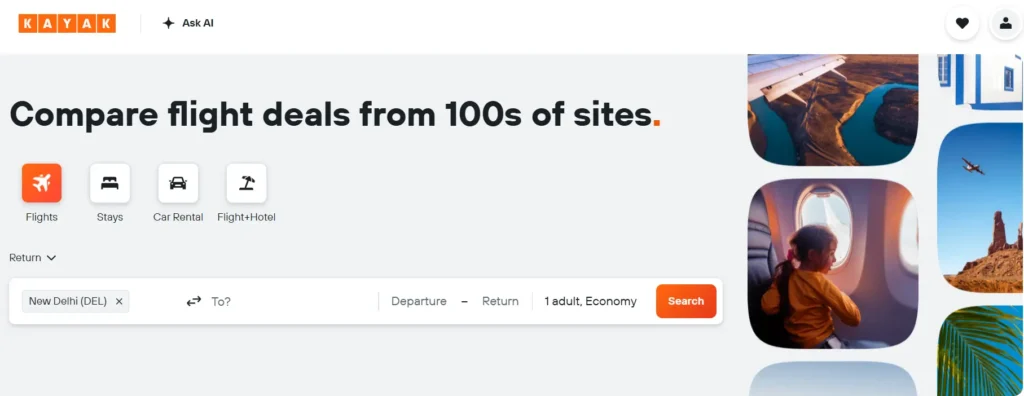
Finding a cheap flight or hotel sounds simple until you open five different travel websites and see five different prices for what appears to be the same trip. This is exactly the problem KAYAK was designed to solve.
Founded in 2004 by Steve Hafner and Paul English, KAYAK has developed into one of the most recognizable travel metasearch platforms. In 2013, it was acquired by Booking Holdings, the travel group behind several major online travel brands. KAYAK says it now processes billions of travel searches across hundreds of travel websites.
The most important thing to understand before using KAYAK is that it primarily operates as a travel search engine rather than a traditional online travel agency.
Instead of owning most of the inventory shown in search results, KAYAK searches travel providers and other booking websites, compares their offers, and generally sends you to the selected provider to complete your reservation.
Its major travel categories include:
- Flights
- Hotels and accommodation
- Rental cars
- Vacation packages
- Travel planning tools
- Price tracking and alerts
- Selected ground transportation and related travel options depending on market
This makes KAYAK particularly useful for price-conscious travelers who want to compare the market before booking.
Budget backpackers can search for inexpensive flights, frequent travelers can monitor airfare, and holiday planners can compare hotels, rental cars, and packages without individually visiting dozens of websites.
However, KAYAK’s metasearch model creates an important trade-off. It can be excellent for finding a deal, but your actual booking experience may depend heavily on the airline, hotel, rental company, or online travel agency you eventually choose.
That distinction is central to this Kayak review.
Core Features and Booking Experience
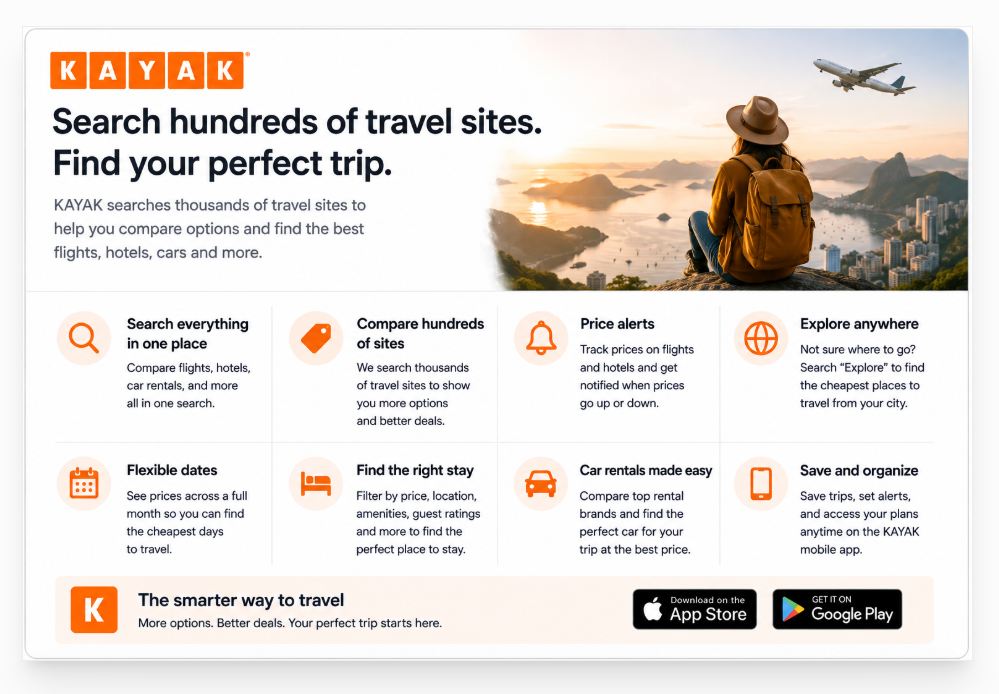
User Interface and Mobile App Usability
KAYAK’s interface is designed around a traditional travel search box. Users choose what they are looking for, enter destinations and dates, and receive a large collection of results.
For flights, you can specify details such as:
- Departure and destination
- One-way or round-trip
- Multi-city journeys
- Number of passengers
- Cabin class
- Travel dates
Once results appear, the platform provides filtering and sorting options that help reduce hundreds of possibilities to a manageable shortlist.
The experience is particularly useful when you do not have a specific airline or hotel in mind. Instead of beginning with a brand, you begin with your route, dates and budget.
KAYAK’s mobile experience follows a similar philosophy. It allows travelers to search and manage travel information while away from a computer, making it particularly useful during multi-stage trips.
For regular travelers, keeping searches, alerts and itinerary information accessible from a mobile device can save considerable time.
The interface can nevertheless become busy. KAYAK is designed to show a lot of information, including multiple booking providers for certain results. First-time users should pay attention to who is actually selling the reservation, rather than automatically selecting the cheapest button.
Booking Flow and Search Filters
A standard KAYAK booking journey usually works like this:
- Enter your trip information.
- Review results collected from different providers.
- Apply filters based on your preferences.
- Compare price, schedule and booking provider.
- Select the preferred offer.
- Continue to the provider and complete your reservation.
This system gives travelers considerable control.
For flights, filters can help narrow results according to stops, airlines, departure times, airports, duration, cabin and other criteria.
Hotel searches can similarly be narrowed using factors such as:
- Price
- Guest rating
- Star rating
- Property type
- Amenities
- Neighborhood or location
- Free cancellation where available
- Meal options
KAYAK’s vacation package searches also provide useful filters, including options such as free cancellation and breakfast, depending on the property and offer.
One of the biggest mistakes users make is sorting purely by price.
A flight that costs $40 less but has two long connections may represent worse value than a slightly more expensive nonstop ticket.
Likewise, the cheapest hotel rate may be non-refundable, exclude breakfast or come from a third-party agency with more restrictive customer-service procedures.
The strongest way to use KAYAK is therefore as a comparison and research tool, not simply as a “click the cheapest price” website.
Unique Selling Propositions and Special Features
KAYAK’s strongest features are those that help travelers make smarter decisions before booking.
Price Alerts
Instead of repeatedly searching for the same flight, users can monitor prices and receive notifications when fares change.
This is especially valuable when:
- You are planning several months ahead.
- Your dates are flexible.
- Current fares appear expensive.
- You are waiting for a potential price drop.
Price comparison
KAYAK searches across many travel providers, allowing travelers to see different offers without manually opening every airline and booking site.
Flexible travel discovery
Travelers who know their approximate budget but have not selected a destination can use KAYAK’s discovery-oriented tools to explore possibilities.
Vacation package search
KAYAK can compare bundled travel arrangements. Its package pages may combine flights and accommodation and allow users to filter according to relevant hotel features.
Multi-category trip research
The ability to research flights, hotels and cars within the same ecosystem makes KAYAK more useful for complete trips than flight-only search tools.
Comprehensive Feature & Service Breakdown
| Feature | Platform Availability | Best Use Case | Standout Capability |
|---|---|---|---|
| Flight Search | Web & Mobile | Comparing airfare | Searches many providers simultaneously |
| Hotel Search | Web & Mobile | Comparing accommodation | Strong price and property filters |
| Car Rentals | Web & Mobile | Road trips and airport rentals | Comparison across rental providers |
| Vacation Packages | Web & Mobile | Flight + hotel trips | Bundle comparison |
| Price Alerts | Web & Mobile | Travelers waiting to book | Tracks fare changes |
| Flexible Search | Web & Mobile | Budget travelers | Helps identify cheaper travel options |
| Multi-City Search | Web & Mobile | Complex itineraries | Search several flight segments |
| Trip Planning Tools | Web & Mobile | Frequent travelers | Keeps travel research organized |
| Hotel Reviews & Ratings | Web & Mobile | Accommodation research | Helps compare price with guest feedback |
| Travel Filters | Web & Mobile | Almost every traveler | Quickly reduces large result sets |
KAYAK’s advantage is not any single inventory source. Its value comes from bringing large numbers of travel options into one searchable interface.
Pricing, Hidden Fees, and Loyalty Programs
Transparency in Pricing and Payment Options
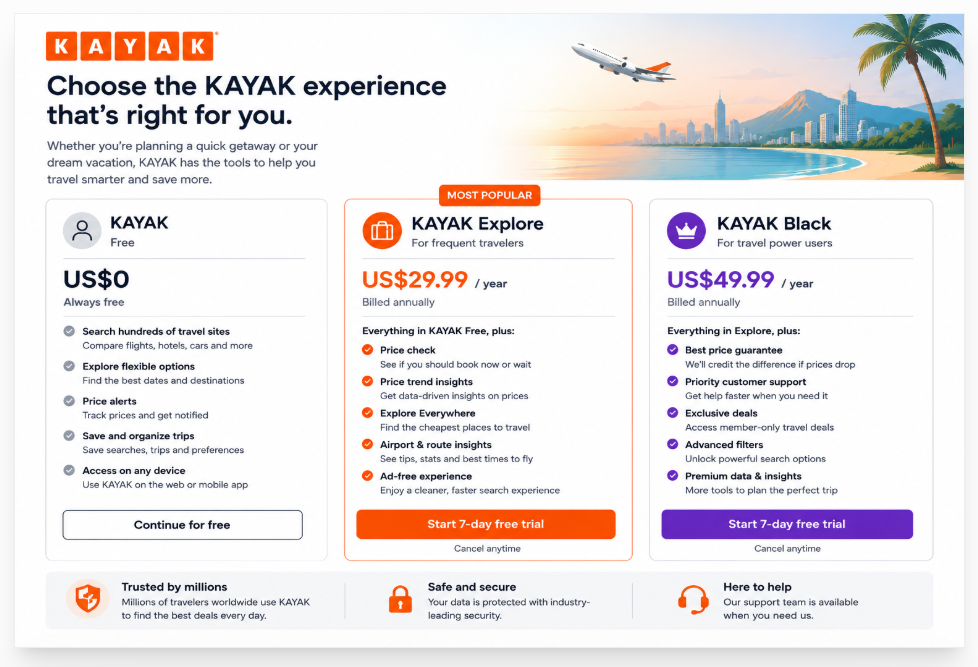
Using KAYAK to search and compare travel is free for consumers. According to KAYAK, it does not charge travelers a fee simply to search or compare offers.
The company makes money partly through commissions when users click through or book with participating partners. Sponsored listings may also appear and should be labeled accordingly.
This does not mean your final trip will be free from extra charges.
The provider completing your reservation may charge additional amounts for:
- Checked baggage
- Seat selection
- Meals
- Priority services
- Payment methods
- Hotel resort fees
- Local taxes
- Rental-car insurance
- Additional drivers
- Optional upgrades
| Cost Area | KAYAK Charge | Possible Provider Charge | What to Check |
|---|---|---|---|
| Search fee | $0 | None | KAYAK search is free |
| Flight booking | Usually $0 from KAYAK | Varies | Final provider price |
| Checked baggage | None | Often applicable | Airline baggage policy |
| Seat selection | None | May apply | Airline fare conditions |
| Hotel taxes | None directly | May apply | Final checkout total |
| Resort/destination fees | None directly | Property dependent | Hotel conditions |
| Car insurance | None directly | Optional/required depending on rental | Rental terms |
| Cancellation | None from search itself | Fare dependent | Provider policy |
| Payment fees | None directly | Possible | Payment method conditions |
KAYAK states that it is generally not the payment processor for reservations found through its search engine. Deposits and payment conditions are normally determined by the provider receiving the booking.
Therefore, always inspect the final checkout page before paying.
A fare shown during your initial search should be treated as the beginning of the comparison, not automatically as the final cost of the entire journey.
Reward System and Loyalty Benefits Breakdown
KAYAK is different from traditional airline and hotel loyalty programs.
Its biggest financial benefit comes from helping users compare prices and identify deals, rather than encouraging travelers to remain loyal to a single airline or hotel chain.
This can actually be an advantage for budget travelers.
Instead of thinking:
“Which brand gives me the most points?”
KAYAK encourages a different question:
“Which available option gives me the best overall value?”
However, travelers who care heavily about elite hotel benefits or airline status should carefully check whether a third-party booking qualifies for their preferred loyalty benefits.
For example, hotel loyalty programs can place restrictions on points, elite-night credits or status benefits when reservations are made through certain third-party channels.
If loyalty benefits are important, use KAYAK to find the rate, then compare the offer with the hotel’s or airline’s direct booking option before paying.
Cancellation, Refund, and Customer Support Policies
This is one of the most important sections of any KAYAK review.
Because KAYAK primarily functions as a search engine, cancellation and refund rules are normally controlled by the company that actually issued or sold your reservation.
If KAYAK redirects you to an airline and you book directly with that airline, the airline usually handles the reservation.
If you select a third-party travel agency, that agency may become your main point of contact.
This distinction matters considerably when:
- A flight is cancelled.
- You need to change travel dates.
- Your name is incorrect.
- You miss a connection.
- You need a refund.
- Your hotel reservation cannot be found.
For this reason, choosing the booking provider can be almost as important as choosing the flight or hotel.
Deep-Dive Analysis: Pros and Cons
Key Advantages (Pros)
- Excellent travel comparison: KAYAK can search hundreds of travel websites simultaneously, reducing the amount of manual comparison required.
- Free search service: Travelers do not have to pay KAYAK simply to search and compare travel prices.
- Strong flight filters: Travelers can eliminate inconvenient flights and concentrate on options that fit their schedule, airline preferences and budget.
- Useful price-monitoring tools: Price alerts can be particularly helpful for travelers planning trips months in advance.
- Multiple travel categories: Flights, accommodation, rental cars and vacation packages can be researched through the same platform.
- Good for flexible travelers: Backpackers and leisure travelers who can move their dates or destinations often have more opportunities to find meaningful savings.
- Direct-booking opportunities: Some results redirect users to an airline, hotel or rental company’s own website. This can combine KAYAK’s comparison capabilities with the convenience of booking directly with the service provider.
- Strong global position: KAYAK has operated since 2004 and is owned by publicly traded travel group Booking Holdings.
Major Drawbacks and Limitations (Cons)
- Third-party booking quality varies: KAYAK may show offers from different travel agencies. The cheapest agency is not necessarily the easiest company to deal with if your trip changes.
- Customer support can be confusing: Users sometimes expect KAYAK to resolve booking problems even when another company actually sold the reservation.
- Displayed price may not represent total trip cost: Baggage, seat selection, insurance and other optional services can increase the final price. KAYAK itself acknowledges that providers may charge additional fees.
- Too many options for inexperienced travelers: Seeing numerous agencies offering the same itinerary can make choosing a provider more difficult.
- Cheap complex itineraries need careful inspection: Travelers should check whether an itinerary involves separate tickets, airport changes, self-transfers or unusually tight connections.
- Refund experience depends on provider: A smooth KAYAK search does not guarantee a smooth refund process if you subsequently book through a less reliable third-party agency.
Recent traveler discussions illustrate this distinction. Some users report successfully finding lower fares through KAYAK that redirect to an airline’s own checkout, while others describe difficulties involving third-party agencies or complicated itineraries. These anecdotes should not be treated as representative of every booking, but they reinforce the importance of checking the actual seller before payment.
Detailed Comparison Matrix
KAYAK competes most directly with travel-search platforms such as Skyscanner, Google Flights and momondo.
| Parameter | KAYAK | Skyscanner | Google Flights | momondo |
|---|---|---|---|---|
| Flight Comparison | Excellent | Excellent | Excellent | Excellent |
| Hotel Search | Yes | Yes | Limited compared with full OTA ecosystem | Yes |
| Car Rental Search | Yes | Yes | Limited | Yes |
| Vacation Packages | Yes | Market dependent | No traditional package focus | Yes |
| Price Tracking | Yes | Yes | Yes | Yes |
| Flexible Destination Search | Strong | Strong | Excellent | Strong |
| Search Fee | Free | Free | Free | Free |
| Global Coverage | Excellent | Excellent | Excellent | Excellent |
| Search Filters | Excellent | Very Good | Excellent for flights | Very Good |
| Direct Customer Support for Provider Bookings | Limited | Limited | Limited | Limited |
| Cancellation Ease | Depends on provider | Depends on provider | Depends on provider | Depends on provider |
| Best For | All-round travel comparison | Broad global deal search | Fast airfare research | Alternative fare comparison |
Google Flights is particularly strong for travelers focused almost exclusively on airfare. Its Date Grid, Price Graph, price tracking and historical price insights make it a powerful flight-research platform.
momondo follows a model similar to KAYAK, comparing flights, hotels, rental cars and package holidays and directing users toward providers. Interestingly, momondo itself is part of KAYAK’s wider travel-search brand portfolio.
KAYAK’s main advantage is its all-round travel research experience. Rather than being useful only for airfare, it can remain relevant while you compare accommodation, cars and packages.
Is Kayak Safe and Legit?
Yes, KAYAK is a legitimate travel search platform.
It has operated since 2004 and has been owned by Booking Holdings since 2013. KAYAK states that its security program includes a 24/7 Security Operations Center, external audits and use of the NIST Cybersecurity Framework.
However, “Is KAYAK legit?” and “Is every company listed through KAYAK equally reliable?” are two different questions.
The first answer is yes.
The second requires research.
Because KAYAK can direct you toward airlines, hotels, rental companies and online travel agencies, the actual booking relationship may be with another business.
Best Practices for Booking Safely Through KAYAK
- Check the seller before paying.
Identify whether you are booking directly with an airline or through an online travel agency. - Compare the direct price.
If a third-party agency saves only a small amount, consider whether booking directly is worth the difference. - Read fare restrictions.
Check whether the ticket can be changed, cancelled or refunded. - Check baggage separately.
A cheap airfare can become expensive after adding checked luggage. - Avoid judging flights purely by price.
Compare total duration, stops and airport changes. - Inspect complex itineraries carefully.
Be particularly cautious with separate tickets or self-transfer connections. - Save your confirmation.
Keep the booking reference, ticket number, payment receipt and provider’s contact details. - Verify important reservations.
After purchasing a flight through a third-party provider, check that the reservation appears correctly with the operating airline when possible.
These simple steps remove many of the risks travelers associate with metasearch booking.
Quick Verdict
- Ideal for: Budget travelers, frequent flyers and holiday planners who want to compare large numbers of travel options before booking.
- Avoid if: You want one company to handle the search, payment, changes, cancellations and customer service from beginning to end.
- Best feature: Powerful travel comparison combined with filters, price monitoring and flexible search tools.
- Overall Score: 8.7/10: An excellent research and comparison platform, provided you carefully check the company that will actually handle your booking.
Final Verdict
After looking at KAYAK’s features, pricing model, search tools and potential limitations, its strongest role becomes clear: KAYAK is best used as a travel research engine rather than treated like a traditional travel agency.
That distinction makes a major difference.
If your goal is to search hundreds of travel websites, identify competitive airfare, compare hotels and rental cars, monitor price changes and explore different travel possibilities, KAYAK is one of the most capable tools available.
Its free comparison model is particularly attractive for budget travelers.
There is also no requirement to accept the first offer you find. You can discover a flight on KAYAK, compare multiple providers and then decide whether the savings offered by a third-party agency are worth it.
For many travelers, the smartest approach is simple:
Search widely, compare carefully and book with the provider you trust.
KAYAK becomes less impressive if you expect it to behave like a full-service travel agency. When problems occur after booking, responsibility may sit with the airline, hotel or third-party travel seller rather than KAYAK itself.
This is also where many negative experiences with travel metasearch platforms begin. Travelers remember finding the booking through KAYAK but may not realize that the actual transaction was completed with another provider.
For straightforward bookings, particularly when KAYAK finds a competitive fare that can be booked directly with an airline or hotel, the platform offers an excellent balance of convenience and control.
For complicated international journeys, separate-ticket itineraries or expensive bookings through unfamiliar agencies, additional caution is sensible.
It is safe, legitimate, feature-rich and genuinely useful for comparing travel, but it works best when travelers understand what it is designed to do.
KAYAK does not eliminate the need to read booking conditions. What it does exceptionally well is make the enormous travel market easier to search.
For frequent travelers, budget backpackers and holiday planners willing to spend a few extra minutes checking the final provider, that can translate into better travel options, less comparison work and potentially meaningful savings.