
Explore TravelTweaks for practical travel guides, destinations, airlines, hotels, maps, itineraries, money-saving tips, restaurants, and trip inspiration.
Travel planning should be exciting. Somehow, it often ends with 20 browser tabs, conflicting advice, outdated hotel information, and a spreadsheet that looks more complicated than the trip itself.
That’s where TravelTweaks aims to be useful.
Rather than focusing on only one part of travel, TravelTweaks covers the bigger picture. You’ll find destination inspiration, airline content, hotels and resorts, outdoor adventures, travel trends, restaurants, practical distance guides, maps, and other resources designed to help travelers make better decisions.
For me, the biggest appeal of a travel site like this isn’t simply finding another “10 places you must visit” article. It’s being able to move from inspiration to practical planning without completely changing how you research.
You might start by discovering a destination, compare ways to get there, research where to stay, work out the distance between two places, and then find ideas for what to do once you arrive.
Here’s a closer look at what TravelTweaks offers, how its content is organized, and how I’d use the platform when planning an actual trip.
What Is TravelTweaks?
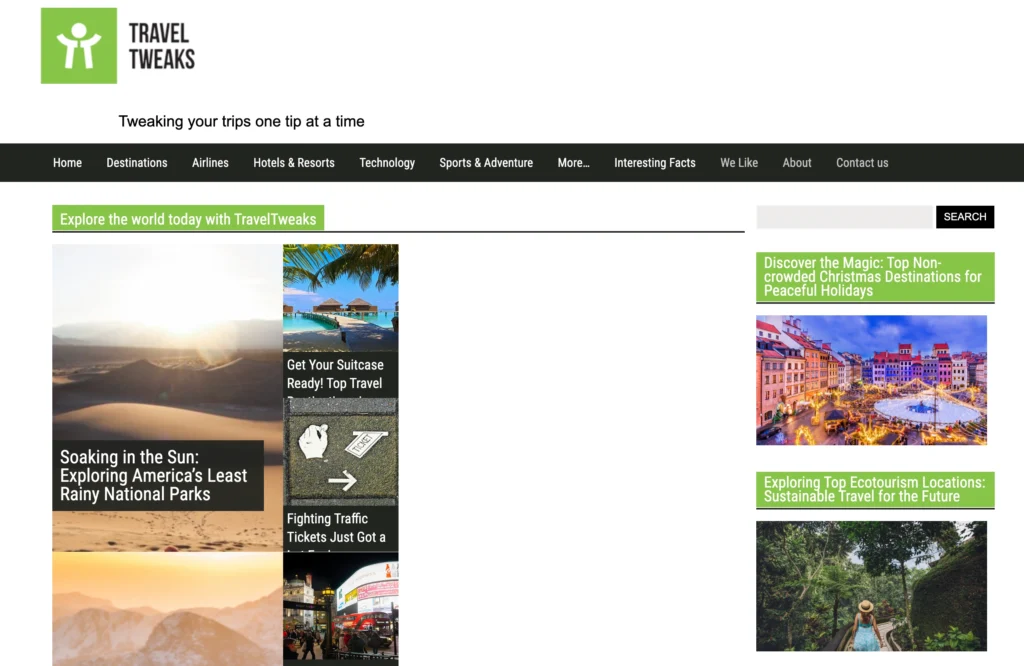
TravelTweaks is a travel-focused website covering a broad mix of trip-planning topics.
The easiest way to understand it is as a travel information hub rather than a single-purpose booking tool.
You aren’t visiting purely to search for a flight or reserve a hotel.
Instead, the content can help at several different stages of the planning process.
For example, imagine you’re considering a trip to Nashville.
You might initially want to know whether Nashville is worth visiting in December. Once you’ve decided to go, your questions become more specific.
- What will the weather be like?
- Where should you stay?
- What attractions are worth visiting?
- How far is your hotel from Downtown?
- What time do Broadway bars close?
- Are there any Christmas events?
What’s the closest beach if you’re turning the trip into a longer road trip?
Those questions require different types of travel content, but they’re all part of the same trip.
That’s the role TravelTweaks is trying to fill.
Instead of thinking about travel only as booking, it treats research, transportation, accommodation, food, activities, distances, and destination knowledge as connected pieces of the planning process.
Key Content Categories on TravelTweaks
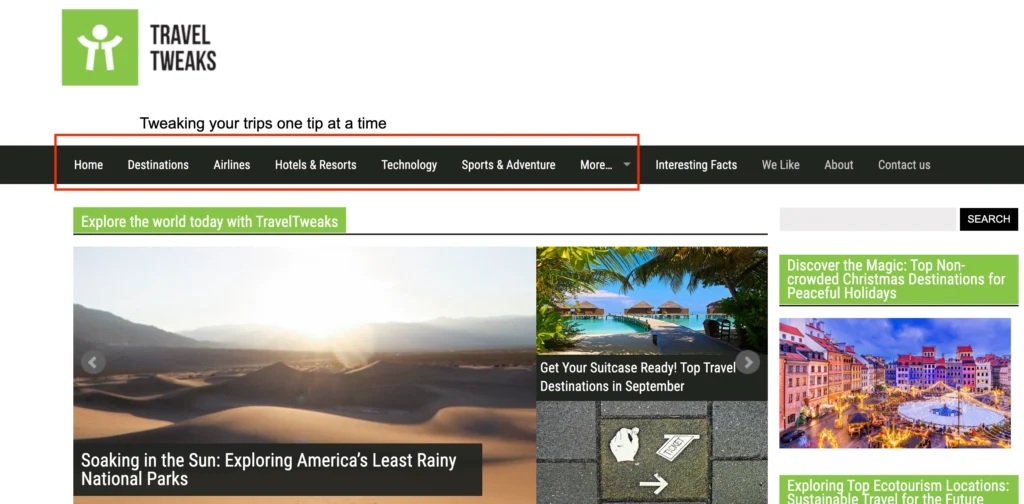
TravelTweaks covers several major travel categories, which makes it useful for travelers who haven’t yet decided exactly what they’re looking for.
You might arrive for an airline article and end up discovering a destination you hadn’t considered.
Destinations
Destination content is the natural starting point.
These guides can help answer the broad questions travelers usually have before booking:
- Is the destination worth visiting?
- What should I do there?
- When should I go?
- How long should I stay?
- What neighborhoods should I explore?
- What seasonal events are happening?
- What should I know before arriving?
The best destination guides aren’t simply lists of famous attractions.
They help you understand how a place works.
That’s particularly important for large cities. Knowing that a city has 25 attractions isn’t very helpful if you don’t know which ones are close together, which require advance tickets, and which areas make the best base.
I’d use the Destinations section early in the planning process, before locking in a detailed itinerary.
Airlines
Flights can be one of the biggest expenses and biggest uncertainties of an international trip.
TravelTweaks’ airline content helps travelers research carriers and understand what the experience may be like before booking.
Useful airline coverage can include:
- Cabin experience
- Economy and premium cabins
- Baggage
- Check-in
- Seat comfort
- Food and beverages
- Airline policies
- Routes
- Booking considerations
- Overall passenger experience
This becomes especially valuable when two airlines offer similar fares.
Saving $30 isn’t always worthwhile if one itinerary involves worse connections, stricter baggage rules, or a much less convenient schedule.
When comparing airlines, I always recommend looking beyond the headline ticket price.
The real cost includes baggage, seat selection, meals where applicable, transportation to the airport, and the value of your time.
Hotels & Resorts
Accommodation can completely change how a destination feels.
A great hotel in the wrong location can still be a bad choice.
TravelTweaks’ hotel and resort content can help travelers think about accommodation in context rather than looking only at room photos.
When researching hotels, I focus on five things:
- Location
- Total price
- Recent guest experience
- Transportation
- Cancellation conditions
Location deserves particular attention.
A hotel that’s $25 cheaper per night but requires 45 minutes of transportation each morning may not save you anything meaningful.
For resort trips, the priorities change. Pools, beach access, restaurants, children’s facilities, resort fees, and included activities become much more important.
Sports & Adventure
Not every vacation revolves around museums and restaurants.
TravelTweaks also covers sports, adventure, and outdoor travel for people who’d rather spend the day hiking, skiing, cycling, diving, or exploring natural areas.
Adventure travel requires a different level of preparation.
A normal city itinerary might survive poor planning.
A remote hiking itinerary may not.
Travelers need to consider:
- Weather
- Seasonal accessibility
- Equipment
- Fitness requirements
- Transportation
- Trail conditions
- Permits
- Safety
- Insurance
- Emergency preparation
This is one category where I’d always combine travel articles with official local information before setting out.
Trail closures, weather warnings, and park restrictions can change quickly.
Travel Trends
Travel changes constantly.
Destinations become popular because of social media. Airlines introduce new routes. Visa rules change. New technology affects how people book. Travelers start choosing smaller cities to escape overtourism.
The Travel Trends category helps put those changes into context.
Trend content is useful for inspiration, but I wouldn’t let popularity dictate an entire trip.
A destination going viral doesn’t automatically mean it’s right for you.
Sometimes the best travel decision is doing exactly the opposite of what everyone on social media is doing.
Travel Photos
Photos are one of the fastest ways to understand a destination.
A written guide can tell you that a beach is beautiful.
A good photograph shows you the water, sand, surrounding development, landscape, and atmosphere immediately.
Travel photography is particularly useful during the inspiration stage.
It can also help with practical decisions.
For example, seeing actual street scenes may help you understand whether an area feels highly urban, walkable, isolated, mountainous, or resort-oriented.
Just remember that travel photography naturally shows destinations at their best.
Real trips include clouds, crowds, construction, traffic, and bad weather too.
Bars & Restaurants
Food is part of the destination.
I don’t think travelers need every meal scheduled before arriving, but researching a few good restaurants can prevent the classic problem of getting hungry in a tourist district and choosing the first mediocre place you see.
TravelTweaks’ food and nightlife coverage can help with:
- Local restaurants
- Bars
- Nightlife districts
- Regional foods
- Dining experiences
- Opening and closing times
- Food-focused travel ideas
For destinations famous for nightlife, practical details matter just as much as recommendations.
Knowing where the bars are is useful.
Knowing when they close, whether reservations are needed, and how you’re getting back to your hotel is better.
What Makes TravelTweaks Stand Out?

There are thousands of travel websites online.
The useful ones make complicated decisions easier rather than simply producing more information.
TravelTweaks’ broad structure is one of its strengths because travelers can move between different types of research without treating each question as a completely separate project.
A Clean, User-First Experience
Good travel content needs to be scannable.
Most people aren’t reading a destination guide like a novel.
They’re jumping between sections looking for an answer.
How much does it cost?
How far is it?
When should I visit?
Is it safe?
Where should I stay?
Clear headings, short paragraphs, lists, tables, and visual elements make those answers easier to find.
That becomes particularly important when you’re already traveling and reading an article on your phone.
Nobody wants to scroll through 1,500 words to find one opening time.
Regularly Updated Content
Travel information ages quickly.
A restaurant closes.
An airline changes its baggage policy.
An attraction increases its ticket price.
A festival changes dates.
A hotel changes ownership.
A border requirement disappears.
That’s why update dates matter.
Whenever I’m using TravelTweaks or any travel publication, I check how recent the information is, particularly for prices, schedules, laws, entry requirements, and transportation.
For anything that could affect whether you can board a flight or enter a country, always verify against the relevant official source before traveling.
Practical Money-Saving Advice
Saving money on travel isn’t about choosing the cheapest version of everything.
It’s about spending less without making the trip worse.
A $20 flight saving isn’t useful if the alternative airport costs $50 more to reach.
A cheaper hotel isn’t a bargain if you spend two extra hours commuting every day.
A non-refundable booking may not be worth a small discount if your plans could change.
Useful money-saving advice looks at the total cost.
That includes:
Flights + baggage + seats + airport transportation
and
Hotel + taxes + resort fees + daily transportation
Travel planning becomes much smarter when you compare the final number rather than the number displayed in the largest font.
Navigating the TravelTweaks Offers Section
Deals are useful, but they can also encourage travelers to book things they didn’t actually need.
I’d approach any travel offers section with a simple rule:
Decide what you need first. Look for the deal second.
If you’ve already decided to visit Paris in October and need a hotel near the Latin Quarter, an offer matching those requirements could genuinely save money.
If you see a discounted resort and suddenly redesign your entire vacation around it, the “saving” becomes much harder to measure.
When evaluating a travel offer, check:
- Final price
- Travel dates
- Blackout dates
- Cancellation terms
- Taxes and fees
- Baggage conditions
- Room category
- Minimum stay
- Location
- Booking deadline
Always compare the offer against the normal price available for the same dates and conditions.
A large percentage discount doesn’t mean much if it’s calculated against a rate nobody normally pays.
Unique Features Worth Knowing

TravelTweaks becomes more interesting when you move beyond standard destination articles.
Several content types answer the small practical questions that often appear once you’ve already started planning.
The “How Far” and “What Is the Distance?” Sections
Distance questions sound simple.
They often aren’t.
You might ask:
How far is Nashville from the closest beach?
The straight-line answer isn’t particularly useful.
You actually need to know driving distance, realistic travel time, route options, traffic considerations, and whether the destination makes sense as a day trip or requires an overnight stay.
That’s why distance-focused guides can be surprisingly useful.
I’d use them for:
- Airport-to-hotel planning
- Road trips
- Day trips
- Beach drives
- National parks
- City-to-city travel
- Cruise ports
- Attraction planning
The real question usually isn’t “How many miles?”
It’s “How difficult is this journey?”
Interesting Facts
Not every travel question needs to help you book a hotel or catch a train.
Sometimes you simply want to know something interesting about the place you’re visiting.
That’s where an Interesting Facts section can add value.
These articles can provide quick background on destinations, landmarks, cultures, geography, transportation, food, or unusual pieces of travel history.
For example, before visiting a city, you might want to know:
- How the city got its name
- Why a famous landmark was built
- Which foods originated there
- What makes the local geography unusual
- How old a particular neighborhood is
- Why certain local traditions exist
- Which famous people lived there
This type of information might not change your hotel booking, but it can change how you experience the destination.
I’ve always found that knowing even a little background makes sightseeing more interesting.
A building stops being “another old church” once you understand what happened there.
A local dish becomes more memorable when you know why people started making it.
The same applies to neighborhoods, festivals, architecture, and traditions.
I’d use the Interesting Facts section during the inspiration stage or shortly before traveling. It’s also useful when you have ten minutes to spare and want a quick introduction rather than a huge destination guide.
“We Like” — A Curated Travel Blog List
One travel website can never cover everything.
That’s why curated recommendations to other useful travel resources can actually improve the research process.
A “We Like” section can point readers toward travel blogs and resources that offer useful perspectives, destination expertise, photography, practical guides, or specialized travel knowledge.
This becomes particularly valuable for niche trips.
Suppose you’re planning a three-week hiking trip through New Zealand.
A general travel website might help you understand the major destinations and logistics, but a specialist hiking blogger may have spent years documenting individual trails.
Likewise, someone planning a food-focused trip through Japan might benefit from a resource specializing specifically in Japanese restaurants and regional cuisine.
I wouldn’t treat a curated blog list as a ranking where the first website automatically has the best information.
Instead, use it to expand your research intelligently.
Look for specialists relevant to your trip.
That might include:
- Solo travel blogs
- Family travel websites
- Luxury travel specialists
- Budget backpacking blogs
- Airline and aviation sites
- Road-trip resources
- Outdoor adventure blogs
- Food travel websites
- Photography-focused travel blogs
- Destination specialists
The goal isn’t to read all of them.
It’s to find one or two additional sources that answer questions a general guide can’t.
How to Get the Most Out of TravelTweaks?
The easiest way to waste time on a travel website is to browse without knowing what stage of planning you’re in.
I prefer breaking travel research into phases.
Step 1: Start With Destination Research
First, answer the big question:
Where am I going?
Use destination guides, travel trends, photos, and seasonal articles to narrow down your choices.
At this stage, don’t worry about choosing the perfect restaurant or creating a minute-by-minute itinerary.
You need to establish:
- Destination
- Approximate dates
- Trip length
- Budget
- Travel style
- Main interests
Once those are clear, everything else becomes easier.
Step 2: Research Transportation
Now work out how you’ll get there.
If you’re flying, research airlines, routes, baggage policies, airport locations, and realistic ticket costs.
Don’t automatically book the cheapest flight.
A slightly more expensive nonstop flight can sometimes be much better value than a cheap itinerary involving two connections and an overnight airport stay.
Look at the total journey, not just airfare.
Step 3: Choose the Right Area Before Choosing a Hotel
This is one of my strongest travel-planning rules.
Choose the neighborhood first. Choose the hotel second.
A beautiful hotel in the wrong part of town can make your entire trip inconvenient.
Start by mapping your main attractions.
Then ask:
Where will I spend most of my time?
If six of your eight must-see attractions are concentrated around one part of the city, staying nearby could save hours of transportation.
Once you’ve selected an area, compare hotels and resorts within it.
Step 4: Build a Realistic Itinerary
Now you can start turning your wishlist into actual days.
Don’t simply arrange attractions by popularity.
Arrange them geographically.
If three attractions are within walking distance of each other, visit them on the same day.
If another attraction sits 45 minutes across town, move it to a different day.
This is where interactive travel maps become particularly helpful.
You can group restaurants, attractions, neighborhoods, transportation hubs, and hotels visually instead of constantly switching between articles.
Step 5: Research Food and Nightlife
Once your daytime itinerary is roughly organized, start looking at restaurants and bars.
I don’t recommend booking every meal.
That removes too much spontaneity.
Instead, save several good options near the neighborhoods you’re already visiting.
If you’re spending Tuesday afternoon in East Nashville, for example, finding dinner there probably makes more sense than traveling across the entire city because one restaurant has a slightly higher online rating.
For nightlife, research practical information as well.
Check closing times, transportation, age restrictions, dress codes where applicable, and whether reservations are recommended.
Step 6: Check Distances
Before finalizing the itinerary, use the How Far and What Is the Distance? style resources to test your assumptions.
This is where you discover that your “quick afternoon trip” actually requires three hours of driving.
Look at:
Distance + transportation + traffic + parking + walking + return journey
A destination 50 miles away isn’t automatically an easy day trip.
Step 7: Look for Offers Last
Only after you know what you actually need should you start looking seriously at offers.
At this point, deals become genuinely useful.
You already know your destination, dates, preferred neighborhood, and transportation requirements.
That makes it much easier to recognize whether an offer is actually valuable.
Step 8: Verify Time-Sensitive Information
This final step matters regardless of which travel website you’re using.
Before departure, verify anything that could materially affect your trip.
That includes:
- Flight schedules
- Visa and entry requirements
- Attraction opening hours
- Ticket prices
- Public transportation
- Weather
- Road closures
- Festival dates
- Hotel policies
- Restaurant reservations
- Local laws
Travel articles are excellent for planning and context.
Official sources should have the final say on information that can change quickly.
Final Thoughts
TravelTweaks works best when you treat it as a starting point and planning companion rather than simply another place to collect destination ideas.
Its broad range of topics is the biggest advantage.
You can begin with a destination guide, move into airline research, compare accommodation ideas, look at restaurants, understand driving distances, explore maps, and discover other travel resources without treating each part of your vacation as an unrelated problem.
That’s closer to how people actually plan trips.
We rarely sit down and say, “Today I will research only airlines.”
Instead, one question leads naturally to another.
You find an affordable flight to Nashville.
- Then you wonder whether December is a good month to visit.
- That leads to Christmas events.
- Then you need a hotel.
- Then you want to know how far Opryland is from Downtown.
- Then you start researching Broadway.
- Then you want to know when the bars close.
Suddenly, one flight search has become an entire vacation.
TravelTweaks’ different content categories help connect those questions.
The Destinations section helps with inspiration and planning.
Airlines and Hotels & Resorts help with major travel decisions.
Sports & Adventure opens up outdoor and activity-focused trips.
Bars & Restaurants helps you experience destinations beyond the standard attractions.
Travel Trends and Travel Photos provide inspiration.
The How Far and distance-focused content tackles practical logistics.
Interesting Facts adds context to the places you’re visiting.
And the We Like section can point you toward more specialized travel voices when you need deeper information.
The key is not to over-research.
There’s a point where another 15 articles won’t make your vacation any better.
Use TravelTweaks to answer the questions that actually affect your trip. Organize your important locations on a map. Verify critical details before departure. Then stop researching and go.
Because the purpose of a travel guide isn’t to plan every minute for you.
It’s to give you enough reliable information to make confident decisions while leaving room for the moments you never could have planned.
That’s where TravelTweaks can be most useful: helping turn scattered travel ideas into a trip that actually makes sense.