
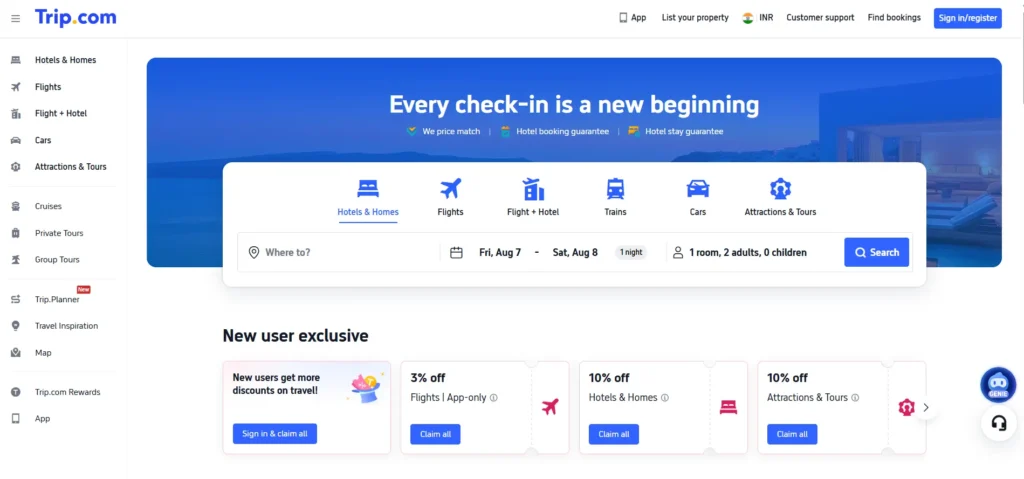
Trip.com has grown from an Asia-focused travel booking platform into one of the largest global online travel agencies. Today, travelers can use it to book flights, hotels, trains, car rentals, airport transfers, attractions, tours, and vacation packages from a single website or mobile app.
Trip.com operates under Trip.com Group, the travel technology company that grew out of Ctrip, founded in Shanghai in 1999. The group has expanded internationally through investments and acquisitions, including Skyscanner, while developing Trip.com as its major international consumer-facing OTA brand.
The scale is substantial. Trip.com says its platform is available in 24 languages across 39 countries and regions, supports 35 local currencies, lists more than 1.7 million hotels, and provides flights from over 600 airlines serving approximately 3,400 airports in 220 countries and regions.
That makes Trip.com particularly useful for travelers visiting China, Japan, South Korea, Southeast Asia, and other Asian destinations, although its hotel and flight inventory now extends worldwide.
Its biggest attraction is simple: competitive pricing combined with a broad range of travel products. Instead of visiting separate websites for flights, hotels, trains, transfers, and activities, travelers can organize much of a trip from one account.
However, Trip.com is still an online travel agency rather than an airline or hotel operator. This distinction becomes important when flights are changed, reservations are canceled, or refunds are required. In complicated situations, an additional company sitting between you and the actual travel provider can make problem-solving slower.
This Trip.com review examines exactly where the platform performs well, where travelers should be cautious, and whether the savings justify booking through a third party.
Core Features and Booking Experience

User Interface and Mobile App Usability
Trip.com has clearly invested heavily in its mobile experience. The app combines numerous travel products without making the basic booking process unnecessarily complicated.
The homepage provides quick access to major categories such as:
- Flights
- Hotels and homes
- Trains
- Car rentals
- Airport transfers
- Attractions and tours
- Flight + Hotel packages
- Cruises in supported markets
Search results are generally easy to scan, particularly when comparing flights and accommodation.
The mobile app becomes more useful after booking. Travelers can manage reservations, view confirmations, monitor flight information, receive notifications, access loyalty benefits, and contact customer support without searching through emails.
Trip.com also encourages travelers to use the app through certain promotions, rewards, and mobile-oriented features.
The main weakness is that the interface can occasionally feel promotion-heavy. Discount labels, member prices, Trip Coins, coupons, package offers, and upgrade messages can make it harder to determine the actual value of a deal.
The safest approach is to concentrate on the final checkout price and booking conditions, rather than the largest discount percentage displayed on the search page.
Booking Flow and Search Filters
Trip.com’s basic booking process is straightforward:
- Enter your destination or route.
- Select travel dates.
- Add the number of passengers or guests.
- Review available options.
- Apply filters.
- Select a fare or room.
- Review baggage, cancellation, and booking conditions.
- Enter traveler information.
- Pay and receive confirmation.
For hotels, useful filters typically include property type, price range, star rating, guest rating, location, amenities, meal options, and cancellation conditions.
Flight searches allow travelers to narrow results according to factors such as:
- Departure and arrival time
- Number of stops
- Airline
- Airport
- Travel duration
- Baggage
- Fare conditions
- Price
The filtering system works particularly well for travelers who already know what they want.
One important warning applies to flights: do not compare fares based purely on the first price shown.
Check whether your selected fare includes:
- Checked baggage
- Cabin baggage
- Seat selection
- Meals
- Changes
- Cancellation
- Refundability
A cheaper ticket can quickly become poor value if the fare excludes something you actually need.
Unique Selling Propositions (USPs) and Special Features
Trip.com has several features that differentiate it from a basic hotel or airfare comparison website.
Strong Asian travel inventory: Trip.com has particularly deep coverage in Asian markets. This can be valuable when booking regional airlines, local accommodation, rail travel, and transportation that may be harder to navigate through Western-focused platforms.
Integrated train booking: Train booking is one of Trip.com’s more distinctive strengths. Availability depends on the country, but the platform supports rail products in markets including mainland China, the UK, Europe, Japan, Hong Kong, and South Korea.
Trip Coins: Instead of limiting rewards to occasional coupons, Trip.com operates a points-style currency that can be redeemed against eligible future bookings.
Broad travel ecosystem: Flights, accommodation, transportation, tours, attractions, and transfers can all sit inside one account.
Member benefits: Higher loyalty tiers can unlock increased Trip Coin earnings and, depending on tier and market, benefits such as lounge passes, eSIM packages, train refund-fee benefits, airport transfer upgrades, and other perks.
Comprehensive Feature & Service Breakdown
| Feature | Platform Availability | Best Use Case | Standout Capability |
|---|---|---|---|
| Flights | Website + App | International and Asian flights | 600+ airline network |
| Hotels & Homes | Website + App | Budget to luxury accommodation | 1.7M+ properties advertised |
| Train Tickets | Primarily app + web depending on market | China, Japan, Korea, UK and Europe travel | Convenient international rail booking |
| Car Rentals | Website + App | Road trips and airport rentals | Multiple rental providers |
| Airport Transfers | Website + App | Travelers wanting pre-arranged transport | Integrated with itinerary |
| Flight + Hotel | Website + App | Holiday planners | Bundled booking convenience |
| Attractions & Tours | Website + App | Destination activities | Book activities alongside accommodation |
| Trip Coins | Member account | Repeat customers | Redeemable against eligible bookings |
| Price Alerts | Primarily App | Flexible flight shoppers | Helps monitor airfare changes |
| 24/7 Support | App, web and phone options | International travelers | Multilingual support network |
The biggest advantage here is not necessarily any single feature. It is the combination of services.
A traveler visiting Japan, for example, could potentially arrange an international flight, Tokyo hotel, domestic train journey, airport transfer, and attraction tickets through the same account.
Pricing, Hidden Fees, and Loyalty Programs
Transparency in Pricing and Payment Options
Pricing is one of the main reasons travelers consider Trip.com.
The platform frequently competes aggressively on flights and hotels, particularly in Asian markets. There are situations where Trip.com may display a lower rate than booking directly or through another OTA.
But travelers should distinguish between low prices and transparent prices.
The number that matters is the amount shown immediately before payment.
| Cost Area | What to Check | Potential Issue |
| Base flight fare | Compare with airline directly | Cheapest fare may exclude baggage |
| Hotel rate | Check taxes and property fees | Local taxes may be payable separately |
| Baggage | Check exact allowance | Low-cost fares can have limited baggage |
| Seat selection | Determine whether included | Additional payment may be required |
| Currency conversion | Compare card and platform rates | Exchange rates can affect final cost |
| Cancellation | Read fare conditions | Cheapest bookings may be non-refundable |
| Changes | Check airline + agency conditions | Change costs can be substantial |
| Extras/insurance | Review before payment | Optional products increase checkout total |
There is no universal “Trip.com fee” applicable to every reservation. Costs depend heavily on the airline, hotel, ticket type, destination, currency, and booking conditions.
Therefore, compare the same product.
If Trip.com offers a flight for $470 and the airline charges $485, determine whether both tickets include identical baggage, cancellation, and change conditions before assuming Trip.com is $15 cheaper.
Reward System and Loyalty Benefits Breakdown
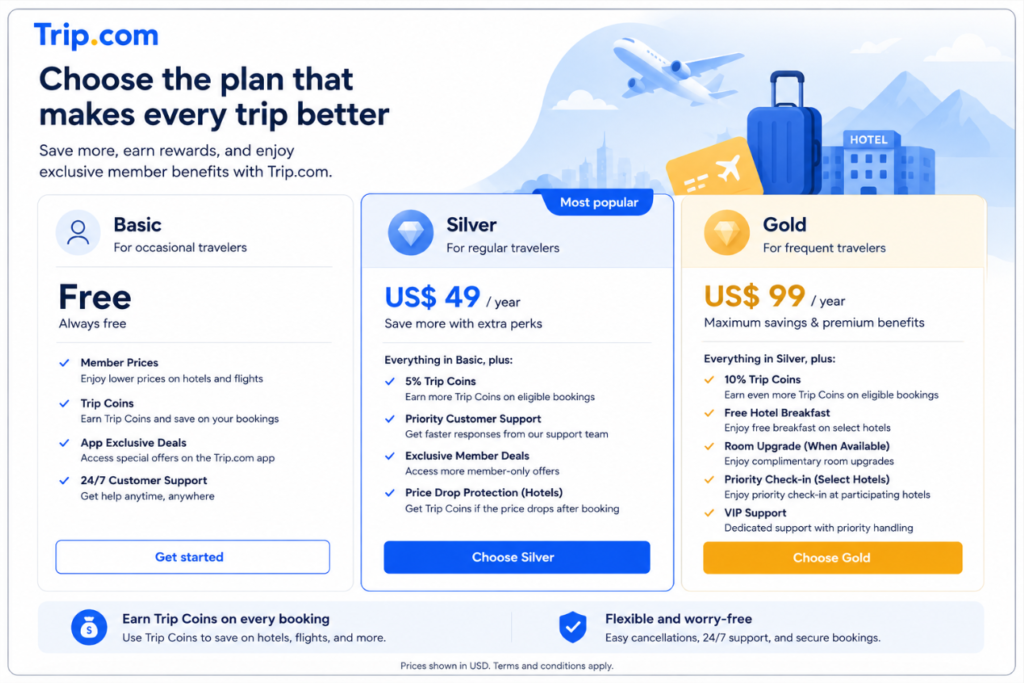
Trip.com’s loyalty system is one of its strongest features for repeat travelers.
Members earn Trip Coins, which can function similarly to travel credit on eligible prepaid bookings. Trip.com states that approximately 100 Trip Coins equal US$1, although the exact local-currency value can vary.
Standard earning rates listed by Trip.com include approximately:
- 20 Trip Coins per US$100 on flights
- 50 Trip Coins per US$100 on hotels
- 35 Trip Coins per US$100 on Flight + Hotel bookings
- 20 Trip Coins per US$100 on many eligible train bookings
Higher-tier members can earn Trip Coins faster.
The current loyalty structure includes Silver, Gold, Platinum, Diamond, Diamond+, and Black Diamond tiers. Trip.com states that Silver and Gold status are permanent once earned, while higher levels have ongoing qualification requirements.
At higher levels, the program becomes considerably more interesting.
Depending on membership level, benefits can include:
- Increased Trip Coin earning rates
- Hotel member deals
- Airport lounge access
- Complimentary eSIM packages
- Airport transfer upgrades
- Train refund-related benefits
- Attraction tickets
- Enhanced service benefits
These benefits make Trip.com considerably more appealing to frequent users than travelers making one isolated reservation.
Cancellation, Refund, and Customer Support Policies
This is where the Trip.com experience becomes more complicated.
There is no single cancellation policy covering everything sold through the website.
The actual rules depend on:
- Airline policy
- Hotel policy
- Fare class
- Room rate
- Supplier terms
- Cancellation deadline
- Reason for cancellation
- Trip.com-specific conditions
A non-refundable hotel room remains non-refundable simply because it was purchased through Trip.com.
Likewise, cheap airline fares can carry significant cancellation or modification penalties.
Trip.com advertises 24/7 multilingual customer support, with support operations in several locations.
For ordinary questions and uncomplicated bookings, support can work well. Problems become harder when Trip.com must coordinate with an airline, hotel, or another supplier.
Recent customer feedback reflects this split. Trip.com’s main Trustpilot profile has a strong overall score, with users frequently praising its pricing, convenience, and easy booking process. At the same time, negative reviews frequently involve cancellations, refunds, fare conditions, or unexpected charges.
That pattern is common among large OTAs: booking is usually easier than fixing a disrupted booking.
Deep-Dive Analysis: Pros and Cons
Key Advantages (Pros)
- Competitive pricing: Trip.com can offer attractive flight and hotel rates, especially across Asian destinations. Travelers willing to compare prices can find genuine savings.
- Excellent coverage across Asia: This remains one of the platform’s strongest advantages. Trip.com can be particularly useful for complicated trips involving China, Japan, South Korea, or Southeast Asia.
- Huge inventory: With more than 1.7 million hotels and flights from 600+ airlines advertised, travelers have an enormous selection.
- Strong all-in-one booking experience: Flights, hotels, trains, transfers, cars, and attractions being available from one account makes multi-stage journeys easier to organize.
- Useful mobile app: The app is well suited to travelers who want confirmations, booking management, rewards, and travel information accessible in one place.
- Trip Coins offer real repeat-booking value: Although the basic earning rate is not huge, regular travelers can accumulate rewards, while higher loyalty tiers improve earning rates considerably.
- Train booking capabilities: This is an underrated advantage, particularly for travelers navigating countries where local rail booking systems can be confusing.
- Free loyalty membership: Travelers do not need to purchase a subscription simply to begin earning rewards.
Major Drawbacks and Limitations (Cons)
- Third-party booking risk: Trip.com becomes an intermediary between you and the airline, hotel, or supplier. If something goes wrong, resolving it may require communication between multiple parties.
- Complex refunds can take time: User reports show that disrupted flights and unusual refund cases can become frustrating. Some travelers describe repeated communication while waiting for the airline or Trip.com to finalize the refund.
- Cheapest fares can have restrictive conditions: A low headline price does not necessarily mean a flexible booking. Non-refundable tickets and rooms require careful attention.
- Promotions can make pricing feel complicated: Member discounts, coupons, Trip Coins, and promotional prices are useful, but they can also make it harder to determine the true baseline price.
- Support quality varies with problem complexity: Straightforward booking questions are different from airline cancellations, schedule changes, missed connections, or disputed refunds.
- Direct bookings can be safer for complicated itineraries: Saving $10 or $20 may not justify adding an intermediary to an expensive multi-city journey where schedule flexibility is essential.
Pros and Cons Comparison
| Pros | Cons |
| Competitive prices | Third-party booking complications |
| Strong Asian inventory | Refunds can become complicated |
| Huge hotel and airline network | Restrictive fares require careful reading |
| Excellent mobile app | Promotions can clutter pricing |
| Useful Trip Coins system | Support experience can vary |
| Train booking capabilities | Direct airline booking may offer easier changes |
| Multiple travel products | Supplier rules still control many bookings |
| Free loyalty program | Best rewards require frequent booking |
Detailed Comparison Matrix
Trip.com competes most directly with large OTAs such as Booking.com, Expedia and Agoda.
| Category | Trip.com | Booking.com | Expedia | Agoda |
| Hotel Selection | Excellent | Excellent | Excellent | Excellent |
| Flight Booking | Excellent | Good | Excellent | Good |
| Asian Coverage | Excellent | Excellent | Good | Excellent |
| Train Booking | Excellent | Limited | Limited | Limited |
| Mobile Experience | Excellent | Excellent | Excellent | Excellent |
| Loyalty Program | Trip Coins + tiers | Genius | One Key | AgodaVIP |
| Package Booking | Strong | Moderate | Excellent | Strong |
| Budget Travel | Excellent | Excellent | Good | Excellent |
| Global Coverage | Excellent | Excellent | Excellent | Excellent |
| Cancellation Ease | Depends on supplier | Depends on booking | Depends on supplier | Depends on supplier |
| Best For | Asia + multi-service trips | Accommodation | US/global packages | Asian hotels |
Trip.com’s most meaningful competitive advantage is its combination of Asian inventory, flights, hotels, and rail travel.
Booking.com remains extremely strong for accommodation, Expedia is particularly capable with vacation packages, while Agoda is another formidable option for Asian hotels.
Trip.com makes the strongest case when your journey involves several different types of transportation and accommodation.
Is Trip.com Safe and Legit?
Yes. Trip.com is a legitimate international online travel agency, not a scam website.
It operates as part of the publicly traded Trip.com Group, which is listed in the United States and Hong Kong and has operated in the travel industry for decades. Trip.com Group reported reaching US$160 billion in GMV in 2023, illustrating the enormous scale of its travel ecosystem.
Trip.com’s primary Trustpilot profile also contains more than 190,000 reviews and currently maintains a strong overall rating, although individual experiences vary substantially.
The more important question is therefore not “Is Trip.com real?”
It is:
Should you use an OTA for this particular booking?
For a straightforward hotel reservation or inexpensive regional flight, the savings can easily make sense.
For an expensive honeymoon, complicated multi-airline itinerary, or journey where you may need last-minute modifications, paying slightly more to book directly can provide valuable simplicity.
Travelers can reduce their risk by following a few basic rules:
- Compare the final Trip.com price with the supplier’s direct price.
- Read cancellation conditions before paying.
- Check baggage allowance carefully.
- Verify passenger names exactly match passports.
- Save screenshots of important fare and refund conditions.
- Confirm major flight bookings using the airline’s PNR after ticketing.
- Use a payment method offering appropriate purchase protection.
- Avoid non-refundable rates unless your plans are firm.
- For complicated international itineraries, consider booking directly with the airline.
These precautions apply to almost every third-party OTA, not just Trip.com.
Quick Verdict
- Ideal for: Budget-conscious travelers, Asia-focused trips, rail travelers, frequent travelers, and people who like managing multiple bookings through one app.
- Avoid if: You expect frequent itinerary changes, need maximum flexibility, or prefer dealing directly with airlines and hotels during disruptions.
- Best feature: Strong Asian travel inventory combined with flights, hotels, trains, transfers, and Trip Coins.
Final Verdict
Trip.com has evolved into much more than an alternative flight-search website.
Its biggest strength is the breadth of its ecosystem. Travelers can search hundreds of airlines, more than a million accommodation options, book rail travel in multiple countries, arrange airport transportation, reserve rental cars, and purchase attraction tickets without constantly switching between platforms.
For travelers exploring Asia, the value proposition becomes particularly strong. Trip.com’s regional experience, extensive transportation coverage, and support for local travel products can simplify journeys that would otherwise require several different booking websites.
Pricing is another major advantage. Trip.com frequently competes aggressively enough that checking it alongside airline, hotel, and competing OTA prices is worthwhile.
The Trip Coins and tiered membership system further improves the equation for frequent users. A traveler who repeatedly books hotels, flights, and trains through the platform can extract more value than someone using Trip.com once every few years.
However, cheap prices should never distract travelers from the fundamental disadvantage of an OTA.
When everything goes according to plan, Trip.com is convenient.
When an airline cancels a flight, a hotel disputes a reservation, or you suddenly need to change an itinerary, having an intermediary can make the process more complicated. Customer reports concerning refunds and disrupted bookings show why travelers should pay close attention to fare conditions and cancellation rules before purchasing.
For simple, price-sensitive bookings, Trip.com is easy to recommend. A $120 hotel that costs $150 elsewhere or a straightforward regional flight offering a meaningful discount can represent excellent value.
The decision becomes less obvious when Trip.com is only marginally cheaper.
If an international airline charges $1,000 directly and Trip.com charges $990, many travelers would be better served paying the extra $10 and keeping the booking directly under the airline’s control.
But if Trip.com offers a substantial discount with identical baggage, cancellation, and fare conditions, using the platform becomes much easier to justify.
Ultimately, Trip.com is safe, legitimate, feature-rich, and often competitively priced, but it should be used strategically rather than automatically.
Compare prices, understand exactly what is included, read cancellation rules, and evaluate how much flexibility your particular trip requires.
For budget travelers, frequent Asia visitors, backpackers, and holiday planners comfortable using an OTA, Trip.com is one of the strongest all-in-one travel platforms currently available.